
Car AC not blowing cold air can mean two different things: the fan pushes plenty of air that feels warm, or very little air reaches the vents at all. That distinction matters. The first points toward the cooling circuit, its controls, or heat entering the cabin; the second directs attention toward the cabin filter, blower, ducts, or air doors. Buying a recharge before separating those symptoms can waste money and delay the real repair.
This guide helps U.S. drivers record useful observations, understand what a shop may test, and decide when to stop experimenting. It is not a substitute for diagnosis on the specific vehicle. Never open a pressurized refrigerant line or intentionally release refrigerant. The EPA’s motor-vehicle AC service guidance explains the federal service requirements.
Quick Answer
If the car AC is not blowing cold air, check vent strength, compare both sides, and note whether cooling changes at idle versus on the road. Record warning lights, unusual sounds, and odors. A technician should reproduce the symptom and test the relevant controls and cooling circuit before recommending a recharge or compressor replacement.
First, Separate Temperature From Airflow
Put a hand near a center vent with the fan set to a moderate speed. Is there a steady stream of air that fails to cool, or is the stream weak even at high fan speed? Record the answer before changing settings. A car air conditioner not cooling may have normal airflow. A weak-airflow complaint may have a cold evaporator but insufficient air moving across it.
If the vents barely move air, a shop may inspect the cabin filter, blower, and air doors. If airflow is strong and warm, tests may instead include compressor command, fan operation, refrigerant charge, leaks, and temperature controls. These are possibilities, not a remote diagnosis.
| What you observe | First area to investigate | What not to assume |
|---|---|---|
| Strong airflow but consistently warm | Cooling circuit or temperature controls | That refrigerant is low |
| Weak airflow at all speeds | Filter, blower, intake, or duct path | That a recharge will help |
| Cold while driving, warm at idle | Condenser airflow, cooling fans, controls | That the compressor has failed |
| One side colder than the other | Zone controls or temperature doors | That both sides need separate recharges |
| Cooling stops after a period of driving | Intermittent controls, icing, airflow | That the fault is permanent and simple |
| New musty odor with airflow | Moisture or cabin-air path | That refrigerant has an odor |
For the broader system overview, start with our car AC repair guide. The checks below focus specifically on the no-cold-air symptom rather than every possible AC job.
Check 1: Confirm the Settings and Describe the Test Conditions
Before scheduling service, confirm the AC function is selected, the temperature is set as intended, and the system is not running a defog or automatic mode you misunderstood. On some vehicles, automatic climate control changes fan speed and air routing on purpose. The owner’s manual is the right reference for unfamiliar icons and settings. Record whether the trouble occurs with both fresh-air and recirculation modes, without repeatedly toggling controls to chase a brief change.
Note outside temperature and sun exposure. A hot parked cabin takes time to cool. Tell the shop whether this is slow cooldown or no cooling after a reasonable drive.
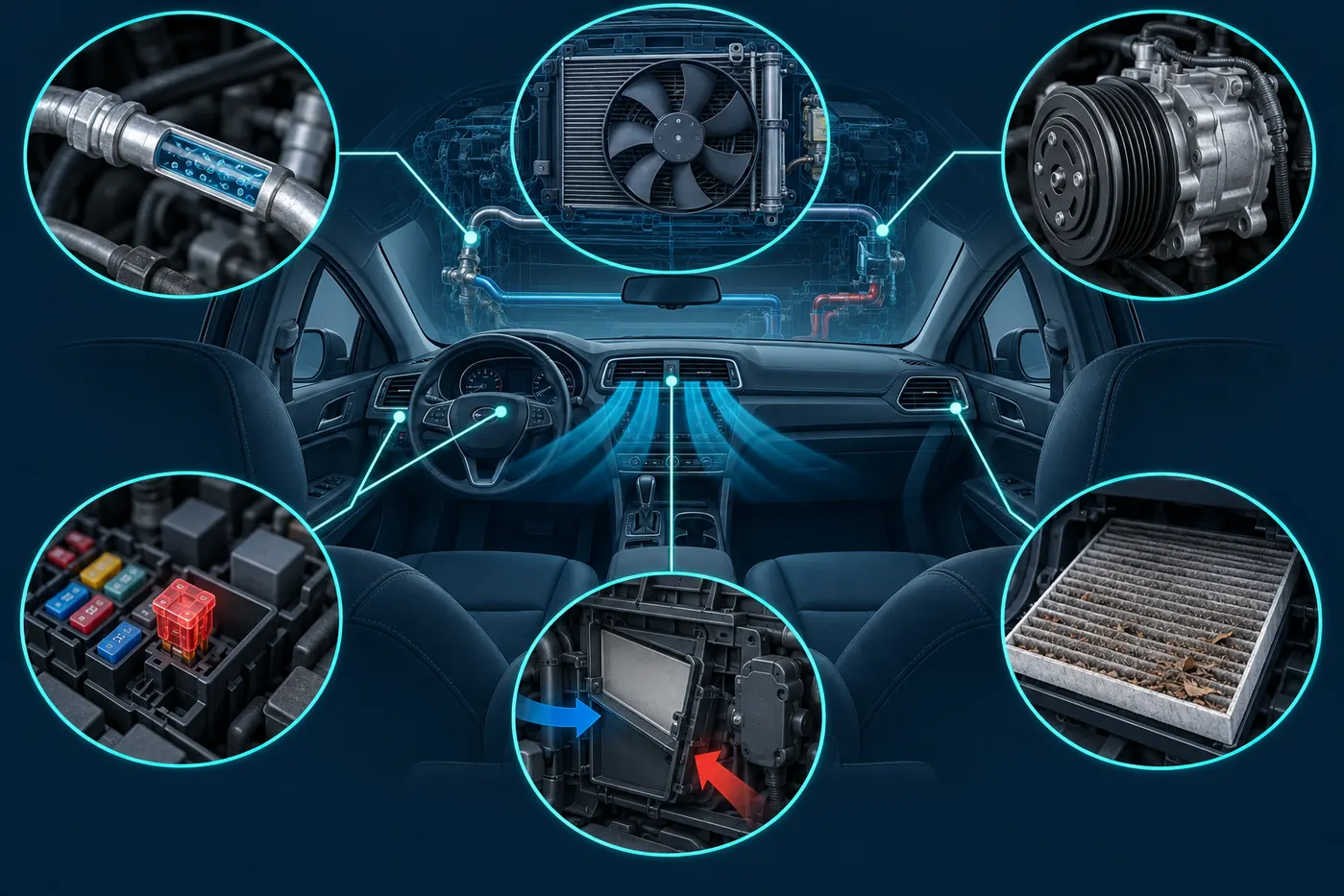
Check 2: Compare Vent Strength at Several Fan Speeds
With the vehicle safely parked, select the face-level vents and move through the fan speeds. Does airflow increase smoothly? Is one vent much weaker than others? A cabin filter loaded with debris can restrict airflow, but it is not the only cause. A blower motor, resistor or controller, blocked intake, or misdirected mode door can create a similar complaint. A clogged filter is a relatively accessible inspection item on many cars, yet access varies. Follow the vehicle manual and avoid forcing trim panels.
If air is strong only at high fan speed, report that pattern. If no air moves on any setting, call it an airflow complaint. If the fan runs but vents remain weak, the air path deserves attention before refrigerant service.
Check 3: Compare Idle and Road-Speed Cooling
Does the AC feel cool at normal road speed but turn warm at a stoplight? Record how long it takes to change and whether the engine temperature gauge behaves normally. Air moving past the front of the vehicle at speed helps the condenser reject heat. At idle, the vehicle relies more heavily on its fans and controls. A fan problem or blocked airflow can therefore show up as an idle-only cooling complaint, although other faults can mimic it.
Do not reach near running fans to test them. Electric fans can start unexpectedly, even when the engine seems quiet. A technician can verify fan command and operation safely, inspect the condenser, and compare system readings under the same conditions. If the engine is overheating, or you see a temperature warning, stop driving as the owner’s manual advises; an AC diagnosis is secondary to an engine cooling problem.
Check 4: Compare Both Sides and All Vent Modes
On dual-zone systems, set both zones to the same temperature and compare the left and right vents. One warm side and one cool side may implicate a blend-door or temperature-control problem, but refrigerant-related performance can also vary with operating conditions. Treat the pattern as evidence, not as proof that a particular actuator has failed.
Check whether air exits the selected face, footwell, and defroster outlets. If temperature is acceptable but air exits the wrong place, report a distribution problem. Mention recent dashboard work or clicking behind the dash.
Check 5: Listen for Changes, Not Just Noises
With the system running in a safe, parked location, note whether a new grinding, rattling, squealing, or rapid clicking sound appears when AC is requested. Record a short video if it can be done safely without reaching into the engine bay. A noise may come from a belt-driven component, a blower, a fan, or a dashboard door. Sound alone cannot establish the failed part, but the moment it starts is valuable information.
If noise is severe, the engine overheats, or you smell burning, switch off the system and arrange service. Do not repeatedly cycle the AC to reproduce a distressing sound.
Check 6: Look for Clues, But Do Not Open the System
You can look for visible debris at the front of the vehicle, fresh damage after a minor collision, or an obvious fluid stain, but do not disconnect an AC line. The refrigerant circuit is pressurized, and releasing its contents can injure someone and violate federal rules. Even a visible stain does not prove a leak without inspection. Condensation water under the car on a humid day can be normal; its presence alone is not a refrigerant diagnosis.
If cooling has declined gradually over weeks or a previous recharge helped only briefly, tell the shop. A persistent low charge may mean the system is leaking. Ask where the leak was found, which method confirmed it, and whether the estimate includes fixing the source before the system is refilled. Our car AC refrigerant leak guide explains that decision in more detail.
Check 7: Note Odor, Moisture, and Cabin-Air Clues
A musty smell after the AC starts is a different complaint from air that is merely warm. Moisture around the evaporator and the cabin-air path can be involved; an old cabin filter may contribute. A sweet smell, burning smell, or exhaust-like smell warrants a different and potentially more urgent assessment. Do not try to mask those odors with fragrance and assume the issue is fixed.
If the system both smells musty and cools poorly, describe both symptoms separately. One may not explain the other. The car AC smells musty guide covers odor-specific checks. If you suspect exhaust entering the cabin, stop using the vehicle and seek professional help rather than treating it as routine AC maintenance.
When Warm Air Suggests a Refrigerant or Leak Problem
Low refrigerant is a common possibility, but the symptom is not unique. A shop should determine whether the system has the correct charge and whether there is evidence of leakage. It should also check the relevant electrical commands and heat-exchange components. Recharging without investigating the cause can leave you paying twice: once for a temporary improvement and again for the leak repair.
The correct refrigerant and service quantity are vehicle-specific. Look for the under-hood label or the manufacturer’s documentation; do not assume that all cars of similar age use the same product. A quote should specify what service is performed, what material is used, and whether leak detection is included. For the service-price question, see car AC recharge cost.
When a Compressor Diagnosis Needs More Evidence
The compressor is an expensive component, so it deserves confirmation. A compressor may be mechanically damaged, electronically uncommanded, or apparently inactive because another fault prevents operation. Replacing it before checking power, controls, system pressures, and related components can miss the real problem. Ask the technician what test separated a failed compressor from a control or refrigerant issue.
If there is internal compressor damage, the estimate may need to address contamination and related parts. Those tasks are vehicle-specific; do not assume every quote should have the same list. Compare written estimates on scope, not just total price. Our car AC compressor replacement cost guide breaks down the questions to ask before authorizing a major repair.
What a Useful Shop Diagnosis Looks Like
The shop should first reproduce the complaint under conditions resembling yours. It may check cabin airflow, commanded cooling, fan operation, condenser condition, electrical faults, refrigerant charge, and temperature controls as appropriate. Not every vehicle needs every test. The important point is that the proposed repair follows evidence rather than a guess based on a single symptom.
Ask for the findings in plain language: which part failed, how it was tested, why that failure explains your complaint, and whether another problem may remain. If the shop cannot reproduce an intermittent symptom, offer your notes or a short recording. A reasonable diagnostic fee can be worthwhile when it prevents unnecessary parts replacement. Ask whether that fee is separate from or credited toward the repair; policies vary.
Repair Cost: Compare Like With Like
There is no credible single price for a car AC not blowing cold air complaint. A clogged filter, wiring problem, refrigerant leak, and compressor failure have different parts and labor requirements. Prices also vary with vehicle design, refrigerant, region, parts availability, and how easy the component is to reach. Search-result price snippets are not a quote for your car.
Use our car AC repair cost guide to organize a quote. Before comparing two totals, confirm that each shop proposes the same repair, tests the same failure, includes the same refrigerant and related work, and offers a comparable warranty. If one quote is much cheaper, ask what is excluded rather than assuming it represents a bargain.
Questions to Ask Before You Authorize Work
- What exact symptom did you reproduce, and under what conditions?
- What test identifies the failed component or control?
- Is the system losing refrigerant? If so, where is the evidence?
- What refrigerant and service method apply to this vehicle?
- Does the estimate include diagnosis, parts, labor, and related required work?
- What might still be wrong after this repair, and how will you verify the result?
- What warranty covers the repair and any replacement part?
Frequently Asked Questions
Why is my car AC blowing hot air all of a sudden?
A sudden change could involve a fan, control, electrical issue, refrigerant loss, or another system fault. Check whether airflow remains normal and whether the complaint occurs at idle, at speed, or on one side only. If there is engine overheating, burning smell, or a severe new noise, stop using the system and seek service. Do not assume the compressor failed simply because the change was sudden.
Can a dirty cabin filter make the AC stop cooling?
A heavily restricted filter can make the cabin feel hot by limiting air from the vents. It does not prove the refrigerant circuit has stopped cooling. If airflow is weak, inspect the filter according to the vehicle manual or ask a shop to check it. If airflow is strong but warm, the diagnosis should look beyond the filter.
Should I add refrigerant when the AC is warm?
Not without confirming the correct refrigerant, charge condition, and cause. Low charge can indicate a leak, and a gauge attached to a small can does not diagnose every failure. Refrigerant service belongs with a qualified technician using appropriate equipment. The goal is to fix the cause, not only to make the vents cold for a short drive.
Why does my AC work while driving but not at idle?
The condenser receives more moving air at road speed. If cooling fades when the car stops, fan operation and airflow are sensible first checks, although other faults remain possible. Tell the shop whether engine temperature also rises and whether the symptom is repeatable. Keep clear of running fans when looking under the hood.
Does one warm side mean I need an AC recharge?
Not necessarily. Dual-zone temperature controls and air doors can cause side-to-side differences, and system conditions can produce other patterns. Set both zones identically and report the result. A technician should confirm the fault before recommending a recharge.
Bottom Line
When your car AC is not blowing cold air, separate weak airflow from warm airflow, compare idle and driving conditions, and note one-sided changes, sounds, or odors. Pay for a diagnosis that connects a documented test to the proposed fix. No single repair fits every warm cabin.
Sources and Scope
- U.S. EPA: Motor Vehicle Air Conditioning service requirements
- U.S. EPA: Acceptable refrigerants and their impacts
- Federal Trade Commission: Auto Repair Basics
This is general U.S. consumer guidance. Model-specific diagnostic steps, approved refrigerant, capacity, and safe repair procedures come from the manufacturer and a qualified technician.