A salvage VIN check is a sequence of checks, not one green or red result on a free website. Start by matching the vehicle identification number on the car to the title and listing. Then review an NMVTIS vehicle history report, use NICB VINCheck as a narrower supplemental screen, and confirm current title information with the responsible state agency. Finish with an independent inspection. A clean-looking lookup can miss unreported damage, delayed records, or poor repairs.
Quick answer: A reliable salvage VIN check starts by photographing the VIN and current title, ordering an NMVTIS report from an approved consumer provider, checking NICB’s participating-insurer records, and resolving conflicts with the issuing DMV before a deposit. No database replaces a physical inspection or guarantees that a car is safe.
This guide is for U.S. buyers deciding what a VIN can and cannot tell them. It is not a universal definition of salvage versus rebuilt status, and it does not promise a vehicle is registrable in your state. For the title terminology first, read salvage title vs rebuilt title. For the larger purchase decision, use the salvage-title buying guide.
What to Collect Before Searching
Ask the seller for a clear image of the current state-issued title or other ownership document, the VIN, the issuing state, the seller’s name or business, and the listing description. If the car was repaired after a significant loss, request pre-repair photos, invoices, parts receipts, and any state examination documents. A seller can redact irrelevant private information before sharing a copy, but the vehicle’s identity and title brand must remain verifiable.
Do not pay a nonrefundable deposit simply to get the VIN. A legitimate buyer needs it to check the car. Compare the number from the listing with the number on the dashboard label, door-jamb certification label, and ownership paperwork when you see the vehicle. A photo of only the title is not enough: it might belong to a different car. Similarly, a clean VIN report on one number tells you nothing about another number on the actual vehicle.
The 17-character VIN is an identifier, not a repair certificate. A VIN search can associate reported records with that identifier; it cannot see hidden structural repair, verify whether airbags were installed correctly, or predict future reliability. Treat each source as one layer of evidence. If the seller prevents you from checking the physical identifier or obtaining an independent inspection, the missing access is itself a buying concern.
Seven Steps for a Salvage VIN Check
1. Match the VIN on the car, title, and listing
Begin with a simple three-way match. Read the VIN through the lower windshield and compare it character by character with the current title document and the online advertisement. Inspect another manufacturer-applied label where reasonably accessible. Make sure the year, make, and model shown on reports agree with the car in front of you. A transcription error is possible, so resolve it before assuming fraud or buying a report for the wrong vehicle.
Save the listing and search date. If one VIN character does not match, stop and request correct documents; every later result depends on the right number.
2. Obtain an NMVTIS report from an approved provider
The U.S. Department of Justice’s National Motor Vehicle Title Information System (NMVTIS) is designed to help consumers examine title-related history. Use a provider linked from the official NMVTIS consumer site rather than a search advertisement whose data source is unclear. Read the report’s current state of title, last title date, brand history, available odometer information, and any reported junk, salvage, or insurance total-loss information. Save the report and order date.
Read the entire brand chronology, not just a prominent summary badge. A prior salvage or flood brand matters even if a later document uses another term. Pay attention to states and dates: the car may have moved between jurisdictions. An unexpected change does not automatically prove wrongdoing, but it creates a question for the seller and the issuing state. Ask for the paperwork that explains how the vehicle moved from one status to another.
NMVTIS is not a complete repair history, and state updates arrive at different times. Inspect the vehicle and check other records.
3. Run NICB VINCheck as a supplemental screen
NICB VINCheck is free and can show whether participating NICB member insurance companies reported the vehicle as stolen but not recovered or as salvage or flood-damaged. It is a focused insurance-record check. It is not a complete national title history, a mechanical inspection, or proof that no loss occurred. NICB explicitly describes its participating-insurer limitation.
Run the VIN confirmed on the car and save the dated result. A no-hit does not override an NMVTIS brand, state record, or physical evidence.
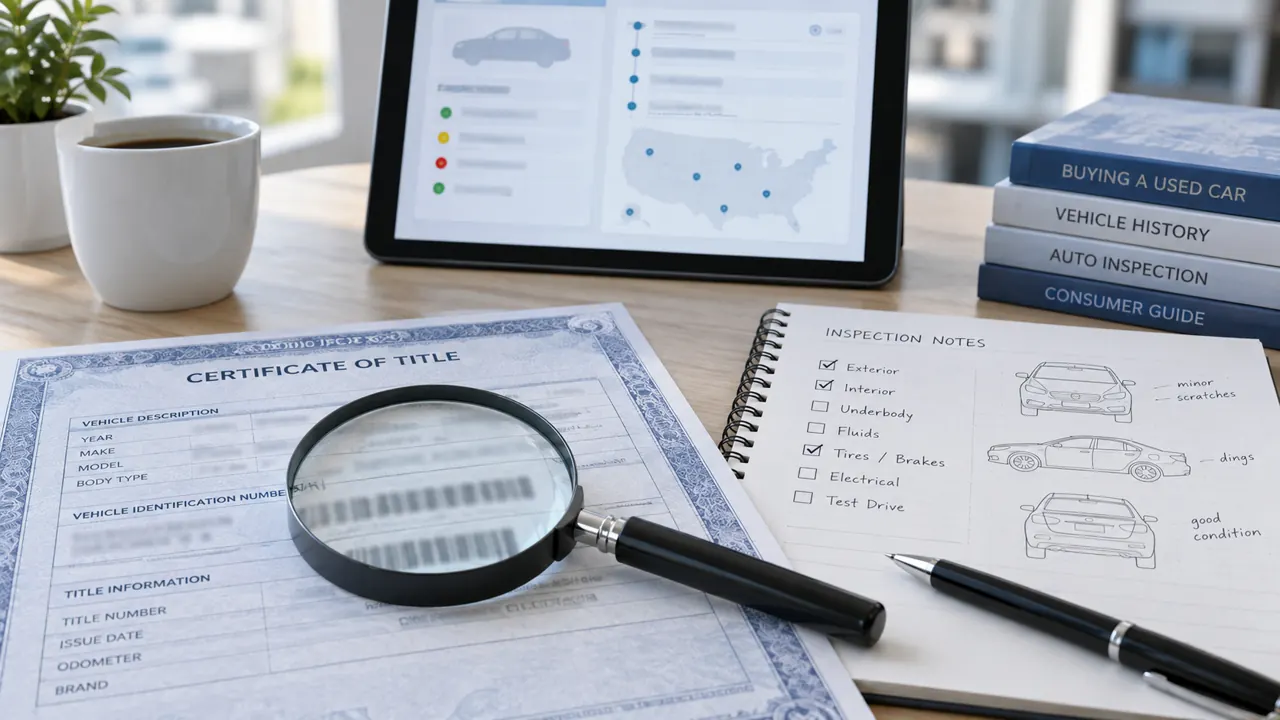
4. Confirm the current title with the responsible state DMV
Identify which state issued the current title and where you intend to register the vehicle. Those can be different. Use the issuing agency’s official site or contact method to ask what its title brand means and whether the document the seller has presented is current. Ask your destination state’s DMV what paperwork it requires for a vehicle with the reported history. State terminology and registration procedures differ, so a general blog cannot decide your exact case.
For example, New York describes a salvage examination in its own process, while California has a revived-salvage registration process. These examples show why one state’s label should not be casually applied to another. Do not treat a seller’s statement that the car is “ready to register” as a state agency determination. Ask what document will transfer, whether an examination is pending, and what proof the agency needs.
If a title application is pending, verify transfer authority and decide who bears the risk of delay or denial.
5. Compare other records without confusing their purposes
A commercial vehicle history report can contain useful accident, service, listing, or auction information beyond NMVTIS’s core title indicators. Coverage still depends on what was reported to that provider. Read dates, sources, and gaps; do not mistake an empty accident section for a physical inspection result. Carvul’s broader vehicle history report guide explains how to use such reports without treating any one provider as exhaustive.
Check NHTSA’s recall lookup separately for open safety recalls using the exact VIN. A recall lookup answers a different question from title branding. It cannot tell you whether collision repairs were adequate, and a title report does not replace it. If the car has imported, rebuilt, or unusual paperwork, you may need further state or manufacturer confirmation. Keep every result labeled by source so conflicting records remain visible instead of being blended into a false “all clear.”
Ask for pre-repair photos, body-shop invoices, parts receipts, alignment records, and diagnostic results. Missing documents leave uncertainty. Flood exposure raises different questions from collision, theft recovery, or hail damage.
6. Investigate every discrepancy before making an offer
Create a short list of conflicts: title brand differs between documents, states and dates do not line up, VIN differs by a character, the odometer chronology looks implausible, or the seller describes minor damage while photos show a more substantial event. Ask for a document-based explanation. A typo can be corrected; a missing repair history may be impossible to reconstruct. Your job is not to convict the seller, but to decide whether enough reliable evidence exists to buy responsibly.
Prioritize identity and title conflicts. Do not pay while ownership or registrability remains uncertain. Next, determine whether the physical damage narrative fits the record trail. If a report indicates salvage history but the seller advertises a clean-title car, do not accept a verbal assurance that the brand “went away.” Request the current state-issued paperwork and consult the relevant DMV. NMVTIS can help uncover past brands that a current document alone may not make obvious.
Assign unresolved questions to the right source: body shop for repairs, DMV for title records, insurer for coverage, independent mechanic for condition. Pause or walk away if a material answer is unavailable.
7. Commission an independent, damage-specific inspection
The Federal Trade Commission advises buyers that a vehicle history report does not replace an independent inspection. Arrange one with a professional who is independent of the seller. Tell the inspector what the records suggest and provide the pre-repair photos where available. A general mechanical check may not be enough for severe collision, flood, fire, or high-voltage EV damage; the inspection scope should fit the concern.
Request written findings rather than an informal “looks fine.” Ask about structural measurements where relevant, alignment, suspension, brakes, restraint systems, warning lights, corrosion, water intrusion, and the quality of visible repairs. No inspection can guarantee future trouble-free use, but it can identify present defects and give you a grounded repair estimate. If the seller will not permit a reasonable independent inspection, do not substitute another VIN website for the missing physical evidence.
Use the written report to decide whether to continue, renegotiate, or leave. Include potential repairs in the total purchase cost. Also verify insurance and financing before committing if you need either: provider acceptance and terms vary by vehicle and policy. The full salvage-title buying guide covers that broader go/no-go decision; this article deliberately concentrates on identifying the car and interpreting the records.
What a Clean Salvage VIN Check Can Miss
“No records found” means only that source returned no record under its coverage and timing. NMVTIS lacks detailed repair history, NICB covers participating insurers, and unreported or recent work may not appear.
There is also a difference between a title brand and repair quality. A properly displayed rebuilt brand tells you a state status; it does not grade every weld, sensor, airbag component, or future failure risk. Conversely, a vehicle with no brand on a particular report can still have safety or mechanical issues. That is why the workflow includes both title verification and a damage-specific inspection. Do not turn either into a substitute for the other.
Read underlying records instead of relying on a vendor’s green icon or summary score.
A Hypothetical Buyer Decision
Suppose a seller advertises a 2018 sedan as “fully rebuilt” and sends a current title image. The windshield VIN matches the title. An NMVTIS report shows an earlier salvage brand in another state and a more recent title in the current state. NICB returns no participating-insurer hit. These facts are not inherently contradictory: the two systems have different sources. The buyer still needs the current state’s paperwork and evidence of the repairs.
The seller then supplies pre-repair photos showing front-end damage and invoices listing replacement components. An independent inspector notes that the car tracks straight but finds an unresolved restraint-system warning and a missing calibration document. In this hypothetical, the correct decision is not “the VIN check passed.” The buyer should seek a documented diagnosis and resolution before agreeing to the purchase. If the seller declines, the buyer can walk away.
If the physical VIN instead differs from the title, stop until identity and ownership are resolved. This hypothetical shows why one yes/no result cannot settle a purchase.
Save This Buyer Checklist
| Evidence | What to record | If unavailable or inconsistent |
|---|---|---|
| Physical VIN | Windshield and another accessible manufacturer label | Pause; establish the vehicle’s identity |
| Current ownership document | VIN, issuing state, title brand, seller authority | Verify through the issuing state before paying |
| NMVTIS report | Current title, dates, brands, odometer and reported loss data | Ask about gaps; do not infer a clean history |
| NICB VINCheck | Search date and any participating-insurer hit | Treat a no-hit as limited coverage |
| State DMV guidance | Transfer and destination-state registration requirements | Do not assume another state’s rules apply |
| Repair evidence | Before photos, invoices, parts, diagnostic results | Price the uncertainty or decline |
| Independent inspection | Written findings and repair estimate | Do not buy on reports alone |
Save a dated evidence folder and written answers. Confirm registration, coverage, or a loan before a nonrefundable commitment when your purchase depends on them.
Frequently Asked Questions
Is NICB VINCheck enough for a salvage title lookup?
No. NICB searches certain theft and salvage or flood reports from participating member insurers. It does not claim to contain every title brand, all repair records, or reports from every insurer. Use it alongside an NMVTIS report, state title verification, and an independent inspection.
Can an NMVTIS report tell me exactly how a car was repaired?
No. NMVTIS focuses on title, brand and related reported indicators. The federal consumer material explicitly says it is not a detailed repair history. Request repair documents from the seller and ask an independent professional to examine the car.
Does a rebuilt title mean the vehicle passed a full safety inspection?
Do not assume that. State procedures differ, and the scope of a state examination may not cover every mechanical or structural concern a buyer has. Ask the relevant DMV what its process verifies, then arrange a separate inspection for the car’s known damage history.
Why do two VIN sites show different results?
They may use different contributors, reporting deadlines, or categories. Check that you entered the same VIN and compare record dates. Resolve a material conflict through the issuer of the underlying title or report; do not choose the result that makes the deal look easiest.
Should I run the check again before delivery?
If time has passed since the initial search, refresh the critical records and verify the VIN on the delivered car. New title activity or newly reported information can appear after your first lookup. The purchase documents should identify the same vehicle you inspected.
Sources and Editorial Note
- U.S. Department of Justice: Understanding an NMVTIS Vehicle History Report and NMVTIS consumer FAQ: covered fields, brand history, repair-history limits and reporting timing.
- NICB VINCheck: participating-member theft, salvage and flood lookup limits.
- Federal Trade Commission used-car guidance: vehicle history reports and independent inspection.
- NHTSA recalls: separate VIN-based open safety recall lookup.
- New York DMV salvage examination and California DMV revived salvage: examples of different state procedures, not a universal rule.
Sources reviewed September 18, 2026. State procedures, report coverage and the facts of an individual vehicle may change. Confirm the current agency requirements and obtain professional advice for a specific purchase.