
Buying a car from a private seller out of state puts more of the verification work on the buyer. There is no dealership office to organize the title, tax paperwork, temporary registration, financing, or delivery. Before sending money, establish that the seller owns the exact vehicle, can legally transfer it, and will deliver the documents your home state requires.
Quick answer: Confirm your home-state rules first. Match the seller’s identity to the title, check the VIN and lien status, commission an independent inspection, agree on a traceable payment and title-release process, activate insurance, and arrange a lawful way to move the car home.
For the entire interstate process, begin with Carvul’s buying a used car out of state guide.
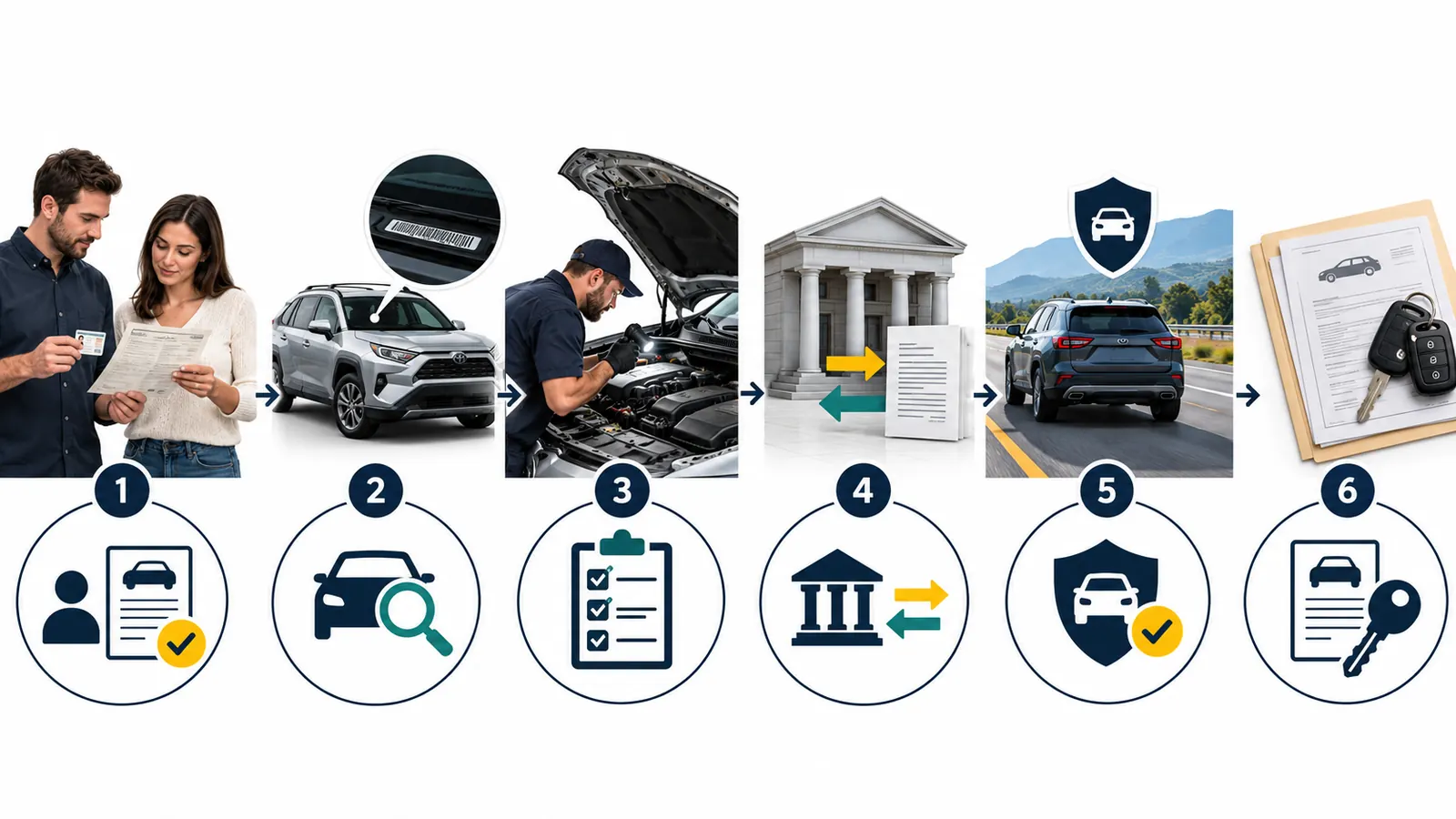
When buying a car from a private seller out of state, verify ownership, condition, payment, and transportation as one coordinated process rather than four separate promises.
1. Verify the Seller and Listing
Ask for the seller’s legal name, telephone number, general location, VIN, mileage, and reason for selling. Request a live video walkaround showing the dashboard, VIN locations, cold start, exterior panels, tires, interior, and any disclosed defects. Save the original listing and messages.
The name on the current title should match the person transferring the vehicle unless a lawful representative or documented estate, business, or power-of-attorney process applies. A seller who says the title belongs to a friend or relative creates a title-jumping risk. Pause until the titling agency confirms an acceptable transfer path.
Independently call the seller if unexpected payment instructions arrive. The FTC’s scam guidance recommends contacting an organization or person through contact information you know is genuine rather than trusting an unexpected message.
Seller verification is the first safeguard when buying a car from a private seller out of state, especially when the listing and payment discussion happen remotely.
2. Examine the Title Before Traveling
Ask for a clear copy sufficient to review the issuing state, VIN, owner name, title number, brands, lien section, and assignment area. The seller may redact unrelated sensitive information, but the transaction details must remain verifiable.
Look for:
- a VIN that matches the listing and vehicle;
- alterations, erasures, or inconsistent printing;
- salvage, rebuilt, flood, lemon, odometer, or other brands;
- an unreleased lien;
- a dealer-only reassignment chain;
- missing seller signatures or notarization fields; and
- a title from a different state than expected.
Do not ask the seller to pre-sign a title incorrectly or leave buyer fields blank. Contact both the issuing state and your home-state agency when the document is unfamiliar.
Use Carvul’s out-of-state title transfer checklist to verify signatures, liens, mileage, and destination-state documents.
Before buying a car from a private seller out of state, make sure the destination agency will accept the exact title and assignment format.
3. Check History, Recalls, and Ownership Signals
Use an approved NMVTIS consumer provider for title, brand, odometer, and certain loss records. Run the VIN through NHTSA’s recall lookup. Read Carvul’s vehicle history report guide before treating any report as complete.
A clean report does not establish ownership and cannot replace a physical inspection. Conflicts between the title, seller story, mileage, service records, and vehicle condition require an explanation supported by documents.
4. Resolve Any Lien Before Payment
If a lender holds the title or appears as lienholder, involve it directly using independently verified contact information. Ask how payoff, title release, and transfer work for an out-of-state buyer. A safe closing may require payment to the lender and only the remaining equity to the seller.
Do not accept a promise that the seller will pay the loan after receiving your money. Get written payoff instructions and understand whether the title is paper or electronic, how long release usually takes, and what temporary ownership evidence your state accepts.
Lien verification protects both payment and title transfer when buying a car from a private seller out of state.
5. Arrange an Independent Inspection
Choose the shop yourself. Ask for a VIN match, diagnostic scan, cold start, road test where lawful, tire and brake measurements, leak and corrosion review, structural-repair assessment, and photographs. For EVs, ask what battery and charging checks the shop can competently perform.
Use Carvul’s used car inspection checklist to discuss findings. Walk away when a seller blocks inspection access or demands full payment first.
An independent inspection is essential when buying a car from a private seller out of state because post-sale repairs or returns can be difficult to negotiate across state lines.
6. Use a Complete Bill of Sale
Use the form required or recommended by the relevant state. Common details include buyer and seller names and addresses, VIN, year, make, model, mileage, price, date, title information, known conditions, included property, and signatures. Notarization rules vary.
The bill of sale supplements the assigned title; it does not automatically replace a missing title. Federal odometer-disclosure rules and exemptions are explained in NHTSA’s odometer-fraud guidance, while states control their own forms and filing procedures.
7. Choose a Safe Payment Process
Agree in writing on the amount, deposit terms, inspection contingency, payment method, lien payoff, document exchange, and pickup or shipping condition. Prefer a traceable process that lets the bank or other involved institution verify identities and funds.
If wire instructions change, stop and call a known number. Never rely solely on an email thread for a last-minute account change. Do not send gift cards, cryptocurrency, or unprotected person-to-person payments to an unverified remote seller.
8. Confirm Tax, Insurance, and Registration
Private-party tax treatment varies. Ask your home-state tax and motor vehicle agencies how value is determined, which receipt or bill of sale is required, and when payment is due. Confirm title-transfer, VIN-verification, inspection, emissions, and registration requirements before pickup.
Call your insurer with the exact VIN and possession date. Obtain written confirmation of when coverage starts and what proof you must carry. Do not assume a universal grace period.
Insurance confirmation should be completed before buying a car from a private seller out of state and taking possession of the vehicle.
9. Plan a Lawful Trip Home
Seller plates may remain with the seller under state law. Ask the relevant agencies whether a temporary registration, transit permit, or drive-away permit is available and whether it is valid along your route. Carry the assigned ownership document, bill of sale, insurance proof, and permit required for the trip.
Check the full temporary-tag and transit-permit guide before driving the vehicle home.
Shipping avoids some road-permit questions but creates carrier and condition-report issues. Photograph the vehicle before loading and at delivery, and read the carrier’s claim procedure.
10. Complete the Exchange Carefully
Before leaving, compare the VIN again and collect the properly assigned title, lien release, odometer disclosure where applicable, signed bill of sale, keys, records, receipts, and any promised parts. Photograph the vehicle and paperwork with sensitive data protected in your stored copies.
| Stop the transaction when | Safer response |
|---|---|
| Seller name does not match title | Ask the DMV for the lawful transfer path |
| Lien is unresolved | Close through the lender |
| VIN differs | Do not pay or move the car |
| Inspection is refused | Walk away |
| Payment destination changes | Verify independently |
| Temporary-tag story is vague | Confirm with the issuing agency |
How to Verify a Remote Private Seller
Start with a real-time phone or video conversation. Ask the seller to show the exact vehicle, dashboard VIN, door label, odometer, cold start, warning lights, title, keys, and known defects. A legitimate seller should be able to explain how long they have owned the car, why they are selling it, where it has been serviced, and whether anyone else has a financial interest in it.
Do not ask the seller to transmit unredacted identity documents through insecure channels. Instead, plan to compare identification with the title in person or through a reputable closing process. Search the VIN, seller telephone number, listing photos, and distinctive description text for copied advertisements.
Warning signs include a seller who is overseas, claims to be acting for an unnamed relative, refuses a live inspection, demands a deposit immediately, offers shipping through an unfamiliar escrow service, or says the title will arrive after payment.
Build a Safe Payment and Closing Plan
Agree in advance on the meeting location, inspection sequence, documents, payment instrument, and moment possession changes. A bank or credit union can provide a controlled setting and help verify a cashier’s check, but its staff does not certify the vehicle or title unless it explicitly offers that service.
For a lien payoff, speak directly with the lender using a independently sourced telephone number. Ask for the current payoff amount, accepted funding method, release procedure, title location, and expected timeline. Structure payment so the lienholder receives its amount and the seller receives only the verified remainder.
The signed bill of sale should accurately identify the buyer, seller, vehicle, VIN, mileage, date, price, included property, known written promises, and payment method. Do not enter a false lower price. Keep proof of payment that can be connected to the transaction.
In-Person Inspection Sequence
Meet during daylight in a safe location where the vehicle can be inspected and test-driven legally. Before starting the engine, compare the VIN and title. Inspect for flood evidence, mismatched paint, uneven panel gaps, tire age, fluid leaks, warning lights, missing emissions equipment, and signs of rushed cosmetic repair.
An independent mechanic should evaluate structure, brakes, steering, suspension, cooling, drivetrain, electronics, diagnostic codes, leaks, tires, and evidence of prior damage. Ask the shop for a written report and price estimates. The seller’s recent inspection or service receipt does not replace your own evaluation.
Use Carvul’s used-car test-drive checklist to evaluate cold start, acceleration, braking, steering, transmission behavior, vibrations, climate control, and dashboard systems consistently.
What to Do After the Exchange
Before driving away, scan or photograph the assigned title, bill of sale, lien release, odometer disclosure, permit, and seller contact information. Confirm that you received all keys, manuals, service records, accessories, wheel-lock key, charging equipment, and promised parts.
Begin title and registration immediately. Track the destination state’s deadline, tax payment, VIN verification, emissions or safety test, and insurance evidence. If the agency rejects a document, contact the seller promptly in writing and preserve the rejection notice.
Change connected-car app access, garage codes, infotainment profiles, navigation history, paired phones, and digital keys. Verify whether the manufacturer requires an ownership update before connected services can transfer.
Private-Sale Cost Worksheet
A private listing price is only the first line. Add travel, inspection, history reports, lien-closing costs, tax, title, registration, temporary permit, shipping, insurance, and immediate repairs. Reserve money for maintenance that has no reliable documentation.
A car that costs less than a dealer alternative may still be a poor value if it needs tires, brakes, timing-related service, or title correction. Negotiate from verified condition and total ownership cost, not from the seller’s urgency.
Frequently Asked Questions About Buying a Car From a Private Seller Out of State
Can I buy from a private seller in another state?
Yes, but the title, tax, registration, insurance, and vehicle-movement requirements depend on the states and transaction.
Use written agency guidance before buying a car from a private seller out of state, because the seller’s local process may not satisfy the buyer’s home state.
Is a bill of sale enough?
Usually it supports the transaction but does not replace a properly assigned title unless the relevant agency authorizes a specific alternative process.
What if the seller still owes money?
Work directly with the lienholder on payoff and title release. Do not rely on the seller to resolve the loan after receiving your full payment.
Private-Sale Decision Test
Before exchanging money, review the deal without the seller present. Confirm that the lower price still makes sense after inspection, travel, tax, registration, transport, and immediate repairs.
Proceed only when the seller and title match, the VIN is consistent, the lien is resolved, history findings agree with the inspection, payment is documented, insurance is active, and the destination agency has confirmed the transfer path. Walk away when pressure replaces documentation. A long trip or inspection fee is a sunk cost, not a reason to accept uncertain ownership.
If a Problem Appears After Purchase
Preserve the listing, messages, title copy, bill of sale, payment proof, inspection, photos, and agency notices. Notify the seller in writing and describe the specific discrepancy without altering documents or vehicle evidence.
For a title defect, ask the motor vehicle agency for the approved correction. For suspected fraud, contact the relevant authority. For a mechanical dispute, review the written representations and obtain an independent diagnosis. Private sales often provide fewer remedies than dealer sales, so the pre-purchase file is the buyer’s strongest protection.
Questions to Ask Before Traveling
Ask in writing whether the seller is named on the title, whether a lien or co-owner exists, where the title is held, whether the car has a title brand, and whether an independent shop may inspect it. Confirm included keys, records, accessories, and known defects.
Treat each answer as a lead for verification, not proof. Compare it with the title, VIN, vehicle history, inspection, and destination-state requirements. Meet during business hours near a bank, shop, notary, or motor vehicle office. If the seller changes the VIN, price, payment destination, meeting person, or title explanation after you arrive, pause the deal.
Private-Sale Records to Keep
Retain secure copies of the listing, seller statements, inspection, history report, VIN photos, bill of sale, payment evidence, lien release, insurance, permit, and delivery condition. Record when each document was received.
After registration, keep the purchase file with maintenance records. A documented ownership chain can help with an insurance claim, title correction, warranty question, or resale. Protect identity and financial information rather than leaving the file in the vehicle.
One-Day Closing Plan
Schedule the independent inspection first, document review second, lender or bank closing third, and title signing last. This order preserves the buyer’s ability to leave before money changes hands. Allow enough business hours to call the lender and motor vehicle agency if a record is unclear.
Do not let the seller’s travel schedule compress those checks. When the deal cannot be verified in one day, secure the documents and return later rather than replacing diligence with a deposit.
Never let urgency override verified ownership, condition, insurance, and lawful transportation.
Bottom Line
Buying a car from a private seller out of state can work when identity, ownership, condition, money, and transportation are verified as one coordinated process. If one part cannot be documented, distance makes walking away the safer choice.