
An out-of-state title transfer moves a vehicle’s ownership record from the selling state’s document system into the buyer’s destination state. The process can fail when a signature is missing, a lien remains recorded, the VIN differs, or the seller is not the titled owner.
Quick answer: Before paying, confirm that the seller’s identity matches the title, the VIN matches the car, every lien is released, the title brand is understood, and your home-state agency will accept the document. Complete all required assignments without erasures, then submit the title, bill of sale, odometer record, tax proof, identification, and state application before the deadline.
For the complete transaction workflow, start with Carvul’s out-of-state used-car buying guide.
What an Out-of-State Title Transfer Changes
A vehicle title is the state’s ownership record. Transferring it typically records the buyer as owner, carries forward any valid brand, records or releases a lien, and creates a destination-state title or electronic ownership record.
Every out-of-state title transfer depends on an unbroken ownership chain and an exact VIN match.
Title transfer is not the same as registration. A buyer may need both, but one does not automatically complete the other. Registration authorizes road use; title establishes the ownership record.
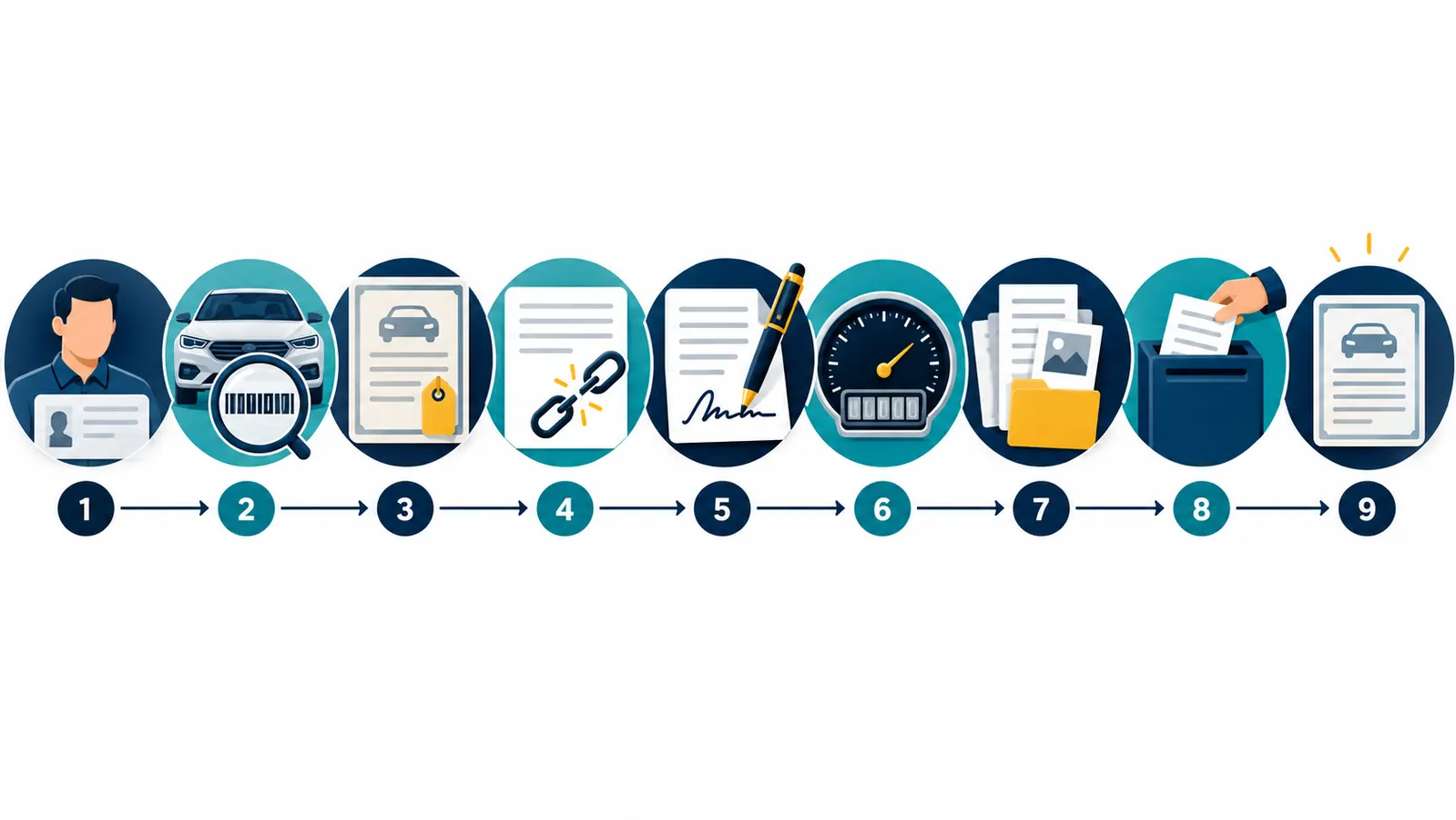
Out-of-State Title Transfer: 9 Essential Checks
1. Verify the seller is the titled owner
Compare the seller’s government identification with the owner name printed or recorded on the title. If a business, trust, estate, representative, or power of attorney is involved, ask the destination agency which supporting documents are required.
Avoid a transaction where a seller says the previous owner signed the title but never transferred it. A skipped transfer, often called title jumping, can leave the buyer without a clean legal chain of ownership.
2. Match the VIN character by character
Compare the full 17-character VIN on the title with the dashboard plate, driver’s-door label, purchase agreement, insurance binder, and financing paperwork. Look for altered rivets, damaged labels, inconsistent fonts, or unexplained replacement stickers.
Use the National Motor Vehicle Title Information System to locate approved vehicle-history providers, and review Carvul’s vehicle history report guide before committing.
3. Read every title brand
A title can carry brands such as salvage, rebuilt, flood, junk, lemon law buyback, odometer discrepancy, or another state-defined designation. Brand terminology and road-use consequences vary.
Do not assume a new state will erase a brand. Ask the destination agency how it carries forward and displays the record, and verify financing and insurance before paying.
4. Resolve all liens
If a lender appears on the title or electronic record, obtain the release method required by both states. A paper letter that looks official may not satisfy an electronic-title system.
A lien must be resolved through the accepted process before an out-of-state title transfer can be completed safely.
When the seller still owes money, coordinate payoff directly with the lender using independently verified contact information. Do not hand the seller extra money based only on a screenshot or verbal payoff amount.
5. Complete the assignment exactly
Titles can require buyer and seller names, addresses, sale date, purchase price, odometer reading, signatures, notarization, dealer reassignment, or witness information. Write only in the correct fields and use the required ink and name format.
Do not use correction fluid, erase an entry, or squeeze a second assignment into an occupied section. Ask the issuing agency how to correct a mistake.
6. Complete the odometer disclosure
Federal and state mileage disclosure rules can apply based on vehicle age and transaction type. The NHTSA odometer fraud page explains federal protections and warning signs.
Compare the disclosed mileage with the dashboard, service records, inspection records, and vehicle-history timeline. An unexplained inconsistency deserves investigation before purchase.
7. Prepare the supporting documents
Your destination state may request:
- original assigned title or approved electronic-title record;
- bill of sale or dealer invoice;
- title application;
- proof of identity and residency;
- odometer disclosure;
- lien release or lender information;
- VIN verification;
- tax receipt or use-tax payment;
- insurance evidence; and
- inspection or emissions records.
Requirements can differ for dealers, private sellers, inherited vehicles, gifts, military members, and vehicles imported from outside the United States.
8. Submit before the state deadline
Late transfers can trigger fees and create practical problems with insurance, temporary tags, parking, tolls, resale, or proof of ownership. Confirm when the clock begins and whether mailing the application counts as timely submission.
Keep a complete scan of the title before surrendering it, but never alter or duplicate the original for deceptive use. Obtain a receipt or tracking number from the processing office.
Tracking protects the buyer while an out-of-state title transfer is pending.
9. Inspect the new title immediately
Check the new record for the correct VIN, owner spelling, address, lienholder, vehicle description, mileage notation, and title brand. Contact the agency promptly if anything is wrong.
Store a paper title in a secure place, not in the glovebox. If the state uses electronic titles, save the account and agency information needed to request a record or complete a future sale.
Paper Titles, Electronic Titles, and Lender-Held Titles
Out-of-state purchases become more complicated when the selling state uses electronic titles or sends the title directly to a lienholder. Ask the destination agency and lender to explain the transfer path before the sale.
Confirm:
- who currently controls the title record;
- whether a paper title must be requested;
- where the lender will send it;
- whether the buyer can register while the transfer is pending; and
- how long the process normally takes.
Do not treat a registration card as proof that the seller can transfer ownership.
Dealer vs. Private-Seller Title Transfers
An out-of-state dealer may handle the transfer, but the contract should identify the destination state, filing service, fees, expected timing, and temporary registration. Review the itemized numbers using Carvul’s dealer fees and out-the-door price guide.
In a private sale, the buyer normally inspects and carries the ownership documents. Use a safe meeting place, verify identification, confirm the payment method, and complete the assignment together. Carvul’s private-party buying guide provides a broader transaction checklist.
Warning Signs That Should Stop the Purchase
Pause or walk away when:
- the seller is not named on the title;
- the title is missing, photocopied, heavily damaged, or altered;
- the VIN does not match;
- a lien lacks an independently verified release;
- a branded title is advertised as clean;
- the seller pressures you to leave buyer fields blank;
- the price on the bill of sale is intentionally false;
- the mileage history conflicts without explanation; or
- the seller promises to fix paperwork after receiving payment.
An attractive price does not compensate for ownership documents that cannot be transferred.
Out-of-State Title Transfer Checklist
Before payment:
- identify the destination agency;
- verify owner identity and authority;
- match every VIN;
- check title brands;
- resolve liens;
- review mileage history;
- confirm required inspections and taxes; and
- verify temporary transportation.
At signing:
- complete every required field;
- use accurate price and mileage;
- obtain all signatures and notarization;
- collect the bill of sale and releases; and
- retain copies and proof of payment.
After purchase:
- insure the exact VIN;
- submit the transfer on time;
- track the application; and
- verify the final title.
Title Brands and State-to-State Differences
Title brands describe significant history, but their names and thresholds are not perfectly uniform. One state may use rebuilt, another reconstructed, and another prior salvage. Flood, junk, lemon-law, taxi, police, or odometer notations can also appear.
Ask the destination agency how it interprets and carries forward the exact source-state brand. Then confirm insurability, financing, inspection, warranty eligibility, resale disclosure, and market value. A clean-looking replacement title should not override an earlier brand in an official history record.
When evaluating a branded vehicle, arrange a specialist inspection that can assess structural repair, corrosion, restraint systems, electronic modules, alignment, and repair documentation. A standard mechanical inspection may not answer all collision or flood questions.
Electronic Title Transfer Questions
Electronic titles reduce paper handling but can make interstate transfers less obvious to the buyer. Before closing, ask:
- Which state currently holds the electronic record?
- Is a lender or owner controlling it?
- Must a paper title be generated for the destination state?
- Who requests and pays for that document?
- Where will it be mailed?
- Can the buyer track the request?
- What temporary proof is accepted while waiting?
Verify these answers with the agencies and lender. A screenshot from a seller’s online account is not the title itself.
Correcting a Title Error
If a name, VIN, mileage, price, or signature is entered incorrectly, stop and ask the issuing agency for the correction process. It may require an affidavit, corrected-title application, duplicate title, notarization, or seller participation.
Never erase, overwrite, use correction fluid, or add a different buyer to conceal an error. Alterations can cause rejection and raise fraud concerns. Keep copies of the original mistake and every correction document.
When the seller will not cooperate, preserve messages and the rejection notice. Contact the relevant motor vehicle agency, dealer regulator if applicable, consumer-protection office, or qualified attorney.
Special Ownership Situations
Deceased owner or estate
The signer may need letters testamentary, small-estate documents, survivorship evidence, or a state-specific affidavit. Confirm authority before paying an heir or representative.
Trust or business owner
Ask for proof that the signer can act for the trust or entity. The title and bill of sale should use the correct legal owner name.
Gift or family transfer
Special forms or tax rules may apply, but calling a sale a gift does not make it one. Use accurate consideration and relationship information.
Divorce or multiple owners
The title’s use of “and,” “or,” or another connector can affect required signatures. Court orders do not always replace agency forms automatically.
Vehicle bought at auction
Review every reassignment and dealer or auction document in the ownership chain. Consumer auction paperwork may contain limitations and brand disclosures that require careful review.
Title Transfer File Organization
Create a digital folder and a paper folder. Include title images, bill of sale, identification checklist, lien release, odometer disclosure, VIN photographs, history reports, inspection, tax receipt, insurance, permit, application, mailing tracking, and agency receipts.
Name files by date and purpose. Protect sensitive identity and financial documents with secure storage rather than ordinary email attachments. Do not keep the original title in the vehicle.
After the New Title Arrives
Compare the title with the purchase file. Verify that the owner and lienholder are correct and that no legitimate brand disappeared or appeared incorrectly. Confirm that the registration and insurance use the same VIN and owner information.
If you plan to sell the car later, retain the old-state purchase and transfer records. They can explain a title-state change and reassure a future buyer that the ownership chain is documented.
Frequently Asked Questions About an Out-of-State Title Transfer
Can I transfer a title from any state?
Generally, states have procedures for valid out-of-state titles, but document formats, brands, liens, inspections, taxes, and identity requirements vary. Confirm your exact case before purchasing.
What if the seller lost the title?
The titled owner usually needs to obtain an official replacement or follow an approved state process. Do not rely on a bill of sale alone unless your destination agency confirms that it is legally sufficient for that vehicle and transaction.
Will my state remove a salvage or rebuilt brand?
Do not assume so. States generally preserve or evaluate prior brands under their own laws. Verify the destination record, inspection requirement, insurance, and financing before purchase.
Can I register while waiting for the title?
Some states or dealer transactions provide a temporary process, while others require ownership records first. Ask the agency what evidence is acceptable and how long any permit remains valid.
Final Title Acceptance Test
Do not release final payment until the ownership record passes a last review. Confirm seller authority, title type, VIN, required signatures, liens, mileage, brands, accurate price, notarization, destination forms, and deadline together.
If anyone asks you to leave a buyer field blank, state a false price, or trust that an agency will overlook an alteration, stop. A transferable title also does not prove the car is safe. Complete both a document review and independent physical inspection, and resolve inconsistencies before the vehicle crosses state lines.
Questions for the Destination Title Office
Ask whether the original source-state title is acceptable, whether notarization is required, how electronic titles arrive, what proves a lien release, and whether VIN verification is mandatory. Confirm how brands and mileage disclosures carry forward, which tax records accompany the application, and when the deadline begins.
Record official form numbers and document standards. A seller’s past experience may not match the buyer’s state or the current process.
Do not resell the vehicle before your ownership transfer is complete unless an agency confirms a lawful procedure. Skipping your name in the chain can create title-jumping concerns and leave taxes, liability, and notices tied to the wrong person. Wait for the corrected ownership record before completing another transfer.
If the application is pending, keep the agency receipt and respond quickly to document requests. Do not assume silence means approval, especially when a temporary registration is close to expiring. Confirm the final record before making another ownership change.
Bottom Line
An out-of-state title transfer succeeds when the ownership chain, VIN, lien status, mileage, brands, signatures, and destination-state forms all agree. Fixing a document problem before the sale is easier than proving ownership afterward.
Keep the seller’s verified contact information until the destination title arrives. Some corrections require a new signature, affidavit, or source-state duplicate. Agree before closing how both parties will handle a legitimate agency correction so a small paperwork issue does not become an abandoned transfer.
Retain every receipt until the out-of-state title transfer appears correctly in the destination state’s ownership record.