
Car AC repair should start with a diagnosis, not a can of refrigerant or an immediate compressor replacement. If your vehicle blows warm air, has weak airflow, smells musty, or cools only while moving, the same complaint can point to several different systems. The right question is not simply “How much is an AC recharge?” It is “What failed on this specific vehicle, how was that failure confirmed, and what will the proposed repair actually solve?”
This guide is for U.S. drivers comparing a repair estimate or preparing to visit a shop. It explains what you can observe safely, what a technician should test, when a recharge makes sense, how to read a quote, and when the value of a repair needs to be weighed against the value of an older car. It does not replace an in-person diagnosis or your manufacturer’s service information. Refrigerant service is specialized work governed by federal requirements; do not vent refrigerant or substitute an unapproved product.
Quick Answer: What Should You Do First?
For car AC repair, document the exact symptom before buying parts. Check whether air comes from the vents, whether it is cold at idle and at road speed, whether the problem is on one side or both, and whether the fan or compressor makes an unusual noise. Then ask a qualified shop for a diagnosis that identifies the failed component or control issue, followed by a written estimate. A weak cabin filter can restrict airflow, but it does not explain every warm-air complaint. Low refrigerant often points to a leak; adding refrigerant without addressing that cause may provide only temporary relief. Compare estimates on the same scope of work, refrigerant type, and parts quality.
How a Car AC System Works
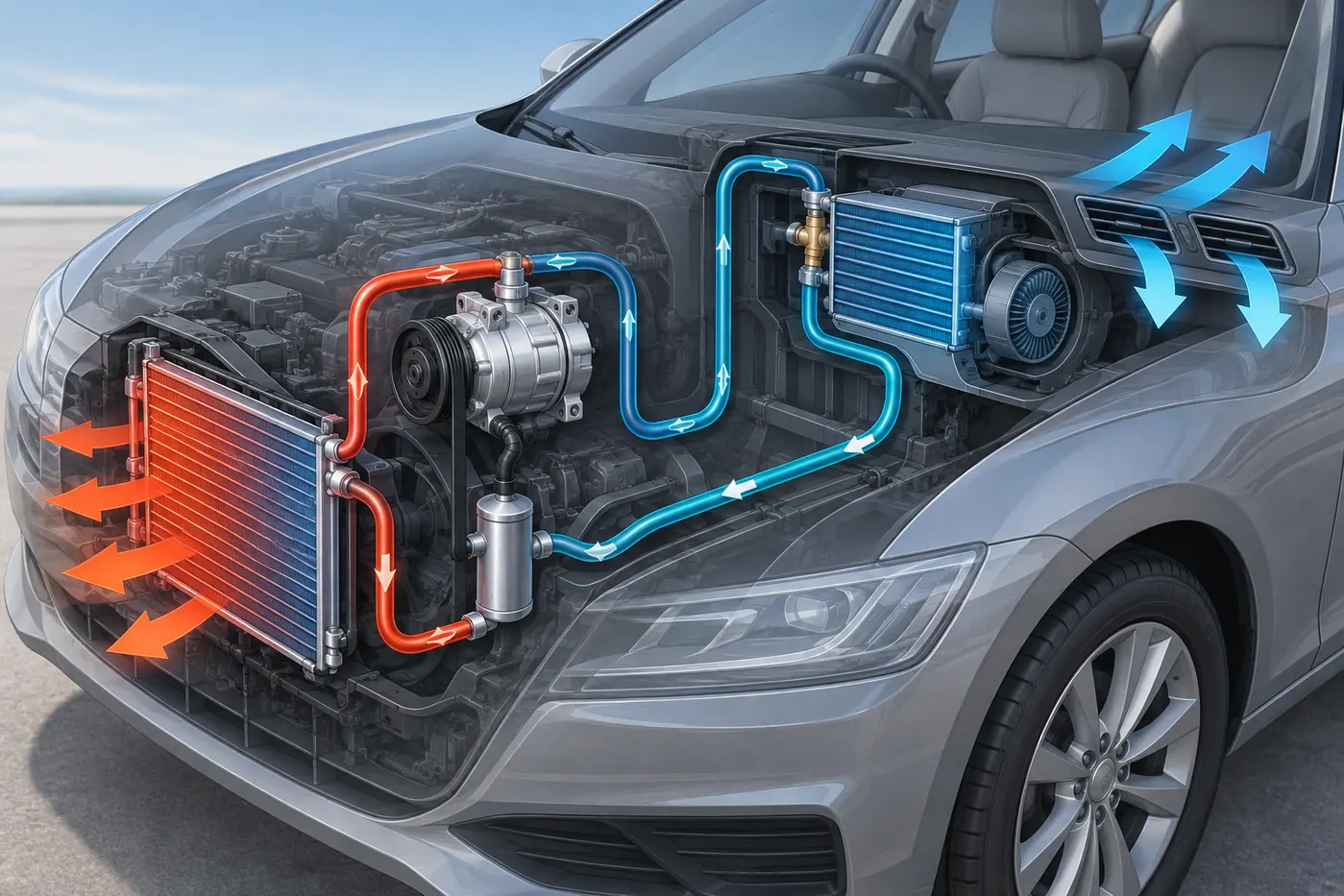
A conventional automotive air conditioner moves heat from the passenger compartment to the outside air. The compressor circulates refrigerant; the condenser releases heat at the front of the vehicle; the expansion device reduces pressure; and the evaporator behind the dashboard absorbs heat from cabin air. A blower pushes that air through the vents. Sensors, relays, fans, blend doors and electronic controls determine when and where cooling occurs. Some hybrids and EVs use different compressor designs and may integrate cooling with battery thermal management, which makes model-specific procedures especially important.
The system is more than its refrigerant charge. A car can have the correct charge yet fail to cool because a condenser fan is not moving enough air, a control module is not commanding the compressor, a blend door is mixing in heat, or the blower is moving too little air. Conversely, a compressor may be commanded correctly but unable to build the pressure difference required for cooling. A technician should identify which function is missing before recommending a costly component.
Two symptoms that drivers often group together are different. “The vents blow strongly but the air is warm” suggests the cooling circuit or temperature control. “The air seems cold but barely comes out” suggests airflow, including a restricted cabin filter, blower, duct or evaporator issue. If only one side of a dual-zone cabin is warm, the problem may be a control or blend-door issue rather than a system-wide refrigerant loss. These are clues, not diagnoses.
Nine Smart Checks Before Paying for Car AC Repair
1. Describe the symptom precisely
Write down when the problem started, whether it appeared suddenly, and whether recent collision, electrical or cooling-system work preceded it. Note whether the AC fails every time or only after a long drive. A shop can reproduce a consistent complaint more efficiently than a vague “AC broken” report. If there is an unusual noise, capture a short recording from inside the cabin without distracting yourself while driving.
2. Compare cooling at idle and while moving
If air cools on the highway but warms at a traffic light, the shop may investigate condenser airflow, radiator fan operation and pressure behavior. If the reverse happens, the diagnostic path may differ. Ask the technician to test the car under the condition that reproduces the complaint; a brief check in a cool service bay may miss a hot-weather problem. Do not touch a running fan or moving belt during your own observation.
3. Separate temperature from airflow
Set the blower to different speeds and note whether the volume of air changes. Check a cabin filter only as your owner’s manual permits; some filters are easy to access, while others are not. A dirty filter can reduce flow and contribute to odor, but replacing it will not repair a leaking condenser or seized compressor. If no air emerges at all, say so: blower, fuse, wiring or control problems deserve different tests from a warm-air complaint.
4. Compare every vent and climate zone
On a dual-zone system, set both sides to the same temperature and test each side. Note whether the floor, windshield and dashboard vents respond to mode changes. The air-mix and mode doors are part of the HVAC case, and their failure can imitate a refrigerant problem. A vehicle with a distinct passenger-side complaint should not be diagnosed from a single driver-side vent measurement.
5. Notice odors and moisture separately
A musty smell can involve a dirty cabin filter, persistent evaporator moisture or drainage. A sweet smell, smoke, burning odor or exhaust-like smell may indicate a different and potentially more urgent problem. Turn off the system and have the vehicle assessed if the odor suggests overheating, electrical damage or exhaust entry. A fragrance spray can mask a symptom without correcting its source. The detailed car AC smells musty guide separates these odor patterns.
6. Review the vehicle’s service record
Look for prior refrigerant additions, compressor replacement, condenser damage, collision repair and dashboard work. Ask what was changed and whether the problem returned. If the AC has needed repeated “top-offs,” the history makes leak testing especially relevant. A service invoice may list a quantity of refrigerant recovered or added; bring that document to the next shop rather than relying on memory.
7. Ask what testing supports the diagnosis
A credible estimate should be tied to an observed failure. Depending on the vehicle, this can include an electronic fault scan, visual inspection, refrigerant recovery and charge measurement, pressure readings interpreted under the correct ambient conditions, fan operation, leak detection, or electrical tests. Pressure alone is not a magic diagnosis. Ask the shop to explain what it measured, what specification it compared the result with, and which alternative causes it ruled out.
8. Get a written, itemized estimate
Ask for parts, labor, diagnostic time, refrigerant service and tax as separate lines. Clarify whether the estimate includes leak repair, a new receiver-drier or related parts, evacuation, recharge to specification and a post-repair performance test. Ask whether a replacement compressor is new, remanufactured or used, and how the warranty applies to the complete repair. The FTC’s auto-repair guidance advises consumers to request a written estimate that describes the condition, parts and labor and requires approval before work exceeds the agreed scope.
9. Test the result and keep the paperwork
Before paying, ask the shop to demonstrate that the original symptom is gone under comparable conditions. Confirm that the system holds the correct charge and that fans, vents and modes respond properly. Retain the original complaint, work order, diagnosis, replaced-parts description, refrigerant type and quantity, final invoice and warranty terms. This record matters if cooling fades again next month or you later sell the car.
Symptom-to-Next-Step Table
| What you notice | Possible categories to investigate | What to ask the shop |
|---|---|---|
| Strong airflow but warm air | Low refrigerant, fan, compressor, electrical control, blend door | Which component failed and how was it confirmed? |
| Cold while moving, warm at idle | Condenser airflow or fan, pressure or charge behavior | Was the complaint reproduced at idle in warm conditions? |
| Little airflow at every speed | Filter, blower, electrical or duct issue | Is the blower operating and is airflow restricted? |
| One side cold, one side warm | Zone control or blend door; other causes possible | Were both temperature zones and their actuators tested? |
| Cooling fades after 20 minutes | Icing, controls, fan, pressure or electrical fault | Can you reproduce the time-dependent failure? |
| Hiss or recurring loss of cooling | Refrigerant leak possible | Where is the leak, and what test identified it? |
| Musty smell | Filter, evaporator moisture, drain or debris | What is the odor source, not just the deodorizer? |
| New grinding or rattling | Compressor, clutch, pulley, blower or other rotating part | Is it safe to operate the system before repair? |
This table is a starting point, not a diagnosis. Some symptoms have several plausible causes, and a person reading from a screen cannot safely determine refrigerant pressure, electrical function or component condition for your exact vehicle. Our detailed car AC not blowing cold air checklist walks through the main no-cooling patterns without presenting a recharge as the universal answer.
What a Professional AC Diagnosis Should Include
The diagnostic scope depends on the complaint and the manufacturer’s service procedure. For an airflow issue, the shop may inspect the cabin filter, blower speeds, control panel, door operation and duct restrictions. For a cooling issue, it may assess ambient temperature, vent temperature, engine or electric-compressor operation, condenser fans, refrigerant charge and system pressures. An electronic scan may reveal faults in climate-control modules or sensors. The technician should use the correct vehicle-specific specifications; generic pressure charts alone cannot replace them.
Ask what would change the recommendation. For example, if a shop suggests a compressor, what evidence distinguishes internal compressor failure from an open fuse, failed clutch control or pressure switch that prevents engagement? If a shop says the system is low, what evidence identifies a leak and where? If the quote recommends an evaporator deep behind the dashboard, how confident is the leak location, and what other work is included when the HVAC case is opened? These questions are not accusations. They protect both the driver and the technician from authorizing the wrong repair.
If the first quote is high, a second opinion can be valuable, particularly when the proposed repair requires dashboard removal or multiple parts. Show the second shop the first diagnosis but ask for an independent finding. Comparing two identical price totals is less useful than comparing the same diagnosis, parts quality, included labor and warranty. A lower quote that omits refrigerant recovery, leak repair or post-repair verification may not be cheaper in practice.
Common Car AC Repair Categories
Low charge and refrigerant leaks
An automotive AC system does not consume refrigerant as fuel. A low charge can therefore indicate a leak, a prior incomplete service or another system problem. Leaks can develop at hose connections, seals, the condenser, compressor or evaporator. The right method depends on the vehicle and shop equipment. Ask whether the shop located a leak or is only adding refrigerant and watching performance. The car AC refrigerant leak guide explains how to evaluate that evidence.
An emergency top-off may seem appealing during a heat wave, but it does not repair a leak. Repeated addition can cost more over time and can complicate diagnosis. A shop should identify the refrigerant specified on the vehicle label and use the equipment and procedures appropriate to that refrigerant. Under EPA motor-vehicle AC rules, paid MVAC service requires Section 609 certification and approved handling equipment; intentional venting is prohibited. Do not use an unapproved hydrocarbon substitute. EPA warns against hydrocarbon refrigerants in MVACs.
Compressor and clutch-related faults
The compressor is expensive enough that confirmation matters. A belt-driven clutch not engaging may be responding correctly to a low-pressure condition or may have an electrical fault. Some newer vehicles use variable-displacement or electric compressors with different controls. A noisy pulley is not always an internally failed compressor, and an internally damaged compressor may contaminate other components. Ask the shop whether the proposed replacement includes the associated parts and cleaning required by the manufacturer’s instructions. Our car AC compressor replacement cost guide explains the quote in detail.
Condenser and cooling-fan faults
The condenser sits where it can collect road debris or be damaged in a front-end impact. Airflow across it is important, especially at idle. A shop should look at fan operation and physical damage before assuming low refrigerant. A fan fault may be electrical, sensor-related or mechanical. If the engine is overheating at the same time, treat that as a separate and potentially urgent cooling-system issue rather than trying to solve it by running the AC harder.
Expansion, evaporator and blend-door issues
A restriction in the refrigerant circuit or an evaporator fault can affect cooling, while a blend-door fault can route heat into otherwise chilled air. These repairs can involve substantial labor because the relevant parts may sit behind the dashboard. Ask how the failure was isolated and what parts and calibration are included. Replacing multiple components without a clear rationale can make an already expensive repair harder to evaluate.
Blower, filter and electrical issues
When air does not move, the blower motor, resistor or controller, fuse, wiring, controls or a blocked filter may be involved. Some checks are inexpensive compared with sealed refrigerant work, but electrical faults still deserve correct testing. Do not replace a compressor to solve a blower that is not running. Review the owner’s manual for the filter’s service interval and access procedure; a filter is a maintenance item, not a cure-all.
Car AC Repair Cost: Why One Number Is Misleading
Car AC repair cost depends on the failed part, access to it, refrigerant type, required supporting work, local labor rate and vehicle model. A diagnostic fee may be separate from the repair. A simple electrical fix and a dashboard-out evaporator replacement should not be placed in one universal price range. Even two compressors with the same label may require different labor hours and additional parts. Online national averages can orient you, but only a vehicle-specific written estimate can support a purchase decision.
Use the car AC repair cost guide for a component-by-component quote comparison. When comparing shops, ask each to state the refrigerant type, recovered and installed quantity, OEM or aftermarket parts, related components, labor hours, warranty and diagnostic evidence. Ask whether the diagnostic fee is credited if you proceed. Taxes, shop supplies and environmental charges should be disclosed rather than buried in a single total.
Do not infer organic search difficulty from Google Ads advertiser competition on this topic. A high advertising bid may indicate commercial value to repair shops, but it does not show that Carvul can rank easily, or that a repair claim is accurate. Carvul’s role is to help a reader make an informed decision, not to quote a price without seeing the vehicle.
When Does an AC Recharge Make Sense?
A recharge can be one stage of a complete service after the shop has identified the correct refrigerant and charge specification and addressed the reason a system was low. It is not a substitute for diagnosis. If a technician recovers substantially less refrigerant than specified, the next question is where it went. If the system passes the appropriate tests after a repair, the technician can evacuate and recharge by the specified amount, then verify operation. Ask for the recovered and installed quantities on the invoice when available.
The term “Freon” is often used informally for any refrigerant, but different vehicles use different refrigerants and fittings. The EPA’s refrigerant overview explains the transition from R-134a toward lower-global-warming-potential alternatives such as R-1234yf. You cannot safely choose a product based only on a search result or another car’s model year. The under-hood label and service information for the exact VIN control the choice. See our car AC recharge cost guide for the distinction between a recharge price and a full repair bill.
How to Compare Two AC Repair Estimates
Start by writing the symptom at the top of both quotes. If one shop diagnosed a leak and the other simply quoted a recharge, they are not quoting the same job. Ask each shop to name the failed component and evidence. Then compare whether the quote includes diagnosis, refrigerant recovery, component replacement, seals or drier, evacuation, correct refrigerant charge, performance test and warranty. A lower price with missing steps may lead to another bill after the car warms up again.
For a compressor quote, ask whether the shop found contamination in the system and what the manufacturer requires to address it. For an evaporator quote, ask how the leak was localized and whether dashboard-related trim or control calibration is included. For a condenser quote, ask whether impact damage, corrosion or a seam leak was documented and whether the fan was tested. For an odor quote, ask whether the source is the filter, evaporator, drain or another safety-related smell. You do not need to tell the mechanic how to do the job, but you should know what you are authorizing.
Request the shop’s warranty in writing. Does it cover parts and labor? Is the warranty transferable or limited to the shop’s network? What happens if cooling fails but a different component caused the second failure? Record the expected pickup date and whether the shop needs further authorization if diagnosis reveals additional damage. The FTC recommends written estimates and understanding the authorization process before repair work begins. Read the FTC’s consumer checklist if the estimate changes unexpectedly.
Is AC Repair Worth It on an Older Used Car?
An older car can still justify an AC repair if the engine, transmission, structure and safety systems are sound and you plan to keep it. Conversely, an expensive AC job may be only one part of a larger deferred-maintenance problem. Compare the proposed repair with the vehicle’s current market value, expected remaining service, known upcoming work, your local climate, and whether the car is needed by passengers vulnerable to heat. An old car’s low resale price alone does not make every repair wasteful: replacing the car also has taxes, financing, insurance and inspection costs.
Start with a used-car maintenance cost plan and add the AC estimate to tires, brakes, fluids, battery and known warning lights. If you are shopping rather than owning, request an independent inspection before purchase. A seller’s phrase “just needs a recharge” is not evidence that the fix is cheap. Document the symptom and require a verified diagnosis or price the car as though the fault remains unknown. Use Carvul’s used-car inspection checklist to keep the AC issue in context with the rest of the vehicle.
A useful repair-versus-replace calculation compares total expected spending over the next 12 to 24 months, not just today’s bill against a trade-in offer. Include the AC work, other known repairs, tax and fees on a replacement, higher or lower insurance, financing interest, and the risk that a newer used car may also need work. If a shop cannot confidently identify the AC fault, pay for better diagnosis before making a large financial decision based on an uncertain quote.
Safety and Environmental Boundaries
You can safely observe vent airflow, settings, odor and when the problem occurs. That does not mean opening a pressurized refrigerant circuit is a normal DIY step. Refrigerant can displace oxygen, cause cold-contact injury, and require specialized recovery equipment. High-voltage components in some hybrids and EVs add another hazard. Leave sealed-system work and high-voltage work to qualified technicians. Never release refrigerant intentionally, mix unknown refrigerants or rely on a can labeled as a universal substitute.
EPA states that paid motor-vehicle AC service requires Section 609 certification and approved equipment, and that refrigerant must be properly recycled or reclaimed before reuse. The rules also cover intentional venting. Because accepted refrigerants and use conditions vary, ask the shop to identify the exact approved refrigerant and confirm it matches the vehicle label. These points are based on the current EPA servicing requirements, not on an online repair shortcut.
Other urgent symptoms are not refrigerant questions. If a burning odor, smoke, visible electrical damage, severe engine overheating or exhaust-like fumes appear, stop using the system and seek appropriate service. A sweet smell and fogging can suggest a coolant issue rather than an AC leak. Do not assume a cabin filter or deodorizer will resolve a potentially dangerous odor. The safest action depends on the vehicle and symptom severity.
After the Repair: What Good Documentation Looks Like
A final invoice should connect the original complaint with the tests and repair performed. It should identify the parts installed and their warranty, labor performed, refrigerant type and quantity when applicable, and the result of the post-repair check. Keep photos of any visible damage the shop showed you and ask for a plain-language explanation of how the diagnosis changed, if it did. This paperwork helps another technician avoid repeating the same work and gives you evidence if a warrantied repair fails.
Test the car before leaving. Run the AC at idle and, if safe, on a short drive similar to the condition where the failure occurred. Check both sides of a dual-zone system, every fan speed, and the vent mode. Confirm there are no new noises or dashboard warnings. If cooling worked only for a few minutes before, ask whether the shop reproduced a full operating cycle. Do not expect a guarantee that no different component will ever fail, but do expect the stated complaint to be addressed and the scope to be clear.
Frequently Asked Questions
Is low refrigerant always the reason my car AC blows warm?
No. A leak and low charge are common possibilities, but fan, compressor, electrical, sensor, airflow and blend-door problems can also cause warm or weak cooling. The shop should diagnose the exact vehicle before adding refrigerant or replacing major parts.
Can I just add a can of refrigerant every summer?
Repeated topping off can hide a leak and may result in an incorrect charge. It also does not explain why the system lost refrigerant. EPA rules govern refrigerant handling, and some marketed substitute products are not approved for motor-vehicle AC use. Ask a qualified shop to locate the cause and service the system to specification.
Why does my AC work while driving but not at idle?
Airflow across the condenser may be different when moving, so a fan or airflow problem deserves attention. Pressure, charge and controls can also play a role. Tell the shop exactly when the fault occurs and ask it to reproduce the symptom before recommending a part.
Should a shop replace the compressor if it does not engage?
Not automatically. The compressor may be disabled by a low-pressure condition, electrical fault or vehicle control decision. The shop should explain how it determined that the compressor itself failed, what supporting work is needed, and how it will verify the repair.
Is a musty AC smell the same as a refrigerant leak?
Usually not. Musty odor often relates to moisture, debris or microbial growth in the HVAC airflow path, but other odors require different investigation. A refrigerant leak is diagnosed from system evidence, not from a generic smell description. Persistent or severe odors deserve an in-person check.
Does a car AC repair cost estimate include refrigerant?
Not always. Some shops quote parts and labor separately from diagnosis and refrigerant service. Ask for an itemized written estimate that states what is included and what could change after further testing. Compare identical work scopes rather than only the bottom-line number.
Can I drive with broken AC?
An AC failure does not automatically prevent a car from moving, but the underlying fault may matter. A seized pulley, electrical burning smell, engine overheating, exhaust intrusion or loss of windshield defogging can require immediate attention. Heat also presents risk for some passengers and pets. Have the vehicle assessed if you are uncertain.
Bottom Line
The best car AC repair is the one that fixes a proven fault, is documented in a written quote, uses the correct refrigerant and parts, and passes a post-repair check. Start with the symptom, not the product on a store shelf. If you are buying a used car, treat an unresolved AC problem as an unknown cost until a professional diagnosis narrows it down. If you own the car, compare the repair to your total ownership plan rather than deciding from one generic national price.
Sources and Editorial Method
- EPA: Regulatory Requirements for MVAC System Servicing
- EPA: Acceptable Refrigerants and Their Impacts
- EPA: Safety Risks of Hydrocarbon Refrigerants in MVACs
- FTC: Auto Repair Basics
This article explains consumer decision steps and federal service boundaries. It does not claim Carvul tested a particular vehicle, shop or repair price. Last editorial review: September 17, 2026.