

Learning how to negotiate a used car price is less about delivering a clever line and more about controlling the numbers. Research closely matched vehicles, verify the car’s condition, request a written out-the-door price, and decide your maximum total cost before discussing monthly payment. Then make an offer supported by evidence and be prepared to leave if the vehicle or contract no longer makes sense.
There is no honest universal rule that says a dealer or private seller should accept a particular percentage below the asking price. A fairly priced, scarce vehicle may leave little room. An overpriced car with documented repair needs may justify a much lower offer. Your leverage comes from comparable vehicles, inspection findings, complete written terms, and your ability to choose another car.
This guide focuses on the negotiation itself. For the entire shopping and due-diligence sequence, use Carvul’s complete used-car buying process.
Quick answer: Build a short list of comparable cars, inspect the exact vehicle, obtain an itemized out-the-door quote, and set three numbers: your opening offer, acceptable ceiling, and walk-away total. Negotiate the vehicle price before mixing in financing, a trade-in, or optional products. Confirm every change in writing and compare the final contract with the agreement before signing.
Table of Contents
- What can you negotiate?
- Build evidence
- Get an out-the-door quote
- Use inspection findings
- Make and manage an offer
- Separate the deal components
- Dealer versus private seller
- Worked examples
- OTD worksheet
- Buy, negotiate, or walk away
- Final checklist
- FAQs
What Part of a Used-Car Deal Can You Negotiate?
A used-car transaction contains several numbers. Treating them as one package makes it harder to see whether the deal is improving. At a dealership, the vehicle price, dealer-controlled charges, optional products, financing terms, and trade-in value may all affect what you pay. Government charges are different.
The Consumer Financial Protection Bureau says buyers may be able to negotiate or control the vehicle price, APR, loan term, optional add-ons, trade-in value, and certain dealer charges. Taxes, title, and registration fees set by state or local government are not bargaining items, although you should still verify that they were calculated correctly. See the CFPB’s explanation of negotiable car and auto-loan terms.
Advertised price versus selling price
The advertised price identifies the car and starts the conversation. It does not prove market value, and it may not include every required charge. Confirm that the price applies to you without a conditional rebate, financing requirement, trade-in requirement, or unrequested product.
Some sellers price aggressively and hold firm. Others leave room to move. Instead of assuming either one, compare the asking price with closely matched vehicles and ask for the seller’s complete written terms.
Dealer-controlled charges versus government charges
A dealer may list a documentation charge, preparation charge, protection package, theft product, service contract, or other item. The name alone does not tell you whether the charge is required by law, required by that dealer, or optional. Ask what it covers, who receives the money, and whether the deal is available without it.
Sales or use tax, title, and registration usually follow state and local rules. Verify those charges with the appropriate government agency rather than demanding that a seller remove them. Carvul’s guide to used-car dealer fees and out-the-door pricing explains the categories in greater detail.
Financing, add-ons, and trade-in value
The payment method can change the total deal. A lower vehicle price paired with a costly loan or unwanted products may be worse than a slightly higher price with clean terms. Likewise, a generous-looking trade-in allowance can be offset by an inflated purchase price.
Write down each component separately. Negotiate the car as if there were no trade-in. Compare financing offers using the same amount financed and term. Evaluate every add-on on its own merits. Only then combine the approved numbers.
Build Your Evidence Before You Make an Offer
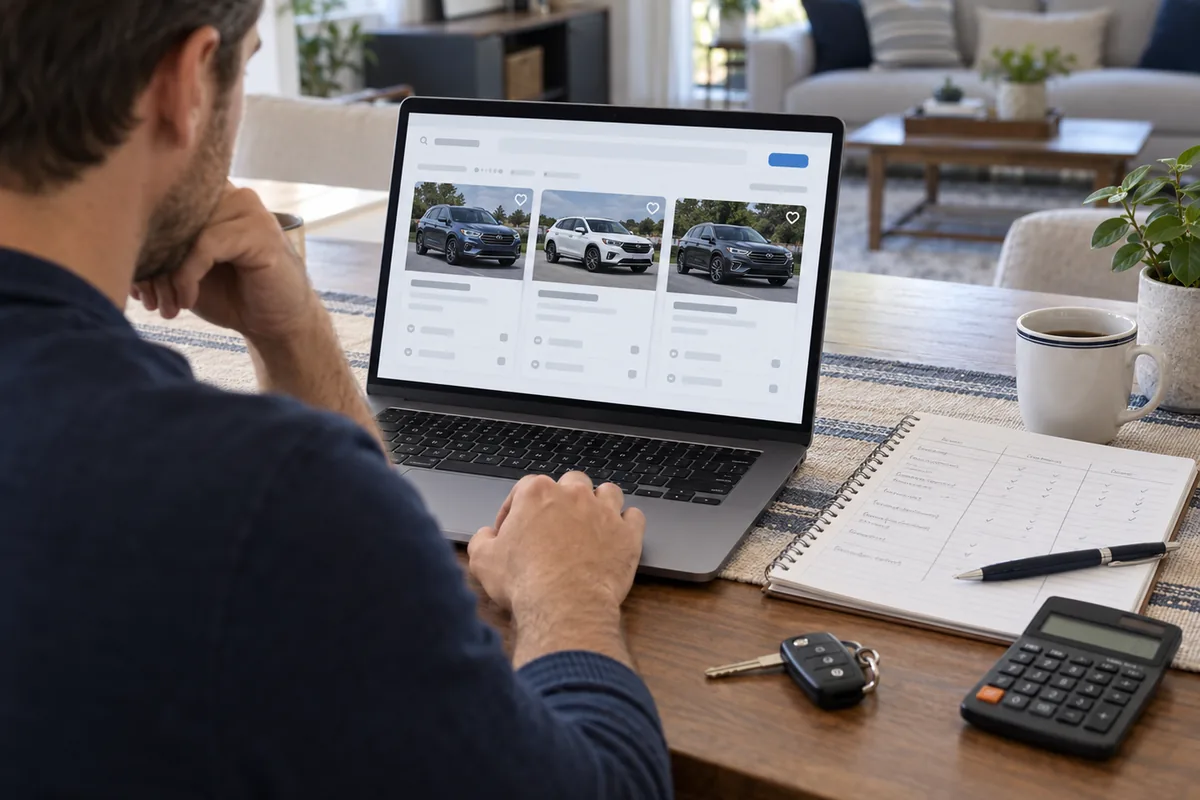
Good preparation gives you a reason for your number. It also protects you from bargaining hard for the wrong car.
Match comparable vehicles correctly
Start with three to six vehicles that are genuinely comparable. Match as many of these factors as possible:
- Model year and generation
- Make, model, trim, and body style
- Engine, drivetrain, and major factory equipment
- Mileage range
- Clean, rebuilt, salvage, flood, or other title status
- Accident and ownership history
- Condition and documented maintenance
- Dealer versus private-party sale
- Local or realistically accessible market
Do not compare a base front-wheel-drive model with a loaded all-wheel-drive trim and call the price difference negotiable. Do not compare a clean-title car with a rebuilt-title vehicle without accounting for the title brand. Asking prices are useful evidence, but they are not confirmed transaction prices.
Save screenshots or links with the date, VIN or stock number, mileage, and listed equipment. Listings can change while you negotiate.
Check the VIN and ownership history
Match the VIN on the dashboard, door label, title or dealer paperwork, history report, and inspection order. Review Carvul’s vehicle history report guide before treating a report as a clean bill of health.
An NMVTIS-based report can provide title, brand, odometer, and certain theft or salvage information. AAMVA explains what consumers can obtain through approved NMVTIS data providers. It is one evidence source, not a substitute for inspecting the vehicle.
Mileage deserves a separate reasonableness check. NHTSA recommends comparing the title mileage with the odometer, maintenance records, inspection records, and service stickers when screening for possible odometer fraud. A discrepancy is a verification problem, not merely a bargaining point.
Use Carvul’s questions to ask before buying to clarify ownership, service history, accidents, existing warranties, liens, and why the vehicle is being sold.
Set three numbers before you negotiate
Write down three numbers privately:
- Opening offer: A credible first number supported by the market and condition.
- Acceptable ceiling: The highest complete purchase total you would accept for this vehicle.
- Walk-away number: The point where another car, postponing the purchase, or keeping your current vehicle is the better decision.
Your ceiling should account for the written out-the-door price, immediate repairs, insurance, and the financing cost you are willing to accept. Do not reveal the ceiling just because a salesperson asks for your target monthly payment.
Get a Written Out-the-Door Quote

The out-the-door, or OTD, price is the amount required to complete the purchase before financing costs. The Federal Trade Commission advises used-car shoppers to ask dealers for written OTD prices before visiting. According to the FTC’s used-car dealer guidance, those quotes help confirm that advertised prices and discounts apply, that the vehicle is present, and that add-ons have not appeared unexpectedly.
What the quote should list
Ask the dealer to identify the vehicle by VIN or stock number and show:
- Advertised price
- Negotiated selling price
- Dealer fees, each on its own line
- Optional products and add-ons
- Sales or use tax
- Title and registration charges
- Trade-in allowance and payoff, if applicable
- Cash down payment
- Amount financed, APR, and term if financing is included
- Final OTD total
“Plus tax and fees” is not an itemized quote. If a dealer will discuss only monthly payment, return to the selling price and complete item list.
Compare the same fields across sellers
Use the worksheet later in this guide. Compare one row at a time, not just the headline price. A $500 lower listing can lose its advantage when one dealer includes $1,500 of products that the other does not.
State disclosure and fee rules vary. Asking for a written quote is prudent even where a seller is not required to produce the exact remote format you prefer. If a charge is described as a government fee, verify it with the state motor vehicle or tax agency.
Use the Inspection to Negotiate the Used-Car Price

An independent pre-purchase inspection can turn vague concern into useful evidence. It can also show that the car is reasonably consistent with its price.
Obtain an independent pre-purchase inspection
Choose a qualified repair facility or technician who is independent of the seller. The inspection should address the vehicle’s current condition, warning lights, diagnostic findings, tires, brakes, leaks, structural clues, road-test behavior, and model-relevant concerns. It does not guarantee that nothing will fail later.
The FTC advises buyers to get an independent inspection even when a dealer says the car was already inspected. It also notes that a buyer who proceeds may use estimated repair costs to negotiate. Start with Carvul’s used-car inspection checklist to prepare for the appointment.
Separate confirmed repairs from uncertainty
Request written findings and estimates where practical. Sort them into four groups:
| Finding | Negotiation treatment |
|---|---|
| Safety defect or active major fault | Require a credible repair plan or consider walking away |
| Near-term wear with a documented estimate | Use as evidence for a price adjustment |
| Routine maintenance already expected for age/mileage | Consider in ownership budget; do not automatically demand a full deduction |
| Speculative future failure | Investigate further; do not present it as a confirmed repair |
A worn set of tires with measured tread depth and a written replacement quote is stronger evidence than “the tires look old.” An oil change due soon is real, but it may already be normal ownership maintenance rather than a reason to reduce the price dollar for dollar.
Decide whether to negotiate or leave
Some findings should change the question from “How low can I get the price?” to “Should I buy this vehicle at all?” Unresolved title problems, VIN inconsistencies, suspected flood or odometer fraud, unsafe structural repairs, and a seller who blocks independent verification can make the risk difficult to price.
Do not let money already spent on an inspection force the purchase. That cost bought information, including permission to walk away.
Make the Offer and Manage the Counteroffer
Your offer should be short enough to understand and specific enough to evaluate.
Present an evidence-based offer
Identify the exact vehicle and state your number. Briefly support it with the strongest facts: closely matched listings, documented condition differences, and written repair estimates.
For example:
“I am ready to buy this VIN if the final terms match. The closest comparable vehicles I found are listed between $17,800 and $18,300, and the inspection documented tires and front brakes due soon. My offer is $17,500 selling price, subject to an itemized written out-the-door quote with no optional products.”
This is a proposal, not a claim that the seller owes you a discount. Avoid fake competing offers, invented defects, or an opening number so disconnected from the evidence that the conversation stops.
Ask for every revision in writing
When the seller counters, ask for the updated selling price and OTD breakdown. Make sure a price reduction was not offset by a new fee, removed trade-in credit, longer loan term, or added product.
Read the FTC Buyers Guide and the purchase paperwork together. The FTC notes that the Buyers Guide tells you whether the vehicle is sold “as is” or with a warranty and advises buyers to get promises in writing. A verbal promise to fix an item later is not the same as a repair commitment in the signed documents.
Pause instead of negotiating against yourself
After making a supported offer, let the seller respond. Do not increase it repeatedly just to fill silence. A higher counteroffer should correspond to something you value: a lower fee, completed repair, included warranty, better financing, or evidence that your comparison missed an important difference.
If you are negotiating by email, keep the initial task narrow: confirm the exact vehicle and obtain the itemized quote. Detailed message sequences belong in the separate email-negotiation guide planned for this cluster.
Keep Price, Financing, Trade-In, and Add-Ons Separate

One conversation may contain four transactions. Keep a written record of each one.
Negotiate vehicle price before monthly payment
A monthly payment can fall when the term gets longer even though the loan costs more. Compare:
- Selling price
- Cash down payment
- Amount financed
- APR
- Loan term
- Finance charge
- Total of payments
- Optional products included in the loan
The CFPB explains that a shorter loan generally reduces total loan cost while a longer term may reduce the payment but increase total interest and extend negative-equity risk. Get preapprovals and compare the dealer’s financing on the same assumptions. Carvul’s guide to credit-union and dealer auto-loan offers provides a deeper loan-comparison process.
Dealer-arranged financing may still be competitive, but it is not the only option. The CFPB says buyers can negotiate the interest rate and explains that the rate presented by a dealer can be above the lender’s buy rate. Ask whether the dealer can improve the APR, then compare the revised offer with your outside approval.
Compare loan offers apples to apples
Two loan quotes are comparable only when the amount financed, term, down payment, and included products match. If one offer finances a service contract or negative equity and the other does not, the monthly payments do not answer which lender is cheaper.
Before taking the car, confirm that financing is final. The CFPB warns that in a conditional or “spot delivery,” a buyer may be asked to return and accept a higher rate, longer term, larger down payment, or a combination. Read its guidance on conditional auto financing and get copies of everything you sign.
Negotiate the trade-in separately
Ask your lender for the payoff amount on your current loan; it may differ from the balance shown on a statement. Obtain multiple trade-in or purchase quotes. Then compare the allowance with the payoff before combining it with the replacement vehicle.
If the payoff is greater than the trade-in value, the difference is negative equity. A dealer may roll that amount into the new financing, which increases the amount borrowed and usually the interest paid. The FTC’s negative-equity guidance recommends understanding how the amount appears in the down payment and amount-financed disclosures before signing.
Keep the math visible:
Trade-in equity = trade-in allowance - current loan payoff
A negative result does not disappear because the dealer says it will “pay off” the old loan. It must be paid by someone, covered by cash, or included in another part of the deal.
Treat optional products as separate decisions
Service contracts, GAP products, wheel-and-tire coverage, theft products, coatings, and other add-ons can increase the amount financed. For each item, ask:
- Is it optional?
- What is the cash price?
- What does it cover and exclude?
- Who provides it?
- Can it be canceled, and how is any refund calculated?
- Does declining it change the advertised vehicle price or financing offer?
Do not accept a product merely because its monthly effect sounds small. Multiply the complete payment difference across the loan term and review the actual contract.
Dealership Versus Private-Seller Negotiation
The evidence-based method works in both settings, but the transaction is different.
| Factor | Dealership | Private seller |
|---|---|---|
| Price document | Request an itemized OTD quote | Agree on vehicle price and identify transfer costs separately |
| Financing | May offer dealer-arranged financing | Buyer usually arranges funds independently |
| Trade-in | Can be mixed into the deal | Usually a separate sale or no trade-in |
| Core paperwork | FTC Buyers Guide applies to covered dealers | Verify seller identity, title, lien release, and state transfer requirements |
| Main leverage | Comparable inventory, listing age, inspection, fees, add-ons | Comparable listings, condition, inspection, service history, seller timing |
| Main risk | Payment-focused negotiation or added charges | Ownership, lien, payment, title, and personal-safety risk |
At a dealership, negotiate against the written OTD structure. With a private seller, first establish that the person can legally transfer the car and that the title, VIN, lien status, and identification agree. Use Carvul’s private-party used-car buying guide for the transaction-safety steps.
Keep the private discussion respectful. Ask how the seller arrived at the price, present your evidence, and make a clear offer. Do not use a real mechanical or title concern merely as theater; verify it. Detailed private-seller scripts and workflows are reserved for the cluster’s dedicated supporting article.
Paying cash also deserves a narrow treatment. Cash may simplify a private sale, but at a dealership it does not automatically produce a lower price because financing can be part of the dealer’s economics. Compare the complete cash deal with the complete financed deal and do not give up a good preapproval without measuring the total cost. A separate cluster article will cover the cash-specific sequence in depth.
Practical Used-Car Negotiation Examples
The figures below are hypothetical teaching examples, not market-price predictions.
Dealer example: compare controllable totals
| Item | Dealer A | Dealer B |
|---|---|---|
| Advertised price | $20,800 | $21,300 |
| Dealer-controlled fees | $995 | $350 |
| Optional add-ons | $1,500 | $0 |
| Pre-tax controllable subtotal | $23,295 | $21,650 |
| Government taxes, title, registration | Enter exact quote | Enter exact quote |
Dealer A advertises the lower price, but its pre-tax controllable subtotal is $1,645 higher. This does not automatically make Dealer B the winner: verify that both vehicles are genuinely comparable and add the exact state charges. It does show why listing price alone is an incomplete negotiation target.
A useful counter to Dealer A would address the products and fee lines directly: “I will consider the vehicle at a $20,800 selling price without the $1,500 optional package, subject to a complete written OTD quote.” If the dealer says the package is mandatory at that store, compare the resulting total rather than debating its label.
Inspection example: turn findings into an offer
Assume:
- Asking price: $18,500
- Closely matched local listings: $17,800-$18,300
- Written tire estimate: $800
- Written front-brake estimate: $500
The buyer should not simply calculate $18,500 minus $1,300 and declare $17,200 the only fair price. The comparable range may already reflect age and mileage, the listed cars may differ in condition, and not every maintenance item is an unexpected defect.
A stronger approach is: “The car is priced above the closest comparable listings, and the inspection documented $1,300 in near-term tire and brake work. Based on those items, I can offer $17,400.” The seller can accept, counter, repair the items, or decline. The buyer then evaluates the revised total against the ceiling.
Financing example: same principal, different APR
Assume a fixed-rate loan of $20,000 for 60 months with no additional fees or products:
| APR | Monthly payment | Total of 60 payments | Finance charge |
|---|---|---|---|
| 7.00% | $396.02 | $23,761.44 | $3,761.44 |
| 9.00% | $415.17 | $24,910.03 | $4,910.03 |
Under these assumptions, the 9% loan costs approximately $1,148.59 more over 60 payments. Actual lender disclosures, payment timing, rounding, fees, and contract terms control. The lesson is to negotiate and compare APR and total loan cost, not only the $19.15 monthly difference.
Out-the-Door Price Comparison Worksheet
Complete one column for each exact VIN. Ask the seller to correct incomplete or inconsistent fields in writing. Government charges should be verified through the relevant state agency; dealer-controlled charges and optional products should be evaluated separately.
| Field | Offer A | Offer B | Offer C |
|---|---|---|---|
| Year/make/model/trim/VIN | |||
| Mileage and title status | |||
| Advertised price | |||
| Negotiated selling price | |||
| Dealer-controlled fees | |||
| Optional add-ons | |||
| Taxes | |||
| Title and registration | |||
| Written OTD total | |||
| Trade-in allowance | |||
| Trade-in payoff | |||
| Negative equity rolled in | |||
| Cash down | |||
| Amount financed | |||
| APR and term | |||
| Finance charge | |||
| Total of payments | |||
| Inspection findings | |||
| Immediate repair estimate | |||
| Final decision | Buy / Negotiate / Walk | Buy / Negotiate / Walk | Buy / Negotiate / Walk |
Keep purchase price and loan cost distinct. The OTD price measures the purchase before financing cost; the total of payments shows what the financing requires over time. A trade-in or down payment can reduce the amount financed without proving that the underlying vehicle price is competitive.
Know When to Buy, Negotiate, or Walk Away

The goal is not to “win” every line. It is to make a sound purchase.
Buy
Buying may make sense when:
- The VIN, title, history, condition, and seller representations agree.
- The inspection does not reveal unacceptable risk.
- The written OTD price fits your ceiling.
- Financing, trade-in, and optional products are understandable and acceptable separately.
- The final contract matches the agreement.
Accepting a fair price is not a negotiation failure. Losing a sound vehicle over an unsupported demand can be as unhelpful as overpaying.
Negotiate
Continue negotiating when a documented, fixable gap remains. Examples include a price above closely matched listings, near-term repairs, an optional product you do not want, or a financing offer that the dealer may improve.
Tie each request to a specific change. Ask for a lower selling price, removal of an add-on, repair before delivery, or improved APR. Then request the revised terms in writing.
Walk away
Leave when the risk cannot be responsibly priced or the deal no longer fits your limit. Warning signs include:
- VIN, title, mileage, lien, or seller identity discrepancies
- Refusal to allow a reasonable independent inspection
- Suspected flood, odometer, or unsafe structural damage
- Pressure to sign incomplete paperwork
- Undisclosed or unexplained mandatory products
- A deal that changes after agreement
- Financing that is not final when you are told it is
- A payment that fits only because the loan became much longer
- A total above your written walk-away number
Review Carvul’s guide to used-car red flags before committing money. If you feel rushed, stop. Another vehicle is usually easier to find than a clean exit from a bad contract.
Final Used-Car Negotiation Checklist
Before signing, confirm:
- [ ] The comparable vehicles match year, trim, mileage, drivetrain, title, and condition.
- [ ] The VIN is consistent across the car, title, reports, inspection, and contract.
- [ ] The vehicle history and odometer evidence have been reviewed.
- [ ] An independent inspection has been completed or knowingly declined for a documented reason.
- [ ] Repair findings are written and separated from speculation.
- [ ] The seller provided an itemized price or OTD quote.
- [ ] Government charges were distinguished from dealer-controlled charges.
- [ ] Optional products were accepted or declined individually.
- [ ] Financing was compared using the same amount and term.
- [ ] Trade-in value and payoff were handled separately.
- [ ] Any negative equity is visible in the contract math.
- [ ] Your acceptable ceiling and walk-away number are written down.
- [ ] Every promise appears in the signed documents.
- [ ] The final contract matches the negotiated terms and contains no blank spaces.
- [ ] Financing is final before you take the vehicle home.
Frequently Asked Questions
How much can you negotiate on a used car?
There is no reliable fixed percentage. Negotiability depends on whether the asking price matches comparable vehicles, the car’s condition and title history, local supply, listing age, seller motivation, and the complete deal structure. Build an offer from evidence rather than subtracting an arbitrary amount. A dedicated supporting guide will examine realistic negotiation ranges without promising a standard dealer concession.
Should you negotiate a used-car price by email first?
Email can help you confirm the exact VIN, advertised conditions, and itemized OTD price before traveling. Keep the first request simple and compare the same fields across sellers. A written exchange is useful evidence, but inspect the vehicle and review the final contract before paying. Do not send sensitive financial information through an unverified contact channel.
Does paying cash help you negotiate?
Not automatically. Cash can simplify a private transaction, but a dealership may earn compensation from arranging financing and may not prefer a cash deal. Negotiate the vehicle and OTD price, then compare the complete cash option with any financed offer, including rebates, APR, fees, and total payments. Do not assume the payment method creates a discount.
Can an inspection help lower the price?
Yes, when it produces relevant, documented findings. A written estimate for necessary near-term repairs can support a lower offer or a request that the seller complete the work. It does not require the seller to accept a dollar-for-dollar deduction, and serious title, structural, or safety concerns may justify walking away instead of negotiating.
Which dealer fees are negotiable?
Optional products and dealer-controlled charges may be negotiable or removable, while taxes, title, and registration set by government generally are not. Fee labels and state rules vary. Ask who receives each charge, what it covers, whether it is required by law, and whether the transaction is available without it. Compare the final OTD total, not the label alone.
Should you negotiate a trade-in separately?
Yes. First establish the replacement vehicle’s price without the trade-in. Obtain the old loan’s payoff amount and independent trade-in quotes, then negotiate the allowance separately. This makes it easier to see negative equity and prevents a higher trade-in figure from hiding a higher purchase price or less favorable financing.
Can you negotiate a no-haggle used-car price?
A no-haggle seller may hold the vehicle price firm, but you should still verify the market value, inspection results, fees, optional products, trade-in, and financing. Ask whether the seller can remove an add-on, complete a repair, or improve financing. If the complete deal is not competitive, the practical negotiation tool is choosing another vehicle.
When should you walk away from a used-car deal?
Walk away when ownership or VIN information does not match, the seller blocks reasonable verification, the inspection shows unacceptable risk, financing is unclear, the contract changes, unexplained products remain, or the total exceeds your limit. A lower price does not cure every problem. Protecting your ability to leave is one of your strongest negotiating tools.
Bottom Line
The strongest used-car negotiation is built before the first offer. Match comparable vehicles carefully, verify the VIN and condition, get the full price in writing, and decide what the car is worth to you. Keep the selling price visible while evaluating financing, trade-in, and add-ons separately.
If the seller can support the price and the complete deal fits your limit, buying can be the right result. If documented gaps remain, negotiate them directly. If the paperwork, condition, or financing cannot be trusted, walk away.