
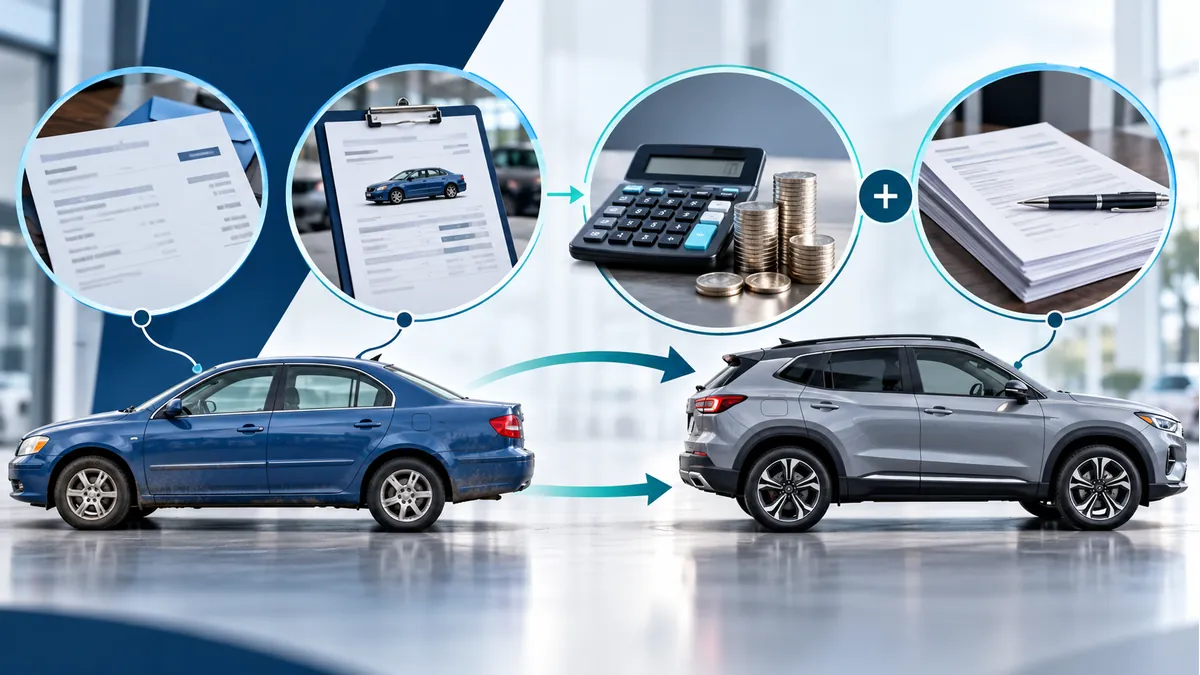
Trading in a car with negative equity means the current loan payoff is greater than the dealer’s trade allowance. The difference must be paid in cash or included in the replacement transaction when the new lender permits it. A dealer may say it will “pay off” your trade, but the old debt does not disappear unless the numbers show that it was covered.
Before signing, obtain a dated payoff quote, collect multiple values, calculate the shortfall, and trace that exact amount through the buyer’s order and retail installment contract. Judge the replacement by its total amount financed, not by a monthly payment alone.
Table of Contents
- Calculate negative equity
- Verify the payoff
- Establish a fair trade value
- Separate the transactions
- Find rolled debt in the paperwork
- Test cash and vehicle alternatives
- Compare financing offers
- Complete a delivery-day audit
1. Calculate the Negative Equity Before Visiting
Start with two current figures:
Lender payoff quote – supported trade value = estimated negative equity
| Current payoff | Trade allowance | Estimated position |
|---|---|---|
| $15,000 | $17,000 | $2,000 positive equity |
| $17,000 | $17,000 | Approximately even |
| $21,000 | $17,000 | $4,000 negative equity |
The principal balance in an app may not equal the payoff. The trade value can also change after physical inspection. Date both figures and leave room for a small adjustment.
Do not subtract the trade allowance from the replacement price and call the result a discount. The allowance belongs to an asset you already own, while the payoff belongs to its loan.
2. Get a Payoff Quote From the Lender
Ask the current lender for a 10-day or other dated payoff and its payment instructions. Confirm whether the quote includes accrued interest, fees, or late amounts. If the account has a co-borrower, title issue, or electronic lien, ask what is required for release.
Verify dealer payoff information against the lender’s quote before signing. After the trade, monitor the old account until the payoff posts. Continue following the existing payment obligation unless the lender confirms otherwise; a dealer’s promise does not by itself close the loan.
If a scheduled payment occurs during the payoff process, ask the lender how any overpayment is handled. Keep copies of the quote, dealer agreement, and confirmation.
3. Establish a Defensible Trade Value
Get more than one offer. A written dealer bid, an online purchase offer with conditions, and comparable local listings can reveal a realistic range. Adjust for mileage, trim, accident history, warning lights, tires, cosmetic damage, and needed service.
Clean the car and gather keys and records, but do not spend heavily on repairs without knowing whether the added value exceeds the cost. Disclose material problems honestly.
A dealer may increase the trade allowance while also increasing the replacement price or reducing a discount. Compare the net transaction, not the trade number in isolation.
Private sale may produce more, but timing is harder
A private buyer may pay more than a dealer, reducing the shortfall. However, the lender’s lien must be satisfied before clear title transfer. Coordinate payment and title release with the lender, and use secure payment methods. Carvul’s selling a car with a loan guide covers those logistics.
4. Negotiate Four Decisions Separately
Keep these decisions separate until each number is clear:
- Replacement vehicle price
- Current vehicle trade allowance
- Current loan payoff and resulting equity
- New financing
Combining them too early makes it difficult to see whether a concession in one area was recovered elsewhere. Ask for the out-the-door replacement price without the trade, then add the trade calculation.
Decline discussion framed only around “difference” or “payment.” A $550 payment could represent a well-priced vehicle on a short loan or an overpriced vehicle with old debt stretched over 84 months.
5. Trace Rolled Negative Equity Through the Contract
Use a worksheet before reviewing the formal disclosure:
| Replacement transaction | Amount |
|---|---|
| Agreed replacement price | $28,000 |
| Taxes and required fees | +$2,200 |
| Current payoff | +$20,000 |
| Trade allowance | -$15,000 |
| Cash down | -$2,000 |
| Estimated amount financed | $33,200 |
Here, the trade has $5,000 of negative equity. The $2,000 cash reduces the combined transaction but does not erase the full shortfall. The buyer finances approximately $3,000 more than the replacement’s out-the-door amount.
Actual forms vary by state and dealer system. Ask the finance manager to identify where the payoff, allowance, and shortfall appear. The final Truth in Lending disclosure should show the amount financed, APR, finance charge, payment schedule, and total of payments.
Never sign a blank form or a document with figures you cannot reconcile. Take a photo or copy of the completed worksheet and signed documents.
6. Understand What “We Pay Off Your Trade” Means
Dealers routinely send payoff funds to existing lenders as part of a trade. Advertising language can make this sound like the dealer absorbs the debt. Usually, the trade allowance is credited and any remaining shortfall is part of the money due or new financing.
Ask a direct question: “How much negative equity is included in the amount financed?” Request the answer in dollars. If the salesperson says the debt was “covered by discounts,” verify the selling price, rebates, and financing lines.
Rebates can reduce the transaction, but they are not free dealer money and may have eligibility rules. A rebate used against negative equity is no longer reducing the replacement car’s effective price for you.
7. Test Cash, Cheaper-Car, and Waiting Scenarios
Pay some or all of the gap in cash
Cash can prevent old debt from entering the new loan. Preserve an emergency reserve and do not use a high-cost cash advance without comparing the full cost.
Choose a less expensive replacement
A lower price can reduce the combined balance, but lenders still apply LTV and underwriting limits. Do not buy an unreliable car merely to create room for negative equity.
Wait and reduce the current balance
If the current car remains reliable, keeping it may allow scheduled and extra principal payments to narrow the gap. Compare the upside-down car loan options guide before assuming a trade is necessary.
Sell privately
A higher sale value may reduce the gap, but title, payment security, tax, transportation, and timing must be managed.
8. Compare New Financing Without Hiding the Old Debt
Get preapproved when possible and disclose the trade situation accurately. The new lender decides whether it will finance the combined amount. Approval does not prove the transaction is affordable or the vehicle is fairly priced.
Compare:
- Replacement out-the-door price
- Negative equity included
- Cash down
- Amount financed
- APR
- Term
- Monthly payment
- Finance charge
- Total of payments
Longer terms can absorb rolled debt into a lower payment while increasing interest and the time spent upside down. Carvul’s used-car loan preapproval guide and dealer financing vs credit union guide help structure the comparison.
Do not add optional products automatically
Service contracts, maintenance plans, theft products, and appearance packages raise the balance. Ask whether each is optional and request its cash price. Adding products to a loan already carrying negative equity can deepen the gap.
9. Check Insurance and GAP Terms
Get an insurance quote for the replacement VIN before signing. The new payment plus required coverage may exceed the budget even when the dealer’s payment target appears acceptable.
GAP coverage may address a qualifying difference after a covered total loss, subject to contract limits and exclusions. It does not remove negative equity during an ordinary trade, and some contracts may limit treatment of old rolled debt or financed products.
Read Carvul’s GAP insurance on a used car guide and compare the actual agreements. GAP should not be used to justify an inflated amount financed.
10. Inspect the Replacement Vehicle
Financial urgency can distract buyers from the car itself. Verify the VIN, title status, history, mileage, equipment, recalls, and condition. Arrange an independent inspection for a used vehicle.
Use the used-car inspection checklist and vehicle-history report guide. A new loan does not solve hidden mechanical or title problems.
If the dealer says the deal must close immediately, remember that old debt becomes harder to unwind after it is attached to another vehicle.
Delivery-Day Eight-Point Check
- Match the VIN on the car, contract, insurance, and title documents.
- Confirm the replacement price matches the written quote.
- Verify the trade allowance.
- Verify the dated payoff.
- Calculate the exact negative equity.
- Confirm cash, deposits, and rebates are credited.
- Match the amount financed to your worksheet.
- Read APR, term, finance charge, payment schedule, and total of payments.
After delivery, confirm the old lender received payoff and preserve the records. Check that optional-product agreements and cancellation instructions are included.
Taxes, Rebates, and State-Specific Treatment
Some states calculate sales tax after giving credit for an eligible trade, while others use different rules or do not offer the same credit. That can affect the net advantage of trading rather than selling privately. Do not rely on a generic online calculation for a state-specific answer.
Ask the dealer to identify the taxable amount and cite the rule used. Compare it with your state motor-vehicle or revenue agency information. A tax benefit may improve the trade’s net value, but it does not change the loan payoff or erase negative equity.
Treat rebates separately too. Confirm the program, eligibility, expiration, and whether the rebate can be combined with the chosen financing. A rebate applied to old debt cannot also reduce the replacement cost in your comparison.
Remote and Online Trade-In Offers
An online offer may be useful evidence, but read its inspection conditions, mileage limits, expiration, pickup terms, and adjustment policy. Enter the VIN, trim, options, title status, damage, and loan information accurately. A preliminary estimate can fall after inspection.
Before sending documents or money, verify the company and web address independently. Do not provide a one-time security code or online-banking password to a buyer. Confirm payoff wiring instructions directly with the lender through a known channel.
If the replacement and trade are transported between states, identify who holds risk during shipping, when ownership changes, and how temporary registration works. Keep insurance active until the transfer and lender payoff are confirmed.
Trading In a Car With Negative Equity: Warning Signs
Slow down when the dealer refuses to provide an itemized quote, focuses exclusively on payment, changes the trade value after discussing financing, or says old debt was “forgiven” without showing how. Other warning signs include blank forms, undisclosed add-ons, pressure to misstate income, and a request to sign a second contract without explaining every change.
Never sign information you know is false. If the transaction depends on inaccurate income, residence, down payment, or vehicle-use information, leave and seek another lender or dealer.
The replacement decision should remain understandable on one worksheet. If trained staff cannot explain the payoff, allowance, cash, price, and amount financed in plain language, the buyer should not be expected to accept the deal.
Recheck the Numbers After a Payoff Delay
Payoff quotes expire because interest continues to accrue. If delivery is delayed or the dealer prepares a new contract, obtain an updated quote instead of reusing the old figure. Even a modest difference should be reconciled so the former lender receives the correct amount and the contract reflects the actual obligation.
Ask how any payoff shortage or overpayment will be handled. Do not give a dealer open-ended permission to add an unexplained amount later. If the old lender returns an overpayment, confirm who receives it and retain the statement.
After the transaction, check the former account until it shows paid or closed as appropriate. If a scheduled payment is due while payoff is pending, contact the lender directly. Protecting the payment history is more important than assuming the dealer has already completed its process.
When Trading May Still Be Necessary
Waiting is not always practical. A vehicle may be unsafe, unreliable, inaccessible for a disability, too small for a changed household, or unsuitable for required work. The objective then is to limit harm, not pretend the gap does not exist.
Choose the least expensive reliable replacement that meets the need. Bring affordable cash if appropriate, remove optional products, avoid an unnecessarily long term, and compare multiple financing sources. A smaller, transparent shortfall is safer than a payment engineered around hidden debt.
Frequently Asked Questions
Can you trade in a car you still owe money on?
Yes. The existing lender must be paid. Positive equity becomes a credit; negative equity must be paid or included in the new transaction when permitted.
Will a dealer pay off an upside-down car?
The dealer can transmit the payoff, but the shortfall is normally funded by your cash, rebates, or the new loan. Trace it in the paperwork.
How much negative equity can be rolled into a new loan?
There is no universal amount. The new lender applies its underwriting and LTV limits based on the borrower and replacement vehicle.
Is it better to repair the car or trade it?
Compare the repair and continued ownership cost with the complete replacement transaction, including taxes, fees, interest, and rolled debt.
Does a down payment cancel negative equity?
Cash reduces the combined balance. It cancels the shortfall only to the extent that the cash equals the gap, after all other transaction costs are considered.
Bottom Line
Trading in a car with negative equity can be completed, but the old debt must remain visible. Get the payoff, verify the trade value, negotiate the replacement separately, and reconcile the amount financed before signing.
If the structure requires a long term, high APR, expensive products, or an unaffordable payment, compare keeping the current vehicle or choosing a cheaper replacement. Use the Carvul car down payment guide to plan cash without draining the reserve needed after purchase.
Sources
- Federal Trade Commission: Financing or Leasing a Car
- Consumer Financial Protection Bureau: Auto Loans
Educational information only, not individualized financial or legal advice. Lender requirements, contract forms, title procedures, and state laws vary.