
Buying a rebuilt title car calls for a different test than buying a conventional used car: you need to establish what happened, what was repaired, whether the current title and registration are valid for your plans, and whether an independent professional agrees the car is fit for the intended use. A rebuilt label records a state process after salvage history; it does not guarantee perfect repairs or future reliability. An attractive asking price is useful only after you account for unresolved risk, coverage, financing, and eventual resale.
Quick answer: Buying a rebuilt title car starts with its title and VIN history. Compare pre-repair photos with invoices, and pay for an independent inspection tailored to the known damage. Ask your insurer, lender, and destination DMV about the exact car before a nonrefundable deposit. Walk away if the seller blocks evidence or inspection.
This guide is about evaluating a repaired car offered for normal use, not buying an unrepaired salvage project. For the terminology, see salvage title vs rebuilt title. If the vehicle still has a salvage document and needs repair, start with buying a salvage title car instead. State terms and requirements vary; nothing here determines the legal status of an individual VIN.
Buying a Rebuilt Title Car: 11 Critical Checks
1. Identify the title you will actually receive
Ask to see the current state-issued document, not a photo of a past title or a seller’s promise that a replacement is coming. Match its VIN to the car and the sale paperwork. Read the full brand wording and ask which state issued it. A listing description such as “fully repaired” or “rebuilt” is not a state title determination. If the document is still a salvage certificate, the buying question is different: the car may not yet be ready for ordinary registration under the rules that apply to you.
Ask whether the seller has authority to transfer the title and whether any lien needs release. If a title is pending, decide whether you are willing to bear that uncertainty at all. Do not substitute a screenshot from a vehicle-history app for the ownership document. Before paying, contact the relevant DMV about any brand or transfer requirement you do not understand.
2. Reconstruct the original loss
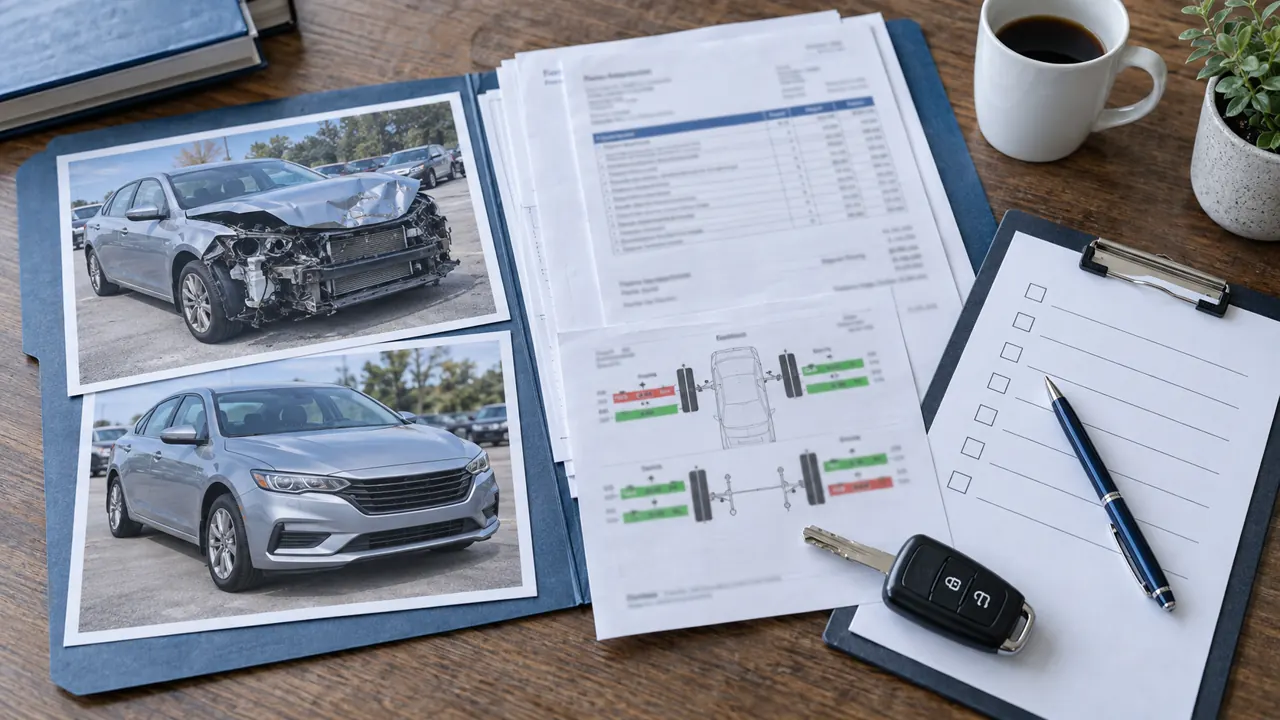
Request pre-repair photographs, insurer or auction condition documents if available, and a candid explanation of the damage. The loss type changes what an inspector should examine. A front impact may require attention to restraint systems, structural alignment, cooling and driver-assistance sensors. Flood exposure calls for careful electrical and corrosion assessment. Theft recovery can involve missing components or identity questions. Hail damage raises a different set of concerns. Do not apply one generic checklist to every rebuilt vehicle.
If the seller says the damage was “only cosmetic,” compare that claim with dated photos and repair invoices. Photos may be incomplete or taken after preliminary work, so ask what is not pictured. A credible seller may lack a perfect archive, but the buyer then needs to treat missing evidence as uncertainty rather than proof that the damage was minor.
3. Audit the repair trail
Look for dated invoices that identify labor, parts, and the vehicle. Ask who performed the work, whether parts were new, used, or remanufactured, and which post-repair tests were performed. A receipt for a bumper does not establish that the underlying structure was measured, and a freshly painted panel does not demonstrate that a safety sensor was calibrated. Tie each major damaged area in the pre-repair photos to a corresponding repair record or a written explanation.
Request alignment measurements, diagnostic scans, airbag or restraint-system documentation, and calibration records where relevant. Do not assume every repair requires every document; the point is to connect evidence to the particular event. If the seller cannot explain a major discrepancy, budget for a specialist assessment or stop the deal. The cost of uncertainty is rarely captured by a listing price.
4. Check brand history across states
Order an NMVTIS vehicle history report through an approved consumer provider. Review current state of title, last title date, brand history, and reported loss indicators. Compare them with the document in hand. An earlier salvage or flood brand remains relevant even if a later title uses a different label. A move between states is not proof of fraud, but unexplained changes require more paperwork.
The federal system does not provide detailed repair history and may receive state data on different schedules. Use the narrower NICB VINCheck as an additional participating-insurer screen, not a substitute for NMVTIS or state records. Our salvage VIN check guide gives the full sequence. A clean-looking online result cannot certify the car’s condition.
5. Verify what the state examination did and did not cover
Ask for documentation of the process that led to the current brand. The New York DMV salvage examination is part of its auto-theft-prevention program before certain vehicles can receive a new title or registration. California’s revived-salvage process has its own requirements. Neither state example supplies a universal national inspection standard.
An issued rebuilt or revived-salvage document is meaningful, but it is not a warranty that every mechanical component was repaired well. Ask the issuing agency what its process verified, then arrange a separate inspection for what it did not. If you plan to register the car in a different state, contact that state’s DMV before buying. A car legally registered elsewhere is not automatically free of paperwork questions at your destination.
6. Hire an independent, damage-specific inspector
The FTC advises an independent vehicle inspection even when a history report exists. Choose a professional who does not work for the seller and share the known loss and repair documents. Ask for written findings tied to the VIN and an estimate for needed work. If the history suggests major collision repairs, you may need a qualified collision specialist as well as a general mechanic. If electrical or high-voltage systems were involved, ask for a technician with the appropriate expertise.
Give the inspector permission to say “cannot determine” where access or records are insufficient. A useful report distinguishes observed defects, evidence of prior repairs, and items that need specialized testing. Do not let a seller’s claimed “state inspection” replace your own examination. If the seller refuses reasonable access for an independent inspection, that is a strong reason to leave.
7. Test-drive only when lawful and sensible
Before driving, confirm that the car is registered or otherwise lawfully permitted for the proposed test under the applicable state rules and that coverage arrangements are clear. Do not assume a salvage certificate itself authorizes a normal road test. For a properly road-registered vehicle, drive a route that allows low-speed turns, normal acceleration, braking, and highway behavior where safe. Note pulling, vibration, warning lights, unusual sounds, or inconsistent driver-assistance behavior.
A test drive can expose symptoms, but it cannot prove the quality of hidden structural repairs. Bring observations back to the independent inspector rather than accepting a seller’s “they all do that” explanation. Check whether the vehicle behaves similarly when cold and after warming up if practical. Avoid a rushed nighttime viewing that hides paint, panel, or water-damage clues.
8. Get an actual insurance response for the VIN
Do not assume a carrier will offer every coverage type at a price you can afford. Ask your insurer or agent to quote the specific VIN and disclose the title brand accurately. Clarify liability coverage, any requested collision or comprehensive coverage, deductibles, and documentation requirements. Ask how the insurer would handle valuation after a covered total loss. An online estimate that does not account for the brand is not a reliable final answer.
Carrier, state, vehicle and policy details can change the result. Get written terms or an explicit underwriting response before putting money at risk. The companion insurance guide for rebuilt-title buyers addresses these questions in depth. This article cannot promise approval or a particular premium.
9. Confirm financing before negotiating around a payment
If you need a loan, tell prospective lenders the exact VIN and title status before relying on a prequalification. Ask whether the vehicle is eligible collateral, what documentation is required, how the lender determines its value, and whether particular insurance coverage is mandatory. A general approval amount does not prove that this vehicle qualifies. Compare written APR, amount financed, term, and total cost, not just a monthly payment.
Be prepared to choose another car if the terms do not work. Do not fill a financing gap with an unaffordable short-term solution merely because the listing price seems lower than clean-title cars. Read can you get a loan on a rebuilt title for the lender-question checklist and Carvul’s general used-car financing guide for basic loan comparison.
10. Compare total ownership cost, not a headline discount
Price a comparable clean-title model as a reference, then adjust for the exact damage, quality of repairs, inspection findings, state fees, insurance quote, near-term maintenance, and resale uncertainty. There is no evidence-based single discount percentage that works across all rebuilt-title cars. A small upfront saving can disappear if the independent report identifies tires, suspension work, calibration, or a difficult-to-insure vehicle.
Ask for an out-the-door price in writing when buying from a dealer. The FTC’s used-car guidance also tells buyers to review the dealer’s Buyers Guide, which states whether the car is sold as-is or with a warranty. Keep any repair promises in writing. If a dealer warranty exists, read its exclusions; do not assume it covers prior-damage components. The separate rebuilt-title value guide offers a comparison worksheet without pretending a universal markdown exists.
11. Protect the transaction and plan the exit
Match the VIN and brand on the final contract, title, inspection report, and insurance paperwork. Confirm which documents the seller will deliver and when. If a state transfer step remains open, spell out how the transaction is handled if it cannot be completed. Avoid irreversible payment before identity, title, inspection and necessary coverage are resolved. State consumer protections and private-sale rules vary, so read the terms that apply to your transaction.
Finally, consider the future buyer. Keep the full repair packet, dated report, and inspection in one folder. You may need to explain the history when you sell, trade, insure, or finance the car later. You cannot guarantee what a future buyer or institution will accept, but transparent records make the vehicle easier to evaluate. If you would not be comfortable handing over the evidence you received today, that is a signal to pause now.
Evidence Worksheet for the Specific Car
| Question | Evidence to request | Stop or follow up when |
|---|---|---|
| Which title transfers? | Current state-issued document and seller authority | Title is missing, pending, or VIN differs |
| What happened? | Pre-repair photos and loss description | The story conflicts with visible damage |
| What was repaired? | Invoices, parts and post-repair tests | Major work has no traceable explanation |
| What do records show? | NMVTIS, state guidance, supplemental reports | Brands or dates conflict without resolution |
| What is the car’s condition? | Independent written inspection | Access is denied or safety issues remain |
| Can you own it as planned? | DMV, insurer and lender responses | A required service will not accept the VIN |
| Is the deal still good? | Written total-cost estimate | Savings disappear after realistic costs |
Identity and ownership must be clear first. Evaluate physical condition next. Insurance and financing matter if your purchase depends on them. Keep records dated. No online price tool can resolve missing documents or safety concerns.
A Hypothetical Offer Decision
Imagine a sedan advertised for $10,000 while similar clean-title examples list for $13,000. Those amounts are hypothetical and are not a recommended rebuilt-title discount. The seller supplies a current rebuilt title, pre-repair photos, body-shop invoices, and a state examination record. An independent inspector estimates $1,200 in immediate maintenance and asks for an additional sensor-calibration record. Your insurer provides an acceptable written quote, but your lender has not confirmed this VIN is eligible.
The buyer’s next move is not to calculate a $3,000 “profit.” The $1,200 in known work already changes the comparison; inspection fees, taxes, financing and future resale may change it further. Obtain the calibration evidence and lender answer before a deposit. If the seller cannot provide a credible explanation for the missing calibration, pause. If the lender declines and cash purchase would drain your emergency funds, leave. A rebuilt-title car can make sense for some buyers, but the decision belongs to this car and this buyer’s constraints.
Now imagine a different seller who cannot produce pre-repair photos but allows a specialized inspection and has detailed invoices. Missing photos do not automatically prove bad repairs. The uncertainty should still be disclosed to the inspector and reflected in your willingness to proceed. The goal is not to reward a perfect-looking document stack; it is to understand whether the evidence is sufficient for your risk tolerance.
Frequently Asked Questions About Buying a Rebuilt Title Car
Is buying a rebuilt title car always a bad idea?
No universal answer fits every VIN. A transparent repair history, current state title, independent findings and workable ownership costs may support a purchase for a particular buyer. Missing evidence, unresolved safety concerns or inability to register or insure the car can make another vehicle the better choice.
Does a rebuilt title prove that repairs are safe?
No. It records a state-specific status after a process that may not address every mechanical, structural or electronic concern. Ask what the state examined and commission an independent inspection suited to the known damage.
Can I insure or finance any rebuilt-title car?
Do not assume either. Carrier and lender policies differ. Disclose the exact brand and VIN, ask about the coverage or loan you actually need, and get a clear response before making a nonrefundable commitment.
Should I change the VIN or title brand in a listing to get quotes?
No. Accurate disclosure matters. A quote or loan estimate based on a clean-title assumption could fail when the real vehicle documents are reviewed. Use the actual VIN, current title and repair history.
What if the seller refuses my independent inspection?
The FTC advises inspection because history reports cannot reveal every mechanical problem. If reasonable independent access is refused, consider another car. Do not replace the inspection with a second online report.
Sources and Editorial Note
- FTC: Buying a Used Car From a Dealer: history reports, Buyers Guides, written prices and independent inspections.
- U.S. DOJ: Understanding an NMVTIS Vehicle History Report: title and brand history and the need for independent inspection.
- NICB VINCheck: participating-insurer record scope and limits.
- New York DMV salvage examination and California DMV revived salvage registration: state-specific examples only.
Sources reviewed September 18, 2026. Confirm current state, insurer and lender requirements for the individual car. This is educational information, not a guarantee of roadworthiness, insurance, financing or resale price.