
Can you get a loan on a rebuilt title? You may find a lender willing to consider a particular car, but approval is not automatic and no single rule covers every bank, credit union, dealer-arranged lender, state or VIN. The lender may evaluate title eligibility, the vehicle’s value as collateral, your credit and income, down payment, repair documents and required insurance. A general prequalification is not confirmation that this branded vehicle qualifies.
Quick answer: If you are asking can you get a loan on a rebuilt title, tell a lender the exact VIN and current rebuilt brand before relying on an estimate. Ask whether that car qualifies, how the lender will value it, how much it will finance, which coverages it requires, and when final approval is issued. Compare written APR, term and total cost before agreeing to buy.
This is U.S. consumer education, not a lender policy list or a promise of an interest rate. It does not tell you to hide the brand, use another car’s VIN, or accept expensive financing to make a deal work. If you have not yet evaluated the repaired car itself, start with buying a rebuilt title car and an independent inspection. The larger used-car financing guide covers ordinary loan-shopping basics; this page concentrates on the branded-vehicle questions.
Why the Brand Can Matter to a Lender
An auto loan is often secured by the vehicle being purchased. The Consumer Financial Protection Bureau (CFPB) explains loan-to-value, or LTV, as the loan amount divided by the car’s actual cash value. A higher LTV can increase risk for the lender and the buyer. When a vehicle has documented prior damage and a rebuilt brand, the lender may have additional questions about eligibility, collateral value and insurance. Whether it will finance the car is a lender-specific decision.
Do not translate that general explanation into a fabricated policy such as “all credit unions accept rebuilt titles” or “every lender requires 20% down.” The actual response depends on that institution and your application. What you can control is disclosure and preparation: accurate VIN, current title, repair evidence, a realistic out-the-door price and insurance confirmation. If one lender declines, ask why; do not assume every other lender has the same policy.
The title brand also affects your downside. If the car is difficult to resell or its value is lower than you assumed, you may owe more than it is worth. CFPB warns that negative equity can complicate selling or replacing a car. A low monthly payment achieved by extending the term may hide a costly loan, especially on a vehicle whose future value is uncertain. Compare total costs, not just the payment printed in an advertisement.
Can You Get a Loan on a Rebuilt Title? Seven Critical Checks
1. Verify the current document and VIN
Start with the state-issued title or equivalent current document. The VIN on it must match the physical car and every loan application. Read the brand exactly as issued; a seller’s phrase “rebuilt” may not match the actual paperwork. If the document remains a salvage certificate or transfer is pending, describe that accurately to the lender. Do not rely on a future title that has not been issued.
Check the NMVTIS title and brand history and ask the responsible state DMV about transfer or registration questions. A lender may require a title it can accept as collateral. You also need to know whether you can register and use the car where you live. No attractive rate fixes an unresolved ownership or identity problem. If you cannot verify the document, pause the entire purchase rather than continuing with financing applications.
2. Ask whether the lender accepts this vehicle
Provide the exact VIN, year, mileage, current brand, issuing state and intended purchase price. Ask a direct question: “Can your institution finance this specific rebuilt-title car as an auto loan?” Follow with any age, mileage, title-transfer or inspection requirements relevant to its process. If the first employee can only give a general answer, ask what review provides a vehicle-specific decision and whether you will receive it in writing.
Separate borrower prequalification from collateral approval. A lender could view you as creditworthy while deciding this car does not meet its auto-loan criteria. Likewise, a dealer saying “financing available” may mean only that it can submit an application, not that you have an approved offer. Do not sign a nonrefundable purchase obligation based on a generic preapproval letter that never identified the VIN or title status.
3. Understand the lender’s valuation and LTV calculation
Ask what value the lender will use for this exact car and whether it accounts for the rebuilt brand. The CFPB’s LTV explanation makes the basic math clear: amount borrowed divided by the vehicle’s value. The seller’s asking price and a clean-title guide value are not automatically the lender’s collateral value. If the lender values the car below the agreed price, the maximum loan or required cash contribution may differ from your expectation.
Ask which fees and add-ons can be included in the financed amount, and whether taxes or registration costs must be paid in cash. Get a clear breakdown. Do not respond to a value shortfall by assuming the lender made a mistake; request its explanation and reconsider the price. For a buyer-side approach to asking price, see rebuilt title car value. No universal rebuilt-title discount can replace a specific appraisal or offer.
4. Plan a down payment you can afford
A larger down payment reduces the amount financed and therefore LTV, but it also uses cash you may need for repairs and emergencies. CFPB notes that a down payment can reduce borrowing and interest over the life of a loan. It does not guarantee lender approval or a particular APR. Ask what amount, if any, changes this lender’s decision for the actual vehicle. Then test whether you can still afford the independent inspection, insurance, taxes and an early maintenance reserve.
Do not stretch to an unaffordable cash contribution merely to force approval. If a rebuilt car is only affordable when you empty savings and accept uncertain repair risk, another vehicle may be a better choice. Put the full purchase budget on paper before negotiating. The decision is not “Can I make this month’s payment?” but “Can I absorb the all-in cost if the car needs more work than expected?”
5. Confirm required insurance with a carrier
Ask the lender which liability, collision or comprehensive coverages and deductible limits it requires for the loan. Then give an insurer the same VIN and rebuilt-title disclosure. Verify that the insurer will offer the needed coverage under the proposed policy. A liability-only estimate does not answer a lender’s physical-damage requirement. A quote that assumed a clean title may be revised when underwriting sees the actual document.
Read can you insure a rebuilt title car for a coverage worksheet. If the insurer cannot provide the coverage the lender requires, the financing plan may not work even if your credit qualifies. Confirm when the insurance policy can take effect and what proof the lender needs before funding. Keep the agent’s answer and the lender’s instructions together so they can be compared directly.
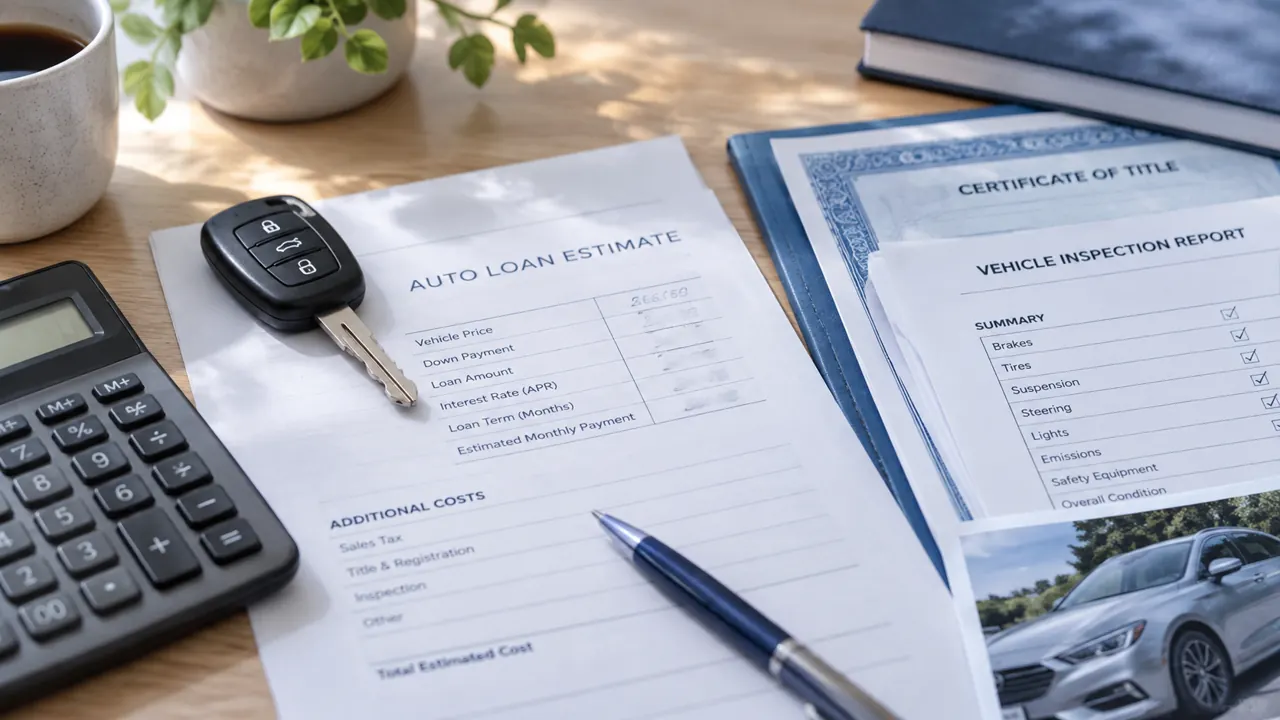
6. Compare written loan offers beyond monthly payment
The CFPB says to compare APR, interest rate, amount financed and loan term. Record fees, total of payments and any required products as well. A longer term can lower the monthly payment while increasing overall interest and the period during which you may owe more than the car is worth. Request offers that describe the same car and comparable down payments so the comparison is meaningful.
Avoid assuming that dealer-arranged financing is automatically best or worst. Compare it with offers from banks or credit unions that actually consider the VIN, if available to you. A quoted APR may change before final approval depending on the borrower and car; note which figures are preliminary. Never add an optional product without understanding its price and whether it is required. If the financing terms make the vehicle uneconomic, walking away is a valid result of the research.
7. Keep an exit plan if financing is declined
Ask the lender why it declined: borrower qualifications, the car’s age, title brand, value, missing document or insurance may call for different responses. Do not pressure a seller to change the car’s description or supply a misleading title image. You can ask another lender about its own policy, but each application and potential credit inquiry deserves consideration. Get factual answers before repeatedly applying.
Other ways to proceed might include choosing a different car, saving more cash, or paying cash only if doing so leaves an adequate reserve and the car passes the nonfinancial checks. Do not take an unsecured, high-cost loan without comparing its total cost and your alternatives. A cheap sticker price does not justify expensive or opaque borrowing. If the deal depends on a loan that no suitable lender will offer, the safe decision may be to leave the deal.
A Hypothetical LTV Example
Suppose a car is offered for $12,000 and the buyer plans to borrow $10,000. If a lender assigns this specific car a value of $10,000, the LTV for that proposed loan is 100%. If the lender assigns a value of $8,000, the same $10,000 loan would be 125% LTV. Those are arithmetic illustrations, not actual rebuilt-title valuations, lender limits or a recommended loan. The seller’s price has not changed, but the lender’s collateral assessment changes the ratio substantially.
Now suppose the buyer contributes another $2,000, reducing the amount borrowed to $8,000. The ratio would be 100% against an $8,000 assigned value. That may or may not satisfy a lender’s separate eligibility policy. Meanwhile, the buyer has $2,000 less cash available for repairs. This example shows why price, lender value, down payment and reserve should be considered together, not optimized one at a time.
The independent inspection can change the decision even after financing appears possible. If it identifies unresolved structural or safety concerns, a numerically workable LTV does not make the car a sound purchase. Conversely, a documented car with a fair price can still be an impractical choice if financing or insurance terms are unaffordable. The buyer’s goal is a purchase that works on all three dimensions: condition, ownership and money.
Take This Comparison Worksheet to Lenders
| Item | Lender A | Lender B |
|---|---|---|
| Exact VIN and rebuilt brand accepted? | Written response | Written response |
| Vehicle value used | Amount and method | Amount and method |
| Maximum amount financed | Amount | Amount |
| Required down payment | Amount | Amount |
| APR and interest rate | Both figures | Both figures |
| Term and monthly payment | Months and amount | Months and amount |
| Total of payments and fees | Amounts | Amounts |
| Required insurance | Coverages and deductibles | Coverages and deductibles |
| Remaining approval conditions | List | List |
Fill in both columns from written terms where possible. Leave a cell blank if a lender has not answered; do not guess. Verify whether a figure is an estimate or a final offer. Protect your personal data by using the lender’s legitimate application channel rather than sharing financial documents through a public listing chat. Keep the vehicle’s repair packet available if the institution requests proof of condition.
The best offer is not automatically the one with the smallest payment. The answer to can you get a loan on a rebuilt title must include both vehicle eligibility and affordable written terms. Consider whether the term outlasts your realistic ownership horizon and whether you can make payments if the car needs repairs. The CFPB’s general auto-loan comparison guidance is useful for this broader decision. A rebuilt brand adds collateral questions; it does not remove the obligation to compare total borrowing costs.
Frequently Asked Questions
Does preapproval mean a rebuilt-title car qualifies?
Not necessarily. A preapproval may reflect borrower information without final review of the VIN, current title, vehicle value or required insurance. Ask the lender when vehicle-specific approval occurs and what remains conditional.
Will a lender use the seller’s asking price as the car’s value?
Do not assume it will. Ask what valuation the lender uses for this particular branded vehicle. The CFPB explains why the value in the LTV calculation matters for both lender and borrower risk.
Is a larger down payment always the answer?
It reduces borrowing, but it does not override a lender’s title policy or repair concerns. It also reduces cash reserves. Compare the total budget and ask for a vehicle-specific answer rather than trying to guess an approval threshold.
Can I get a loan if I can only obtain liability coverage?
That depends on the lender’s insurance requirements and the policy available for this VIN. Ask both lender and insurer directly before signing. Do not assume a liability quote satisfies a loan condition.
Should I use another VIN to get a better quote?
No. The lender must evaluate the car that will secure the loan. Use the correct VIN and disclose the actual title brand. A misleading estimate can collapse at final review and create avoidable legal or financial problems.
Sources and Editorial Note
- CFPB: What is loan-to-value in an auto loan?: LTV calculation and risk.
- CFPB: How do I compare auto loan offers?: APR, term, amount financed and total cost.
- U.S. DOJ NMVTIS report guide: title and brand history context.
- FTC: Buying a Used Car From a Dealer: written price, history report and independent inspection.
Sources reviewed September 18, 2026. The cited CFPB guidance explains general auto-loan principles; it does not establish any lender’s current rebuilt-title eligibility rule or quoted APR. Verify every policy and offer with the institution before committing.