
Rebuilt title car value is not a fixed percentage of a clean-title price. The fair purchase price for an individual car depends on its original loss, repair quality, current condition, documents, local alternatives, insurance and financing options, and the buyer who will eventually take it off your hands. An attractive percentage discount printed in a listing is meaningless if the clean-title reference is inflated or expensive repairs remain.
Quick answer: Estimate rebuilt title car value by comparing the exact year, trim, mileage and condition with local clean-title alternatives, then document the damage history, inspection findings, near-term costs and actual insurance or lender responses. Make an offer only after you can explain the all-in cost and remaining uncertainty. No universal discount can price every VIN.
This guide is a buyer’s pricing framework, not a formal appraisal or a prediction of resale proceeds. For repair and document due diligence, read buying a rebuilt title car. If the vehicle still carries an unrepaired salvage status, use the different decision process in buying a salvage title car. State title terminology and transaction rules vary.
Rebuilt Title Car Value: 6 Critical Price Checks
1. Build a credible clean-title comparison set
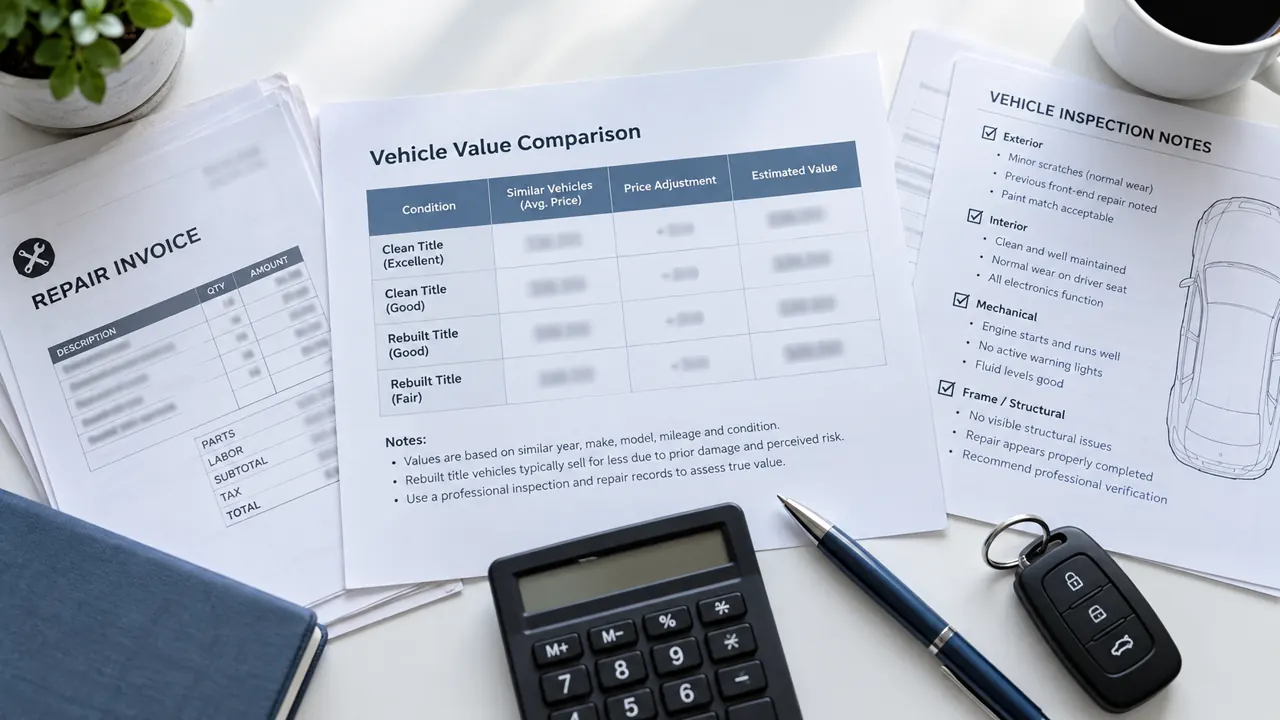
Search current local listings for the same model, generation, engine or drivetrain, trim, mileage range and similar equipment. Note the listing date, asking price, dealer or private-seller context, and any obvious differences in condition. Three genuinely comparable listings are more informative than one expensive outlier. Asking prices are not completed transaction prices, so treat them as starting points for negotiation rather than proof of market value.
Exclude cars with major mismatches. A low-mileage premium trim is not a useful direct reference for a high-mileage base trim. A vehicle with a different powertrain or substantial accident history may belong in a separate set. Adjust for local taxes and dealer fees when comparing the amount you would actually pay. If clean-title comparables are scarce, broaden the geography carefully and note that the confidence of the estimate falls.
Do not begin with a seller’s claim that the rebuilt car is “40% below market.” Ask: below which cars, on what date, and at what out-the-door price? A hypothetical clean-title number in a sales pitch is not a market study. Save links or screenshots of comparables so you can revisit the evidence if the seller changes the offer.
2. Reconstruct the loss and repair evidence
The Department of Justice’s NMVTIS guide explains why past title brands matter to buyers, while also noting that a report is not a complete repair history. Verify the VIN, brand chronology and state-issued title. Then request pre-repair photos, invoices, parts records, state examination documents and any post-repair diagnostic results. A vehicle with clear evidence is easier to evaluate than one whose damage story rests on “it was just cosmetic.”
The nature of the loss affects uncertainty. Flood exposure can raise long-term electrical and corrosion questions; collision repair can raise structural, restraint-system or sensor-calibration questions; theft recovery can involve missing or replaced parts. Do not apply an automatic penalty by category without examining the individual vehicle. But do not pretend that a glossy current photo erases a documented loss either. Price should reflect what can be verified and what remains unknown.
If the title brand in a report conflicts with the seller’s account, resolve it before valuation. The salvage VIN check guide explains how to compare NMVTIS, NICB and state records. A price negotiation is premature while identity or ownership is unclear. A low price cannot make an untransferable title into a good deal.
3. Pay for an independent inspection and estimate immediate work
The Federal Trade Commission advises an independent inspection before a used-car purchase, even when a history report exists. Ask an inspector independent of the seller to assess the car, with special attention to its known damage. Request a written report tied to the VIN and realistic estimates for needed repairs. A general mechanical check may need a collision or electrical specialist for particular losses.
Separate urgent safety work from routine maintenance and cosmetic preferences. Tires, brakes, alignment, sensor faults and water intrusion can change what a seemingly discounted car will cost in the first months. A repair estimate is not always a dollar-for-dollar bargaining credit; it is one part of your total-cost model. If the inspector cannot access an important repaired area, note that uncertainty explicitly instead of assigning a convenient zero cost.
Ask whether the seller will permit a second opinion on unresolved findings. If inspection is refused, consider another car. The FTC’s advice is particularly important here because online histories may not show mechanical defects. You are assessing this car’s value, not the average attractiveness of all rebuilt-title vehicles.
4. Include insurance and financing realities
Ask an insurer for a response using the exact VIN and disclosed brand. Liability coverage, collision and comprehensive are separate questions, and policy terms vary. An online clean-title estimate does not confirm the coverage you want for this car. If you need a loan, ask a lender whether it will accept this branded vehicle and what collateral value it uses. Those responses can change both the purchase budget and the future audience for a resale.
The CFPB explains loan-to-value as the amount borrowed divided by the vehicle’s actual cash value. A lender’s valuation may differ from a seller’s price; a bigger required down payment can change the buyer’s cash needs. Do not claim that all lenders or insurers follow the same rebuilt-title rules. Use actual responses for this VIN. The companion guides on insurance and financing provide question lists.
Think beyond the first premium or first payment. Would the car still fit your budget if you need an extra repair while carrying the insurance and loan? If an insurer would offer only coverage you do not want, or a lender requires terms that erase the price advantage, the vehicle can be a poor fit even at a lower sticker price. Your price ceiling should be based on total ownership, not one promotional number.
5. Consider the narrower resale market without inventing a percentage
When you eventually sell, a buyer may ask the same questions you are asking now. An incomplete repair packet, unusual damage or unresolved warning lights can make the car difficult to explain. Trade-in institutions, lenders and individual buyers have their own policies and risk tolerance. You cannot know today’s future bid, but you can assess whether the car’s documents would let someone else evaluate it. Preserve them for that purpose.
Avoid a blanket formula such as “rebuilt equals half price.” The market is not uniform across model, loss type, quality of work, location or time. Even identical clean-title cars can vary in condition and transaction price. A transparent and well-inspected rebuilt vehicle and a poorly documented one should not receive the same adjustment simply because the titles share a word.
If the seller cites a pricing guide, ask whether the displayed value actually accounts for the branded history. A clean-title retail guide value is a reference, not a guarantee of what this car could sell for. Do not present any third-party brand as formally certifying a specific rebuilt-title valuation unless its own product says so. A real local offer or written appraisal for this car may be more useful, but it too has a date and conditions.
6. Set a personal maximum offer from all-in cost
Write down a realistic clean-title alternative that you would actually consider buying. Then estimate what you would pay for this rebuilt car after inspection, repairs, taxes, fees, insurance, financing and a reserve for uncertainty. Your maximum offer is the amount at which you would still prefer this car to the alternative after considering those costs and risks. There is no universal rule that forces you to make an offer at all.
Ask for an out-the-door price in writing when dealing with a dealer. The FTC recommends written prices and reviewing the used-car Buyers Guide; the Guide states whether the dealer offers a warranty or sells as-is. Read any warranty exclusions and repair promises. Do not let an add-on or fee appear only after you have mentally committed to a bargain. If the seller will not show the actual numbers, the comparison remains incomplete.
Use a walk-away rule. If the title cannot be transferred, the inspection identifies an unresolved safety issue, necessary coverage or financing is unavailable, or the all-in cost is too close to a better-documented car, pass. A buyer’s ceiling protects against the trap of negotiating a small discount on the wrong car.
Hypothetical Example: Why a Fixed Discount Misleads
Imagine a rebuilt-title sedan offered for $11,000. You find three closely comparable clean-title listings around $14,000 to $15,000. These figures are invented to show the method, not a current market quote or suggested rebuilt-title discount. The seller advertises a $3,000 “saving” against the lowest reference. An independent inspector then estimates $900 in near-term tires and alignment, and notes that a prior repair needs further documentation. Dealer fees and tax also raise the amount you would pay.
Insurance for the actual VIN is available under terms you understand, but a lender values the car differently from the seller. Your required down payment rises. You also expect to keep cash for a possible follow-up diagnosis. The decision is not simply $14,000 minus $11,000. It is a comparison between two realistic purchase paths: what the rebuilt car will cost you and what a clean-title alternative with its own inspection findings will cost you.
Now suppose the seller supplies the missing calibration paperwork and the inspector confirms the questioned repair. The uncertainty falls, but the car still has a branded history and your future buyer may price that differently. If instead the seller refuses inspection access, uncertainty rises sharply. The same $11,000 asking price can therefore be acceptable to one well-informed buyer and unacceptable to another. A percentage alone cannot explain that difference.
Use the example to build your own worksheet, never to infer that $11,000 is a fair price for a real model. Make the clean-title comparables specific, verify title status, and get quotes tied to the VIN. If any major input is unknown, label it unknown rather than selecting a convenient number. An honest “not enough information” conclusion can save more money than an aggressive offer.
Rebuilt-Title Price Worksheet
| Input | Your documented figure or finding | Source/date |
|---|---|---|
| Three clean-title comparables | Year, trim, mileage, asking price | Saved listings |
| Rebuilt car out-the-door price | Price plus taxes and fees | Written seller quote |
| Original loss | Type and extent, as documented | Photos and history |
| Repair quality | Verified work and remaining questions | Invoices and inspector |
| Immediate work | Safety and maintenance estimate | Independent report |
| Insurance | Coverages, premium, deductible | VIN-specific insurer response |
| Financing | Eligibility, APR, total cost, cash required | Written lender response |
| Registration | Transfer and state requirements | Current DMV guidance |
| Your reserve | Cash left after purchase | Personal budget |
Do not turn unknowns into false zeros. If you cannot get the repair story, policy answer or transfer paperwork, the spreadsheet cannot fix that missing evidence. Your budget should also include routine ownership costs that any used car can have. Compare the alternative vehicles with their own inspection findings; a clean title is not a promise of perfect condition.
Before accepting an offer, revisit the saved listings. Were they current, local and genuinely comparable? Were dealer fees excluded? Did an unusual mileage or option package distort the apparent gap? If the answer is uncertain, collect better comparables. A careful buyer needs a defendable range, not a single magical number.
Pricing Red Flags
- The advertised discount is calculated from a clean-title price for a different trim, mileage or market.
- The seller will not share the VIN, current title, repair documents or access for an independent inspection.
- The title or report reveals a brand that conflicts with the sales description.
- The seller says state examination proves flawless repair quality without explaining what the examination covered.
- The proposed price assumes insurance or financing will be available, but nobody has checked the exact VIN.
- Fees or add-ons appear after the quoted “discount” is accepted.
One warning does not establish fraud, but each requires a concrete answer before you price the car. A defensible rebuilt title car value comes from evidence, not pressure or a universal markdown. If the evidence remains weak, a higher apparent discount does not necessarily make the risk acceptable. Good deals survive scrutiny.
Frequently Asked Questions
How much less is a rebuilt-title car worth?
There is no reliable nationwide fixed percentage. Compare the specific car against genuine alternatives, repair evidence, inspection results, insurance and financing. A number quoted without those inputs is too crude for a purchase decision.
Can I use a clean-title pricing guide as the final value?
Use it only as a starting reference unless the tool explicitly addresses the branded history and condition. The actual value of this car may differ. Ask how the guide handles title brands, then compare live listings and the independent findings.
Does a state rebuilt inspection add value?
It can document that a state process occurred, which is useful evidence. It does not prove every repair was excellent or set a market price. Ask what the particular state process verified and keep the records.
What if the seller has no pre-repair photos?
The absence does not prove bad work, but it reduces what you can verify. Seek detailed invoices, a specialized independent inspection and a clearer explanation of the loss. Decide whether the remaining uncertainty fits your risk tolerance.
Should I buy because the monthly payment is low?
No. The CFPB recommends comparing APR, term, amount financed and total cost. A long term can lower the payment while raising overall borrowing cost and increasing the chance of negative equity.
Sources and Editorial Note
- FTC: Buying a Used Car From a Dealer: written price, Buyers Guide and independent inspection.
- U.S. DOJ: Understanding an NMVTIS Vehicle History Report: title brand history and report limitations.
- CFPB: What is loan-to-value in an auto loan? and how to compare auto loan offers: collateral math and total borrowing cost.
Sources reviewed September 18, 2026. The hypothetical numbers in this article are not current market data, appraisals or offers. Confirm current local comparable prices, the exact vehicle’s condition and state-specific requirements before buying.