
Can you insure a rebuilt title car? Possibly, but no nationwide yes-or-no answer covers every insurer, state, policy and vehicle. A carrier may evaluate the exact VIN, current title, registration status, repair evidence and requested coverage. Liability and coverage for damage to your own car are different questions. A generic online quote that assumes a clean title is not proof that the same policy will be issued for a rebuilt vehicle.
Quick answer: If you are asking can you insure a rebuilt title car, give an insurer or licensed agent the exact VIN and disclose the current rebuilt brand before paying a nonrefundable deposit. Ask which liability and optional coverages the carrier will offer, what documents it needs, what deductibles apply, and how a future claim would be valued. Obtain a written response for the actual car.
This is a U.S. buyer’s decision guide, not legal or insurance advice for a specific state. It does not claim that a particular company covers rebuilt-title vehicles or that a specific premium will apply. For how to assess repairs and documents before reaching the insurance step, see buying a rebuilt title car. If you are still unsure what the title brand means, start with salvage title vs rebuilt title.
Why a Rebuilt Brand Changes the Conversation
Insurance companies price and underwrite risk under their own rules, subject to state requirements. A rebuilt brand signals a known title history, but it does not tell a carrier everything about the repairs or the car’s current value. Two rebuilt vehicles can have different loss histories and documentation. A liability-only request can raise different questions from a request for collision and comprehensive protection on the vehicle itself. That is why the agent needs the real VIN and title status, not an average quote for the same model.
The National Association of Insurance Commissioners (NAIC) explains the basic coverage types: liability addresses injury or property damage to others under the policy terms; collision and comprehensive address different causes of damage to your own car. Coverage limits, deductibles and exclusions still matter. NAIC’s consumer shopping material recommends checking the declarations page after purchase to confirm that the policy includes the coverage you intended to buy.
Do not confuse title status with registration or roadworthiness. The state DMV decides title and registration questions; an insurer decides whether to issue the proposed policy and on what terms. A rebuilt title may follow a state process, but that process does not oblige every insurer to provide every type of coverage. Likewise, an insurance quote does not certify that the car’s repairs are safe. Keep the tasks separate.
Can You Insure a Rebuilt Title Car? Six Critical Checks
1. Confirm the vehicle’s exact identity and status
Compare the VIN on the car, ownership document and advertisement before asking for coverage. Obtain the current state-issued title or comparable document and read its brand. If the seller calls the vehicle “rebuilt” but the document is still a salvage certificate, stop and clarify. Do not ask for a quote using a different VIN or describe a branded vehicle as clean title. The response you need must apply to the car you are actually considering.
The issuing state and your destination state may have different paperwork processes. Check registration requirements with the responsible DMV before assuming the car can be put on your policy for ordinary use. If the title transfer is pending, tell the agent that as well. A proposed purchase date and intended effective date matter; a quote arranged after you take possession can leave an avoidable gap.
2. Give the insurer a complete, concise repair packet
Ask the seller for pre-repair photographs, major repair invoices, parts receipts, any state examination documents and a recent independent inspection. An insurer may or may not request each item, but having them ready lets you answer questions accurately. Organize the packet by date and VIN. Distinguish documented repairs from claims the seller made verbally. If a carrier requests proof of repair quality or title status, you can respond without scrambling at the closing table.
Do not alter photos or omit known title history because you think the paperwork might hurt the quote. Incomplete information can make a preliminary price meaningless. If documents are missing, tell the insurer what is unavailable and ask whether it can still make a decision. Also consider whether you, independently of the insurer, are comfortable buying a car whose repair history cannot be reconstructed.
3. Ask about liability first, then each optional coverage
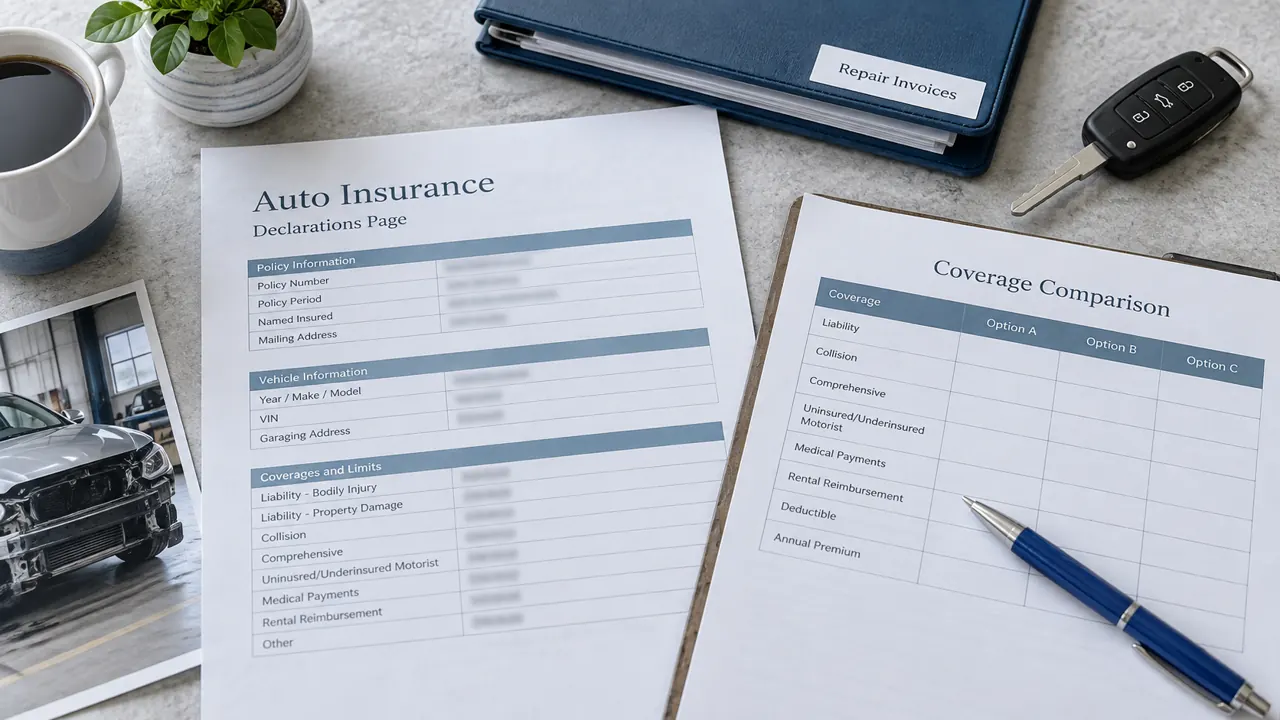
Write down the coverage you need, not just “full coverage,” a phrase that does not identify a precise policy. Ask about liability limits, uninsured or underinsured motorist coverage where offered, medical or personal injury protection where relevant, and any state-required items. Then ask separately about collision and comprehensive coverage for the car itself. The NAIC overview explains why collision and comprehensive respond to different events.
For each offered coverage, ask the deductible, limit, restrictions and premium. One company might provide one set of options while another gives a different response for the same VIN. Do not infer that the ability to purchase liability coverage means the company also approved physical-damage coverage. Equally, do not assume that an online estimator’s collision checkbox means an underwriter has accepted the branded vehicle.
4. Ask how the policy would value a future claim
A quote is only the start of the cost question. Ask how the insurer would determine the value of this particular car after a covered total loss and what documentation would be useful. Do not assume a clean-title pricing guide number will be paid or that a universal percentage reduction applies. Valuation depends on policy terms, state requirements, condition and the evidence available at claim time. Obtain an explanation from the company or agent and keep it with your purchase file.
Consider the economic mismatch: you may pay for optional coverage, but the vehicle’s eventual claim value could differ from an advertised clean-title comparable. That does not make optional coverage inherently good or bad; it makes the written policy and valuation method important. Ask whether repair receipts, documented improvements and comparable listings are relevant under that insurer’s claims process. For the buyer-side price comparison, see rebuilt title car value.
5. Check lender requirements if financing is involved
If a lender will hold a security interest, ask the lender which coverages and deductible limits it requires for this loan. Ask the insurer whether it can issue exactly those coverages on this VIN. A car can appear affordable until the required policy cost or availability changes the math. Do not sign a loan or purchase contract based on a liability-only quote when the lender expects additional protection. Keep the lender and insurer responses in the same file.
The financing question is separate from the insurance question. A lender can decline to finance a branded-title car even if an insurer will cover it; an insurer may offer coverage that does not satisfy a lender’s conditions. Neither institution’s response proves the repairs are sound. For more on financing and collateral questions, see can you get a loan on a rebuilt title.
6. Compare written offers and confirm activation
Seek more than one quote where practical, using the same VIN, drivers, address, annual mileage, coverages, limits and deductibles. Record the date and whether a response is preliminary or approved subject to documentation. Ask what could change the quoted premium before issuance. Comparing one liability-only estimate with another company’s liability-plus-collision estimate tells you very little. A useful comparison holds coverage choices as constant as possible.
When you select a policy, read the declarations page and relevant terms. NAIC’s auto insurance shopping tool advises checking that page to make sure you got the intended coverage. Confirm the effective date and time before taking delivery; do not assume a quote automatically binds coverage. Save the agent or insurer’s written answer about the title brand. If the final documents differ from the quote, resolve it before relying on the policy.
A quote is an estimate based on information provided; it is not the same as proof that a policy has been issued and is in force. Ask what action completes the application, whether an underwriter still must review repair documents, and when written proof of coverage will be available. If the insurer needs additional inspection photos, build that time into the purchase plan. The timing question matters most when the seller wants immediate pickup or the lender expects evidence of coverage before releasing funds.
Quote Comparison Worksheet
| Question | Company A | Company B | Why it matters |
|---|---|---|---|
| Exact VIN and rebuilt brand disclosed? | Record response | Record response | A clean-title estimate may not apply |
| Liability limits and premium? | Record figures | Record figures | Compare like with like |
| Collision offered and deductible? | Yes/no and terms | Yes/no and terms | Separate from liability |
| Comprehensive offered and deductible? | Yes/no and terms | Yes/no and terms | Covers different events |
| Repair/title documents required? | List | List | Can delay final issuance |
| Future claim valuation explained? | Written answer | Written answer | Avoid assumptions about payout |
| Lender conditions satisfied? | Confirm | Confirm | Critical if borrowing |
| Effective date and binding confirmed? | Date/time | Date/time | A quote is not a live policy |
Use this as a note-taking worksheet, not an application form. Share personal details only through a legitimate insurer or licensed agent’s secure channel. Do not put a driver’s license, policy number or private financial information into a public comment or a generic AI chatbot to get an estimate. The key is an answer tied to this VIN and your intended coverages.
If the two quotes differ significantly, ask which assumption changed. One may use different deductibles, different drivers or a different annual mileage estimate. A cheaper number is not automatically better coverage. Review exclusions and the treatment of prior damage; ask the insurer to explain anything you do not understand. The policy language and state rules govern, not the label on a comparison table.
Two Buyer Scenarios
Scenario A, quote before deposit: A seller provides a current rebuilt title and complete repair invoices. The buyer sends the VIN and title brand to an insurer. The insurer offers liability coverage, but says it needs photographs and an inspection before deciding on collision coverage. The buyer’s lender requires collision. The deal is not ready for a nonrefundable deposit. The next step is to resolve the insurer’s documentation request and lender condition, or choose a different car. This is a hypothetical example, not a statement of any insurer’s standard policy.
Scenario B, price without policy clarity: Another buyer gets a low online estimate for a model year and trim but never enters the exact VIN or rebuilt brand. At the closing table, they learn that the estimate did not include the coverage they wanted. The error was not that all rebuilt cars are uninsurable; it was treating a generic price as a vehicle-specific underwriting decision. A short call or secure written request before negotiating would have exposed the gap.
Both examples show why sequence matters. The practical answer to can you insure a rebuilt title car must come from a carrier reviewing the real VIN and requested coverage. Identity and state title status come first, requested coverage and lender rules second, and binding confirmation before delivery. You still need an independent inspection and fair total price. Insurance is one gate in the purchase decision, not a substitute for the others.
Frequently Asked Questions
Is a rebuilt-title car automatically uninsurable?
No universal rule can be inferred from the brand alone. Ask insurers about the actual VIN, state and coverage requested. Some situations may produce options; others may not. Do not rely on a forum anecdote or a quote for a different car.
Is liability insurance the same as full coverage?
No. Liability generally addresses covered harm to others under the policy terms. Collision and comprehensive address different kinds of loss to your own vehicle when included. “Full coverage” is not a precise coverage list. Ask for the actual policy components, limits and deductibles.
Will insurance pay a clean-title value after a total loss?
Do not assume that. Ask the insurer how it determines value under the proposed policy and state rules for this branded vehicle. Keep condition and repair evidence. No general article can promise a payout figure for an individual future claim.
Should I buy first and ask for coverage later?
That creates avoidable risk. Get an answer for the actual VIN and your needed coverage before a nonrefundable deposit, and confirm when any selected policy would become effective. The seller’s assurance that “insurance won’t be a problem” is not an insurer’s decision.
Does a state rebuilt examination guarantee insurer acceptance?
No. A state process concerns title or registration under that state’s rules. Insurance underwriting is a separate decision. An independent physical inspection also remains important for the buyer.
Sources and Editorial Note
- NAIC: What You Should Know About Auto Insurance Coverage: coverage categories and distinctions.
- NAIC Auto Insurance Shopping Tool: comparing coverages and reading the declarations page.
- FTC: Buying a Used Car From a Dealer: history and independent inspection before purchase.
- U.S. DOJ NMVTIS report guide: brand-history context and report limitations.
Sources reviewed September 18, 2026. The cited consumer sources explain general coverage and vehicle-history concepts; they do not establish that a particular insurer will cover every rebuilt-title VIN. Ask the insurer, relevant state regulator or a qualified licensed agent for current terms applicable to your case.