
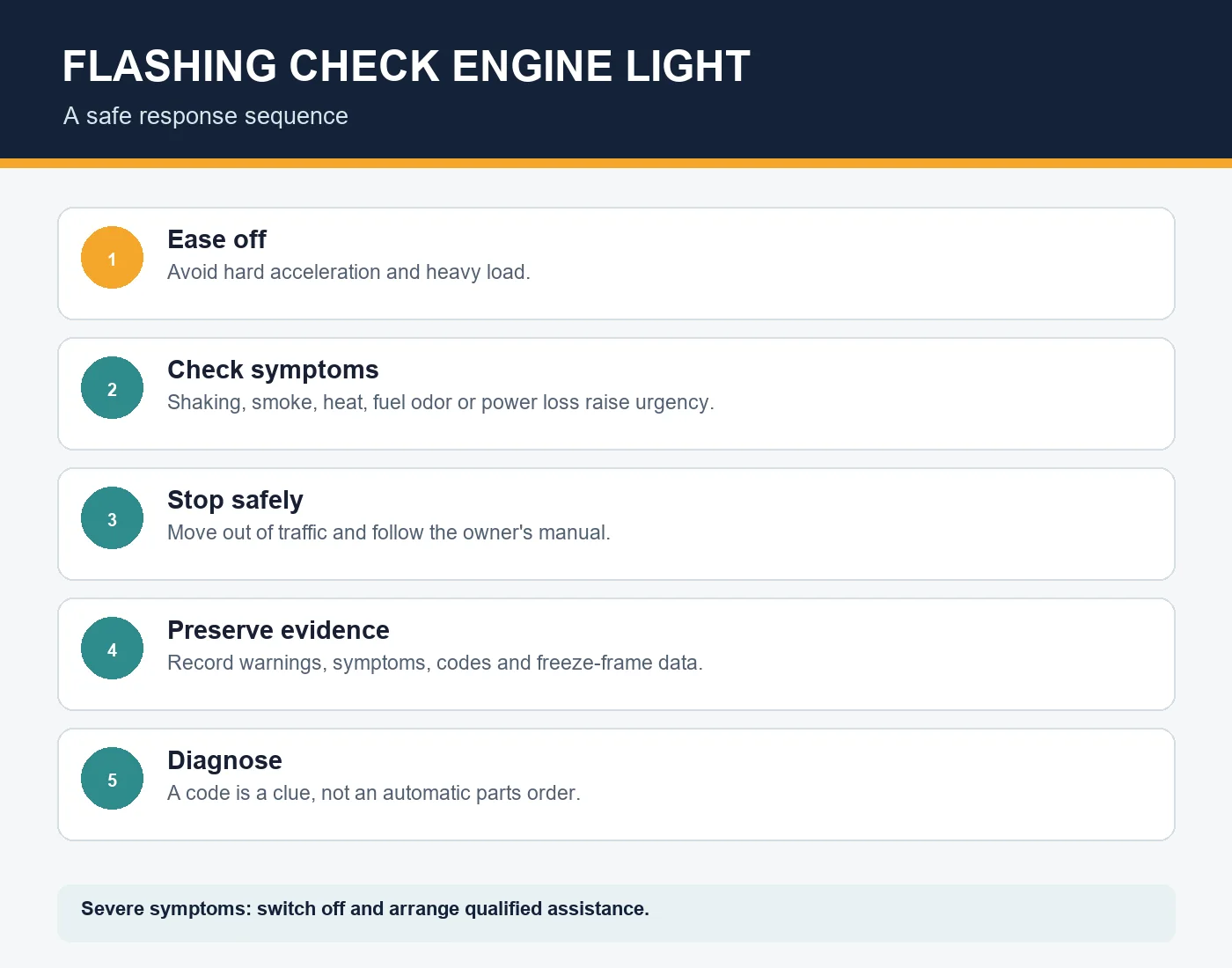
Quick answer: A flashing check engine light commonly warns that a severe problem, such as an active misfire, may be occurring. Reduce speed, avoid hard acceleration, and move to a safe location. If the engine is shaking, losing power, overheating, smoking, or producing a strong fuel smell, shut it off and arrange assistance. The exact instruction for your vehicle comes from its owner’s manual.
A flashing light deserves a different response from a steady light. It does not identify the failed part, and it does not prove that every vehicle has the same fault. It does mean the driver should stop treating the warning as a routine maintenance reminder.
Flashing versus steady: the practical difference
The malfunction indicator lamp, or MIL, is part of the vehicle’s onboard diagnostic system. A steady light usually means the system detected a fault that requires diagnosis. A flashing MIL is generally used for a more urgent condition that may damage the catalytic converter. EPA consumer guidance explains that a blinking light calls for immediate attention, while manufacturer instructions can be more specific for a particular model.
| Warning | Practical response | What not to assume |
|---|---|---|
| Steady check engine light | Check for serious symptoms and arrange timely diagnosis | That the car is safe indefinitely |
| Flashing check engine light | Ease off, reach a safe location, and follow the owner’s manual | That a gas cap or code clear will solve it |
| Flashing light plus shaking, smoke, overheating, or major power loss | Stop safely and arrange assistance | That driving to a shop is worth the risk |
For the broader meaning of steady and flashing warnings, see Carvul’s check engine light guide.
Seven steps to take when the check engine light is flashing
1. Ease off the accelerator
Avoid hard acceleration, towing loads, high engine speed, and aggressive passing. A heavy load can make an active misfire or combustion problem worse. Do not make a sudden unsafe maneuver; first control the vehicle and identify a safe place to stop.
2. Check for symptoms that demand an immediate stop
Pull over as soon as it is safe if the engine is shaking strongly, power drops sharply, smoke appears, the temperature warning rises, oil pressure is low, or you smell raw fuel. These symptoms can point to risks beyond the emissions system. Do not open a hot cooling system or stand in traffic to inspect the vehicle.
3. Read the owner’s manual
Manufacturers do not all use identical wording. Find the exact warning symbol and follow the instruction for the vehicle’s model and year. Carvul’s conservative recommendation is to stop safely and arrange help when severe symptoms accompany a flashing light; that does not replace manufacturer guidance.
4. Decide whether assistance is safer than continued driving
If the vehicle runs poorly or the manual says to stop, towing or roadside assistance is the safer choice. A short distance is not automatically harmless. Unburned fuel can overheat a catalytic converter, and a failing engine may lose more power without warning.
5. Record what happened
Before the ignition is cycled, note the speed, engine temperature, fuel level, weather, recent refueling, and whether the problem appeared under acceleration, at idle, or on a hill. A technician may also retrieve freeze-frame data stored when the fault set. Your notes help connect the code to the operating condition.
6. Scan without treating the code as a parts order
An OBD-II scanner may show a misfire-family code such as P0300 or a cylinder-specific code. A code identifies the system or condition the computer detected; it does not prove that a spark plug, ignition coil, injector, sensor, or engine part has failed. Do not erase codes before recording them unless a qualified repair procedure calls for it.
7. Require diagnosis and repair verification
A useful repair process confirms the complaint, records codes and data, inspects likely causes, performs targeted tests, and verifies that the fault no longer returns. Ask what evidence supports the recommended repair and what test confirmed the result.
Why an active misfire can threaten the catalytic converter
During a misfire, a cylinder may fail to burn its air-fuel charge correctly. Fuel and oxygen can reach the exhaust, where the catalytic converter may become unusually hot. That is why the flashing light is associated with catalyst-damaging conditions. The warning does not reveal the cause of the misfire, and not every flash guarantees converter damage, but continuing to apply heavy load increases avoidable risk.
Possible causes include ignition faults, fuel-delivery problems, air leaks, compression loss, wiring faults, or incorrect sensor information. Replacing the first part named in an online list is not diagnosis.
Can a loose gas cap cause a flashing light?
A loose or damaged cap can contribute to an evaporative-emissions leak and may turn on a steady check engine light. It is not a sound explanation for an engine that is shaking with a flashing light. Check the cap only when it is safe, but do not use it to dismiss severe symptoms. The dedicated loose gas cap guide explains what a cap can and cannot cause once that supporting page is published.
What a repair shop should check
A technician may start with stored, pending, and permanent codes; freeze-frame data; misfire counters; fuel trims; ignition and injector operation; air leaks; compression; and relevant service information. The sequence depends on the vehicle and symptoms. Parts should follow evidence.
Ask these questions:
- Which code and operating condition were recorded?
- Was the concern reproduced?
- What test isolated the failed component or circuit?
- Could another fault have produced the same code?
- How was the repair verified under similar conditions?
- Are readiness monitors complete, or does the vehicle need a drive cycle?
What not to do
- Do not keep driving hard to see whether the light stops.
- Do not disconnect the battery just to hide the warning.
- Do not clear codes before saving diagnostic evidence.
- Do not replace a catalytic converter without diagnosing the condition that overheated or contaminated it.
- Do not assume a vehicle is repaired because the light stayed off for a few minutes.
Frequently asked questions
Can I drive with a flashing check engine light?
Continuing to drive can increase damage or safety risk, especially if the engine is shaking, losing power, overheating, smoking, or smelling strongly of fuel. Reduce load, stop safely, consult the owner’s manual, and arrange assistance when symptoms are severe.
Why does the light flash only when accelerating?
A fault may appear under load because cylinder pressure, fuel demand, ignition demand, or airflow changes. That pattern is useful diagnostic evidence but does not identify the failed part by itself.
Can low oil cause the check engine light to flash?
Low oil pressure normally has its own warning, but low oil level or engine damage can affect operation. If the oil-pressure warning appears, stop according to the owner’s manual. Never rely on the check engine light as the only engine-protection warning.
Will the light stop after the engine cools?
It might, but disappearance is not proof of repair. Intermittent faults can store codes and return under the same load or temperature. Record the event and obtain diagnosis.
Should I clear the code after tightening the gas cap?
Not when the light was flashing or severe symptoms occurred. Preserve the codes and operating data for diagnosis. A cap-related leak can require several successful self-tests before a steady light turns off.
What different driving situations can reveal
The conditions under which the light starts flashing can help a technician choose the first tests. They are clues, not diagnoses.
Flashing under hard acceleration or climbing
An ignition system can require more voltage when cylinder pressure rises, and a marginal coil, worn plug, damaged boot, fuel-delivery problem, or mechanical issue may become obvious only under load. Ease off immediately. Do not repeatedly reproduce the event on public roads just to collect evidence.
Flashing at idle
An idle-only concern may involve unmetered air, an injector issue, ignition performance, compression, or another condition that is more influential at low airflow. Note whether the engine is cold or fully warm and whether accessories such as the air conditioner change the symptom.
Flashing after refueling
Timing does not prove causation. Incorrect or contaminated fuel, an EVAP-related event, or an unrelated misfire may occur after a fuel stop. Save the receipt and note fuel grade, station, and amount. A loose cap is not a convincing explanation for severe shaking.
Flashing in rain or damp weather
Moisture can expose damaged ignition insulation, connectors, or wiring, but the weather itself is not the failed component. A qualified inspection should look for evidence rather than spraying products or replacing coils by trial.
Flashing after recent repair work
Document exactly what was serviced. A disconnected connector, damaged hose, incorrect plug, pinched wire, or unrelated developing fault may be involved. Give the shop the original invoice and avoid altering the work before it can be inspected.
How to communicate the problem to roadside assistance or a shop
Describe observable facts instead of diagnosing the vehicle yourself. A useful message sounds like this: “The check engine light began flashing while accelerating at 45 mph. The engine started shaking, power dropped, and I pulled over within one minute. The temperature gauge stayed normal and there was no smoke.”
Include:
- exact warning behavior: steady, flashing continuously, or flashing intermittently;
- engine behavior: smooth, rough, stalled, or reduced power;
- other warning lights or messages;
- unusual sounds, odors, smoke, or fluid leaks;
- operating condition when it began;
- recent fuel or repair history;
- whether the vehicle is now in a safe location.
This information helps the service provider bring suitable equipment and decide whether towing is appropriate.
Reviewing a repair recommendation
An estimate should connect the complaint to evidence. For an ignition-related repair, ask whether the shop inspected the spark plug, coil boot, connector, wiring, and cylinder condition. For a fuel-related recommendation, ask what pressure, injector, or control test was performed. For a mechanical recommendation, request the compression, leak-down, timing, or other measurement that supports it.
The estimate should also state whether catalyst condition was evaluated after a severe or prolonged misfire. Replacing the misfire cause does not automatically prove the converter escaped damage, while replacing the converter alone does not correct the original misfire.
Do not compare estimates only by total price. Compare diagnostic evidence, parts quality, labor scope, related damage, warranty, and the verification procedure.
After the repair: what verification should include
The engine should operate normally under the conditions that originally caused the flash. The shop may review misfire counters, fuel trims, pending codes, and monitor results. Some permanent codes or incomplete readiness monitors can remain until the vehicle completes the required self-tests.
Ask for the original and final code report when available. Keep the invoice with the mileage, parts, and test results. If the light flashes again, reduce load and follow the same safety process rather than assuming the new event is harmless.
Used-car buyer checks when a seller reports a past flashing light
A seller’s statement that the problem was “just plugs” should be supported by an invoice and diagnostic record. Verify that the repair matches the vehicle, mileage, and date. During an independent inspection, ask the technician to review code status, readiness monitors, misfire data where available, engine operation, and evidence of recent code clearing.
Incomplete monitors do not prove deception because battery or legitimate repair work can reset them. They do mean the self-tests have not all supplied fresh evidence. A pre-purchase decision should combine inspection, records, vehicle history, and a test drive conducted only when the vehicle is safe.
Additional questions drivers ask
Can bad spark plugs make the check engine light flash?
Yes, worn or damaged plugs can contribute to an active misfire, but coils, injectors, wiring, compression, air leaks, and other faults can create similar behavior. Test before replacing parts.
Can a flashing light damage the engine?
The warning commonly emphasizes catalyst-damaging misfire, but the underlying fault can also affect engine operation. Severe symptoms, overheating, low oil pressure, or abnormal noise require immediate attention under manufacturer guidance.
Why did the light flash and then become steady?
The severe condition may no longer be occurring continuously, while the fault remains recorded and the MIL stays commanded on. The change does not prove the vehicle is repaired.
Is it safe to restart the engine after stopping?
That depends on the symptoms and the owner’s manual. Do not restart when there is smoke, fuel leakage, overheating, low oil pressure, or another obvious hazard. Roadside assistance or a technician can advise based on the specific vehicle and condition.
Could an aftermarket modification cause flashing?
Incorrect tuning, wiring changes, intake or exhaust modifications, and nonstandard ignition or fuel components can affect operation and diagnosis. Tell the technician about every modification and provide the calibration or installation records.
Related Carvul Guidance
Continue with check engine light causes and professional check engine light diagnosis for the next step in the diagnostic process.
Bottom line
A flashing check engine light is an urgency signal, not a parts diagnosis. Reduce engine load, stop safely when serious symptoms are present, follow the exact owner’s manual, preserve the evidence, and require testing that proves the repair.
Authoritative sources
- U.S. EPA: On-Board Diagnostics questions and answers
- California BAR: OBD inspection information
- The owner’s manual and service information for the exact vehicle