
Quick answer: A check engine light can be caused by faults in combustion, fuel control, ignition, airflow measurement, evaporative emissions, oxygen-sensor monitoring, catalytic-converter performance, exhaust-gas recirculation, variable valve timing, wiring, control modules, or other manufacturer-monitored systems. The light and code identify a detected condition, not automatically the failed part.
Drivers often want a short list of likely parts. A better approach is to group causes by system and combine the code with symptoms, freeze-frame data, service information, and targeted tests. That avoids replacing a sensor when the real issue is a damaged wire, air leak, exhaust leak, low fuel pressure, or mechanical fault.
Start with Carvul’s check engine light guide if you need to decide whether the vehicle should be driven or stopped.
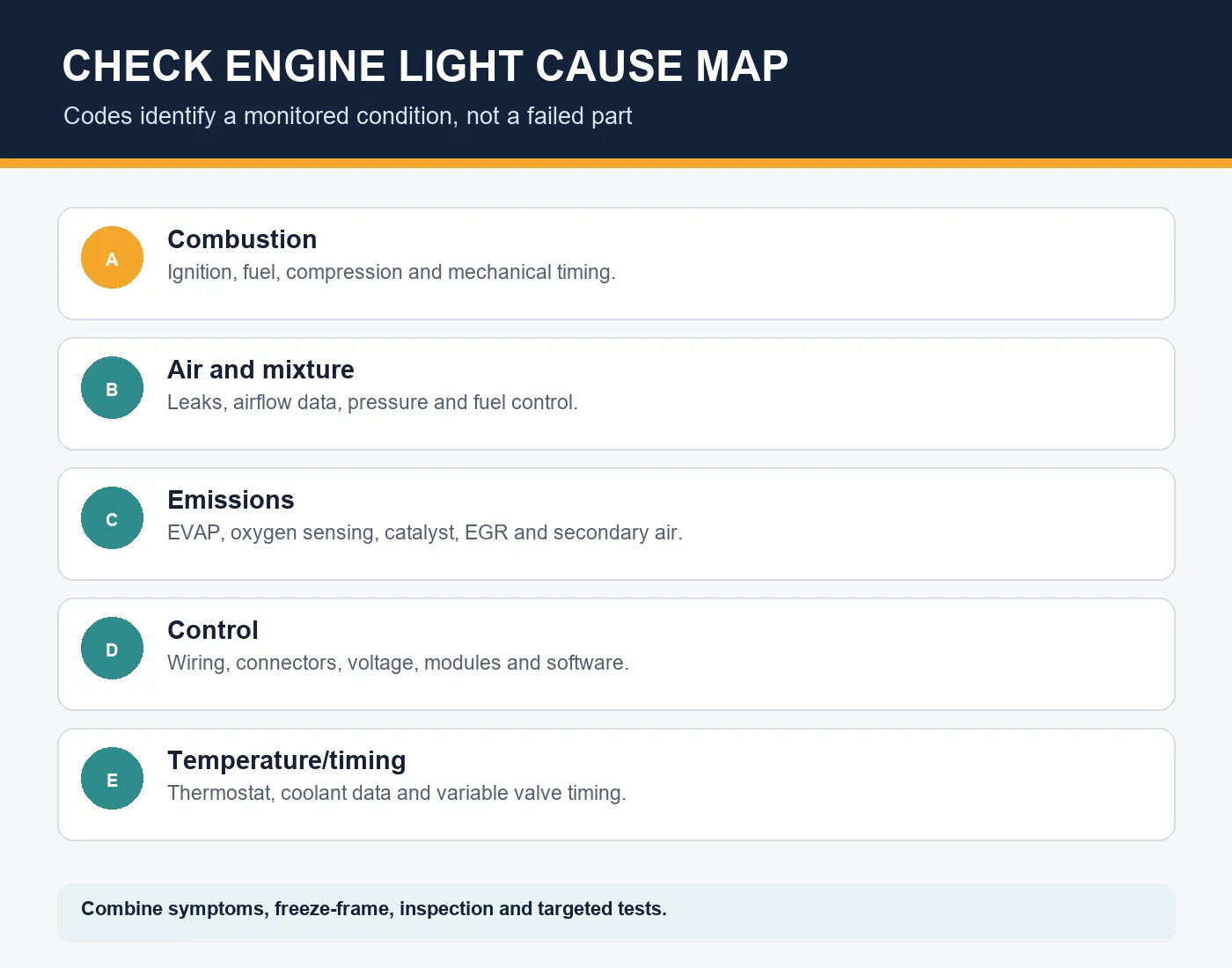
What Causes a Check Engine Light? 12 Fault Categories
1. Ignition and misfire faults
Worn spark plugs, failed coils, damaged boots, wiring faults, incorrect plug gaps, and control problems can contribute to misfires. Fuel delivery, compression loss, air leaks, and mechanical timing can create similar symptoms. A P0300-family code does not prove the ignition coil is bad.
Common clues include rough idle, hesitation, shaking under load, hard starting, and a flashing MIL. A flashing warning deserves urgent attention because continued operation can overheat the catalytic converter.
2. Fuel-delivery and fuel-control problems
Injectors, pumps, pressure control, contaminated fuel, leaks, and electrical faults can alter the mixture. Fuel-trim codes indicate that the computer reached or approached its correction limit; they do not say which part caused the correction.
3. Unmetered air and vacuum leaks
Cracked hoses, intake-gasket leaks, loose ducts, brake-booster leaks, or improperly installed components can allow air into the engine without being measured as expected. Smoke testing and data analysis may be needed to locate the actual path.
4. Airflow and pressure-sensor circuits
Mass-airflow, manifold-pressure, and related sensor codes can result from contamination, wiring, connector, power, ground, air-leak, or engine-performance problems. Cleaning or replacing a sensor without confirming the signal can waste money.
5. Oxygen and air-fuel sensor monitoring
Upstream and downstream sensors help the computer evaluate mixture and catalyst operation. A sensor-related code can involve the sensing element, heater circuit, wiring, exhaust leak, mixture problem, or control issue. Sensor data must be interpreted in context.
6. Catalytic-converter efficiency
Efficiency codes compare signals and operating conditions to evaluate catalyst performance. Misfires, oil consumption, coolant contamination, exhaust leaks, mixture faults, or a worn converter can influence the result. Diagnose the cause before installing an expensive converter.
7. EVAP leaks and flow faults
The evaporative-emissions system controls fuel vapor. A loose cap is one possibility, but valves, hoses, canisters, sensors, filler components, wiring, and capless-filler seals can also fail. See the dedicated loose gas cap and check engine light guide once it is published.
8. Exhaust-gas recirculation and secondary-air systems
Depending on the vehicle, EGR or secondary-air equipment may be monitored for flow, response, electrical operation, or plausibility. Carbon deposits are possible, but passages, valves, pumps, relays, sensors, hoses, and wiring must be evaluated according to the service procedure.
9. Variable valve timing
Oil condition, oil level, control solenoids, wiring, phasers, timing components, and mechanical oil-pressure issues can affect camshaft timing. Changing a solenoid because its name appears in a code description is not enough.
10. Thermostat and temperature-control monitoring
The computer may detect that the engine warms too slowly or that temperature data is implausible. Causes can include a thermostat, sensor, wiring, coolant condition, or another cooling-system issue. Never open a hot cooling system.
11. Electrical, connector, and network faults
Corrosion, damaged wiring, poor grounds, low system voltage, blown fuses, water intrusion, and communication faults can trigger codes across several modules. Multiple unrelated codes can make power and ground checks especially important.
12. Manufacturer-specific systems and software
Automakers monitor additional components and operating strategies. Technical service information, calibration updates, and manufacturer code definitions may be required. A generic scanner may omit enhanced data needed for diagnosis.
Match causes to symptoms, not guesses
| Symptom | Possible categories | Urgency note |
|---|---|---|
| Rough idle | Misfire, fuel, air leak, compression | Flashing light or severe shaking raises urgency |
| Light after refueling | EVAP sealing or flow | Persistent fuel odor needs prompt attention |
| Poor acceleration | Misfire, fuel, airflow, exhaust restriction | Major power loss may make driving unsafe |
| Reduced fuel economy | Fuel control, sensor data, thermostat, misfire | Confirm with records rather than one tank |
| No noticeable symptom | EVAP, heater circuit, intermittent fault | Still diagnose; absence of symptoms is not proof of safety |
| Overheating or oil-pressure warning | Cooling or lubrication concern | Follow the separate warning immediately |
Why a diagnostic code is not a parts list
OBD-II codes are labels for faults detected by monitor logic. A circuit-low code, for example, can result from a sensor, wire, connector, ground, power supply, or control issue. A lean code can result from too much air, too little fuel, exhaust leakage, incorrect measurement, or operating conditions.
A sound diagnosis asks:
- Is the complaint present now?
- Which codes are current, pending, history, or permanent?
- What did freeze-frame data record?
- Are basic mechanical and electrical conditions correct?
- Which targeted test can confirm or reject the leading cause?
- Did the repair restore normal data and complete the relevant monitor?
What you can safely check first
With the vehicle parked, confirm the fuel cap is fitted where applicable, note fluid or fuel leaks without touching hot components, photograph warnings, and record when symptoms occur. Check maintenance history and the owner’s manual. Do not probe wiring, disconnect components, or work near moving/hot parts without the proper procedure and training.
When to stop driving
Stop safely and arrange assistance when a flashing light is accompanied by severe shaking, major power loss, smoke, overheating, low oil pressure, or a strong persistent fuel smell. Manufacturer guidance controls for the exact vehicle. A steady light with normal operation may permit cautious travel for diagnosis, but it should not be ignored.
Frequently asked questions
What is the most common cause?
There is no universal winner across all vehicles and conditions. Vehicle age, design, mileage, climate, maintenance, and the actual code population change the answer. Diagnose the specific car.
Can an oil change turn off the light?
Routine oil service can address maintenance needs but does not generally repair an unrelated OBD fault. Oil level or condition can matter for systems such as variable valve timing, so evidence is still required.
Can a weak battery cause codes?
Low voltage can contribute to electrical or communication faults. Test the battery and charging system when voltage evidence supports it, but do not use a battery replacement to explain every engine code.
Can weather trigger the warning?
Temperature and moisture can expose marginal seals, wiring, batteries, or operating problems. Weather is context, not a diagnosis.
Why are several codes present?
They may share one root cause, reflect cascading effects, or represent separate faults. Record all codes and prioritize them using service information and data.
A symptom-first way to organize the possibilities
The same warning can accompany very different driving complaints. Organizing the evidence by symptom helps prevent a long, unfocused parts list.
Rough idle that smooths out at higher speed
Possible directions include an intake leak, cylinder imbalance, fuel control, ignition, or mechanical condition. Comparing fuel trims and misfire data at different engine speeds can help separate them. The driver should record whether the concern is worse cold, warm, in gear, or with accessories operating.
Hesitation only under load
Higher cylinder pressure and fuel demand can expose marginal ignition, fuel-delivery, airflow, exhaust-restriction, or mechanical problems. Do not repeatedly accelerate hard to reproduce a flashing warning. A controlled test belongs in a safe diagnostic plan.
Hard start after refueling
This pattern can direct attention toward EVAP purge operation, fuel quality, or another starting condition, but timing alone is not proof. Note how much fuel was added, whether the tank was topped off, and whether a fuel smell or stalling followed.
Light on with no drivability complaint
EVAP, heater-circuit, intermittent, and catalyst-monitoring faults may not be obvious to the driver. The absence of symptoms does not make the code imaginary, and it does not establish that every trip is safe indefinitely.
Warning plus reduced power
The control system may be protecting the vehicle or responding to an important fault. Avoid demanding maneuvers, follow the owner’s manual, and arrange diagnosis. Reduced-power operation is not a repair.
How freeze-frame data helps narrow causes
Freeze-frame data records selected values around the time a qualifying fault set. It may include engine speed, load, coolant temperature, vehicle speed, fuel trims, and other parameters. The available fields and which code receives the frame vary.
A cold-engine frame with high positive fuel trim suggests a different test plan from a fully warm, high-load frame. Freeze-frame does not prove root cause, but it helps a technician reproduce the relevant condition and avoid testing only at idle when the fault occurred on the highway.
Record the data before clearing. If the light is intermittent, losing the frame can remove the best clue about when the monitor failed.
How maintenance history changes the diagnosis
Service history does not diagnose the warning, but it changes probability and testing priorities. Missing spark-plug service can matter for a misfire. Recent timing work matters for cam correlation. A newly replaced battery can explain incomplete readiness. Collision or rodent history can direct wiring inspection.
Useful records include:
- dates and mileage for plugs, filters, fluids, and timing-related work;
- battery and charging-system repairs;
- fuel-system or emissions repairs;
- previous code reports and failed-inspection documents;
- recalls, campaigns, and software updates;
- aftermarket parts or calibrations.
Evaluating common repair recommendations
“It needs an oxygen sensor”
Ask whether the code concerns sensor response, a heater circuit, mixture, or catalyst monitoring. Request voltage, current, waveform, wiring, and mixture evidence appropriate to the design.
“It needs a catalytic converter”
Ask whether misfire, fuel control, oil consumption, coolant contamination, and exhaust leaks were evaluated. A new converter can be damaged again if the root cause remains.
“It needs a tune-up”
Tune-up is not a precise diagnosis. Request an itemized list, maintenance basis, and the test linking each proposed part to the fault.
“The gas cap was loose”
That can be plausible for an EVAP leak, but the monitor must pass after the cap is corrected. It does not explain a flashing light with severe roughness.
“The code says the sensor is bad”
Codes often describe circuits or performance. Verify power, ground, wiring, connectors, signal behavior, and the system being measured before condemning the sensor.
Check-engine-light causes in hybrid and electrified vehicles
Hybrid vehicles still use OBD monitoring for the combustion engine and emissions systems, while also having high-voltage and hybrid-control systems. An engine warning can interact with messages that limit propulsion or indicate hybrid-system faults. Do not work on orange high-voltage components without appropriate training and equipment.
Plug-in hybrids may run the engine less often, which can affect when certain monitors complete. Use model-specific service information and scan capability. Battery-electric vehicles do not have a conventional combustion-engine MIL, though they use other propulsion and warning systems.
Seasonal and environmental clues
Cold starts can expose battery weakness, fuel vaporization, air leaks, and ignition limitations. Heat can influence wiring resistance, vapor systems, and cooling. Road salt and moisture can damage connectors. High altitude changes airflow and load.
These conditions help reproduce a problem; they are not replacement diagnoses. A fault that appears every winter still needs a confirmed cause.
Questions to ask before approving repair
- What are the exact current, pending, and permanent codes?
- What did freeze-frame show?
- Was the symptom reproduced safely?
- Which inspection or measurement identified the cause?
- Were wiring, connectors, power, and grounds checked where relevant?
- Could another condition produce the same code?
- What repair is required and what work is optional maintenance?
- How will the shop verify the result?
- Are readiness monitors complete?
- What warranty applies?
More questions about common causes
Can a dirty air filter cause the light?
A severely restricted or incorrectly installed filter can affect airflow, but modern control systems and fault patterns vary. Inspect the intake and use data rather than blaming normal filter dirt for every code.
Can bad fuel cause the warning?
Contaminated or incorrect fuel can affect combustion, but preserve a sample only through safe professional procedures. Save the receipt and report when symptoms began.
Can an exhaust leak cause a code?
Yes. A leak can affect oxygen-sensor readings and catalyst evaluation depending on its location. Inspection and testing should precede sensor or converter replacement.
Can aftermarket parts cause a light?
Incorrect airflow components, exhaust changes, remote-start wiring, tuners, and other modifications can influence monitored systems. Provide full modification records to the technician.
Does high mileage make the cause obvious?
No. Wear changes probability, but a high-mileage vehicle still needs testing. New parts can fail, and old parts can remain functional.
Why does the light return after several days?
Some monitors need specific conditions and multiple trips. The fault may only occur at a certain temperature, load, speed, or fuel level.
What causes a check engine light after recent service?
What causes a check engine light after service can include a disconnected hose or connector, an installation issue, a disturbed wire, or an unrelated fault. Review the recent work and test before assigning blame.
Related Carvul Guidance
Continue with loose gas cap and EVAP warning guide and check engine light diagnostic process for the next step in the diagnostic process.
Bottom line
Understanding what causes a check engine light requires system evidence rather than a universal list of replacement parts.
The check engine light has many possible causes because OBD-II monitors systems, circuits, and operating results. Group the evidence, protect against urgent symptoms, and test the vehicle before authorizing parts.
Authoritative sources
- U.S. EPA: On-Board Diagnostics questions and answers
- SAE International: OBD standards overview
- Manufacturer service information for the exact vehicle