
Quick answer: The correct way to reset a check engine light is to diagnose and repair the underlying fault, preserve the original codes and freeze-frame data, clear codes only when the repair procedure calls for it, and verify that the relevant monitor completes without the fault returning. Disconnecting the battery or erasing a code does not repair the vehicle.
Drivers asking how to reset check engine light warnings should therefore begin with evidence, not the erase button. A proper reset follows a confirmed repair and leaves enough documentation to show what failed, what changed, and whether the vehicle passed its next self-test.
Resetting is useful at the correct stage of a repair. It is harmful when used to hide a warning, erase evidence before diagnosis, or create the appearance that a used car is fixed.
If you have not diagnosed the warning, begin with Carvul’s check engine light guide.
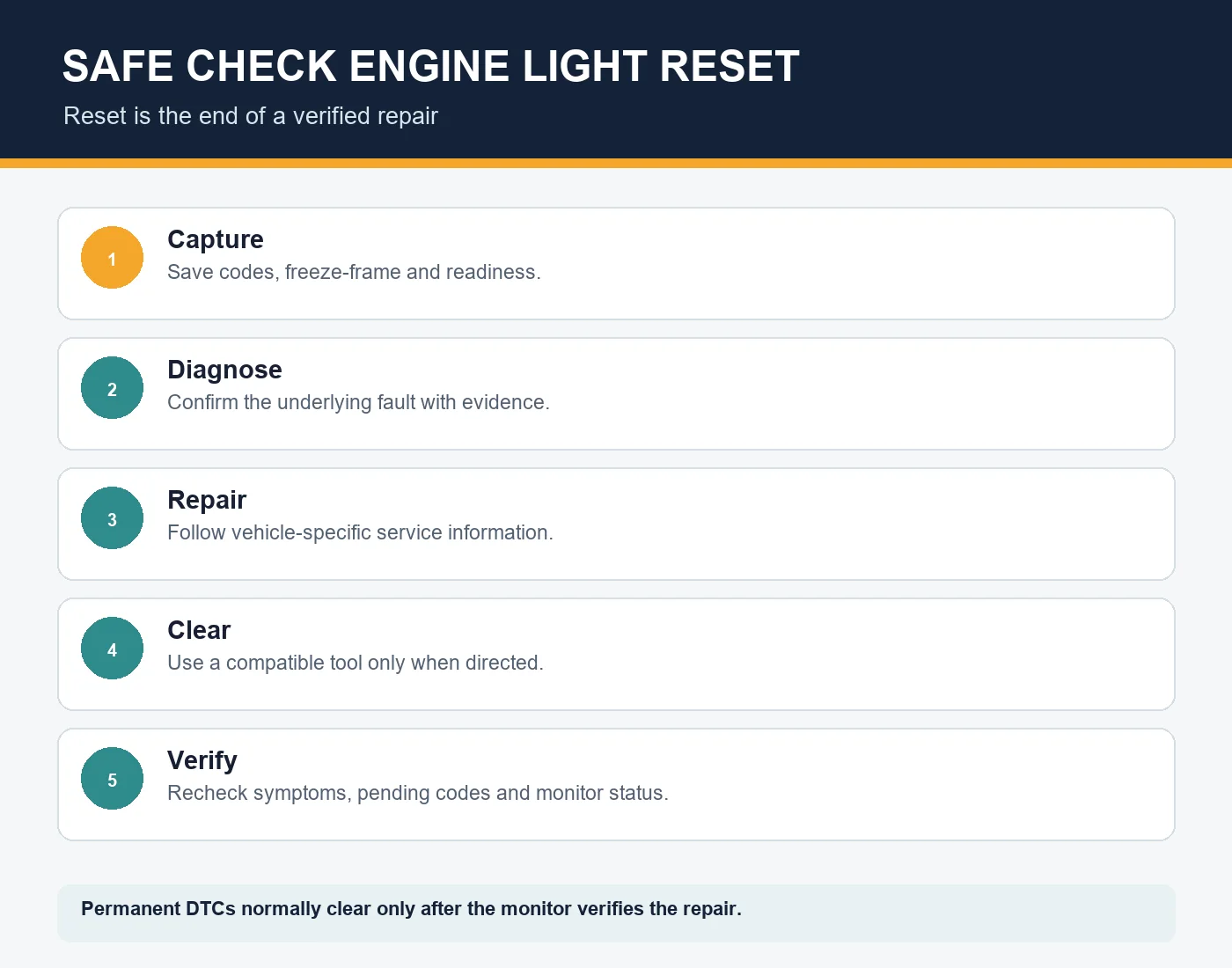
How to Reset Check Engine Light Warnings: 7 Facts
1. A scan tool can clear information, not causes
A compatible scanner may command the control module to erase diagnostic information and turn off the lamp. If the fault remains, the monitor can detect it again and the light can return immediately or after enabling conditions are met.
2. Save codes and freeze-frame data first
Record stored, pending, and permanent codes, freeze-frame data, readiness status, and relevant live data before clearing. Freeze-frame information captures selected conditions near the time a fault set and can be valuable when a problem is intermittent.
3. Battery disconnection is not the preferred reset
Disconnecting power can erase adaptive information, clock and convenience settings, and readiness status; some vehicles require specific battery procedures. It may also create new issues. Follow manufacturer service information rather than using battery disconnection as a universal shortcut.
4. A light may turn off naturally after successful tests
OBD logic can extinguish the MIL after the fault no longer repeats for the required operating cycles. Stored history may remain. The timing varies by fault and manufacturer, so promises such as “drive exactly 50 miles” are unreliable.
5. Readiness monitors matter after clearing
Monitors show whether the vehicle has completed specific self-tests since codes were cleared or power was lost. “Not ready” is not the same as “failed,” but too many incomplete monitors can prevent an emissions inspection from passing. State rules vary.
6. Permanent DTCs behave differently
Permanent diagnostic trouble codes generally cannot be removed through an ordinary clear command or battery disconnection. Under OBD requirements, they clear after the responsible monitor determines the malfunction is no longer present and the required conditions are satisfied. Their presence after a repair does not automatically prove the repair failed, but it must be interpreted with readiness, current codes, and monitor results.
7. Verification is part of the repair
The technician should confirm normal operation, check that codes do not reset, evaluate relevant data, and complete an appropriate verification drive or monitor procedure. Safety and legal road conditions come first; a drive cycle is not permission to operate an unsafe vehicle.
Safe reset workflow
Stage 1: Capture evidence
Photograph the warning and note symptoms, operating conditions, recent work, and refueling. Do not erase an intermittent fault before diagnosis.
Stage 2: Scan and diagnose
Retrieve codes and data, consult the correct service information, and test the suspected system. A code definition alone is not a diagnosis.
Stage 3: Complete the repair
Repair the confirmed fault according to the manufacturer procedure. Avoid replacing multiple parts merely because they are common online suggestions.
Stage 4: Clear only as directed
Use a compatible tool if the service procedure calls for clearing. Some repairs may require relearns or calibration procedures beyond a generic code clear.
Stage 5: Verify
Confirm the lamp remains off, the vehicle operates correctly, and the relevant monitors can run. Recheck for pending and permanent codes.
What happens to emissions readiness?
Readiness monitors cover emissions-related systems that may run continuously or only under certain conditions. After a reset, several may show incomplete. The vehicle must experience the temperatures, speeds, loads, fuel levels, and other conditions required by its strategy.
Do not follow an unsafe internet “drive cycle” that conflicts with traffic laws or the manufacturer’s instructions. An official repair manual or emissions program can provide appropriate guidance.
| Status | Meaning | Appropriate response |
|---|---|---|
| Ready/complete | The monitor has completed since reset | Review result with current code status |
| Not ready/incomplete | Test has not completed | Follow correct conditions; do not assume failure |
| Current code | Fault is detected now | Continue diagnosis |
| Pending code | Fault detected but confirmation logic may be incomplete | Preserve and evaluate |
| Permanent code | Regulatory record requiring monitor-based clearing | Repair and allow required verification |
Why the light came back after a reset
The original fault may still exist, the repair may be incomplete, a connector may be loose, a second fault may be present, or the monitor may only now have reached its test conditions. Compare the returning code and freeze-frame data with the original record. Do not assume the replacement part is defective without testing.
Used-car warning: recently cleared monitors
When inspecting a used car, a dark dashboard is not enough. Check readiness and code status with permission. Multiple incomplete monitors can mean the battery was recently disconnected or codes were cleared, although legitimate repairs and battery service can produce the same result. Ask for repair records and allow an independent inspection.
Frequently asked questions
Can an auto-parts store reset the light?
Policies vary, and clearing is not diagnosis. Preserve the information and repair the fault first. A store scan can be a starting point, not proof of the needed part.
How long does it take for the light to reset itself?
It depends on the fault, vehicle strategy, and whether enabling conditions occur. There is no universal mileage.
Will removing a fuse work?
It can interrupt power and erase useful information without repairing anything. It can also affect other systems. Do not use it as a general reset method.
Can I pass inspection immediately after clearing?
Often not. Required monitors may be incomplete, and state rules differ. Consult the official inspection program.
Why is a permanent code still present after repair?
It may remain until the relevant monitor runs and confirms the fault is corrected under required conditions. Check for current faults and follow manufacturer verification procedures.
Resetting after different types of repair
The correct final steps depend on what was repaired. An EVAP repair may require a sealing test and later monitor completion. A misfire repair may require checking misfire counters under the original load. A throttle or airflow repair may require a manufacturer relearn. A module replacement can involve programming or configuration.
This is why a generic “clear codes” button is not the whole procedure. Use service information for the exact VIN configuration.
What to record before any reset
Create a simple diagnostic record:
- all stored, pending, and permanent codes;
- freeze-frame data for each available fault;
- readiness-monitor status;
- warning behavior and symptoms;
- battery voltage and recent power loss;
- mileage, fuel level, and engine temperature;
- recent repairs, refueling, or maintenance;
- relevant live data requested by the repair procedure.
Screenshots or a printed scan report can prevent transcription errors. Date the record and keep it with the invoice.
Understanding monitor completion
Some monitors run continuously while the engine operates. Others are non-continuous and wait for enabling conditions. Those conditions can include cold soak, coolant temperature, ambient temperature, fuel level, steady speed, deceleration, or a specific sequence of operation.
Do not attempt an unsafe or illegal drive pattern. Manufacturer procedures and official state inspection guidance take priority. If a monitor refuses to complete, investigate whether enabling criteria are unmet, another fault blocks the test, a technical update applies, or the vehicle needs professional diagnosis.
Continuous, pending, stored, and permanent information
Terminology varies by scan tool, but the distinctions matter:
- Pending: the monitor detected a concern that may not yet meet full confirmation logic.
- Stored/current: the fault met criteria and remains recorded or active.
- History: a tool or manufacturer category for a previously detected event.
- Permanent: a regulatory record that depends on successful monitor operation for clearing.
Clearing stored information does not guarantee that pending evidence disappears permanently, and it does not remove the underlying condition.
Why battery disconnection can create extra work
Modern vehicles use learned values for idle control, transmission behavior, windows, steering angle, battery management, and other functions. The effect of power loss varies. Some systems relearn automatically; others need specific procedures.
Battery work also carries physical and electrical risks. Follow manufacturer instructions for memory support, terminal order, battery registration, and high-voltage precautions where applicable. Do not disconnect power solely to make a warning disappear.
Inspection planning after a repair
Before scheduling an emissions inspection, confirm that the MIL is not commanded on, required monitors meet the state’s readiness allowance, and no disqualifying condition remains. State programs can differ by model year, fuel type, and jurisdiction.
A shop saying “drive it for a while” should be able to explain which monitor is incomplete and what general conditions it needs. No one should guarantee that an arbitrary mileage will complete every monitor.
Reset concerns for used-car buyers
Ask permission to scan the car before purchase. If many monitors are incomplete, request the reason and supporting records. A recently replaced battery is plausible, but the seller should be able to document it. A repair invoice should identify the original code, diagnosis, work performed, and verification.
Do not rely on a clean dashboard alone. Combine scan status with a cold start, road test, independent inspection, title and history review, and service records.
Common reset mistakes
Clearing before diagnosis
This discards the context that could make an intermittent fault easier to find.
Clearing repeatedly until inspection day
The monitor may remain incomplete or the code may return. Repetition does not create a repair.
Using a cheap scanner as proof of completion
Tool coverage varies. Confirm that the scanner reads the necessary modules and reports readiness correctly for the vehicle.
Assuming no light means no code
Pending, history, or permanent information can remain when the lamp is off. Review the full report.
Ignoring the original symptom
Verification must address what the driver experienced, not just the dashboard. A hesitation or stall can remain even if the lamp is temporarily off.
When a reset should be handled by a professional
Seek qualified help when the light flashes, the vehicle runs poorly, high-voltage hybrid systems are involved, programming or relearn procedures are required, the fault affects throttle or safety-related operation, or the correct verification procedure is unclear.
A professional should also handle diagnosis when codes return immediately, several modules lose communication, or battery disconnection created new warnings.
Additional reset questions
Can clearing codes damage the car?
The clear command itself is a normal service function, but using it at the wrong time erases evidence and resets monitors. Vehicle-specific relearns and adaptations also matter.
Why is the idle different after battery replacement?
Learned values may have been lost, or an unrelated condition may exist. Follow the manufacturer’s relearn and inspection procedure rather than forcing the engine to idle in an unsafe way.
Can a code clear a permanent DTC?
An ordinary clear command generally cannot. The underlying malfunction must be corrected and the required monitor conditions satisfied.
What if the light returns immediately?
An active electrical, circuit, or major operating fault may still be present. Record the returning code and continue diagnosis.
What if it returns only after a week?
The responsible monitor may need uncommon conditions, or the fault may be intermittent. Compare new freeze-frame data with the original record.
Should I buy a scanner with a reset button?
Choose a tool for accurate vehicle coverage, data, updates, and support, not merely its ability to erase codes. Diagnosis and verification remain separate skills.
Does clearing codes reset the oil-life monitor?
Usually these are separate functions. Follow the owner’s manual after completing the oil service; do not assume an OBD clear resets maintenance tracking.
How to reset check engine light data after a confirmed repair?
How to reset check engine light data depends on the vehicle and repair procedure. Save the original evidence, complete the repair, use a compatible scan tool when directed, and verify readiness afterward.
Related Carvul Guidance
Continue with check engine light diagnostic process and common check engine light causes for the next step in the diagnostic process.
Bottom line
The safe answer to how to reset check engine light warnings is to repair first, clear deliberately and verify the monitor result.
Reset only after evidence is captured and the fault is repaired. Then verify operation, monitor status, and returning codes. Clearing the dashboard without correcting the cause delays diagnosis and can complicate an emissions inspection.
Before considering the job complete, keep one final record showing the post-repair code status, readiness results, mileage, and date. If one monitor remains incomplete, identify it rather than promising that more driving will automatically solve the issue. If a permanent code remains, confirm that no current or pending fault has returned and follow the manufacturer or inspection-program guidance for monitor-based clearing.
For owners, the practical rule is simple: reset is the last administrative step in a verified repair, not the first attempt at fixing a warning. For buyers, a recently reset vehicle deserves documentation and an independent inspection. For repair facilities, preserving before-and-after evidence makes the recommendation understandable and protects the customer from paying twice for the same unresolved condition.
Never perform a drive cycle when the vehicle has unsafe symptoms, expired registration restrictions, or conditions that conflict with traffic laws. Diagnosis, repair, and safety come before monitor completion.
If the scanner and dashboard disagree, stop and verify tool compatibility, module selection, and ignition state. Do not repeat clear commands in an attempt to force a different result.
Authoritative sources
- California BAR: On-Board Diagnostic Test Reference and permanent DTC standards
- U.S. EPA: On-Board Diagnostics questions and answers
- Official state emissions-program and manufacturer service information