
Quick answer: On many U.S. vehicles, “Service Engine Soon” and “Check Engine” are two labels for the malfunction indicator lamp monitored by OBD-II. On other vehicles, a maintenance reminder is separate from the emissions or powertrain warning. Identify the exact symbol and read the owner’s manual before deciding what the message means.
The wording alone is not enough. A dashboard may contain a text warning, an engine-shaped icon, a wrench symbol, an oil-service reminder, and manufacturer-specific messages. Treating all of them as interchangeable can lead either to unnecessary alarm or to ignoring a real fault.
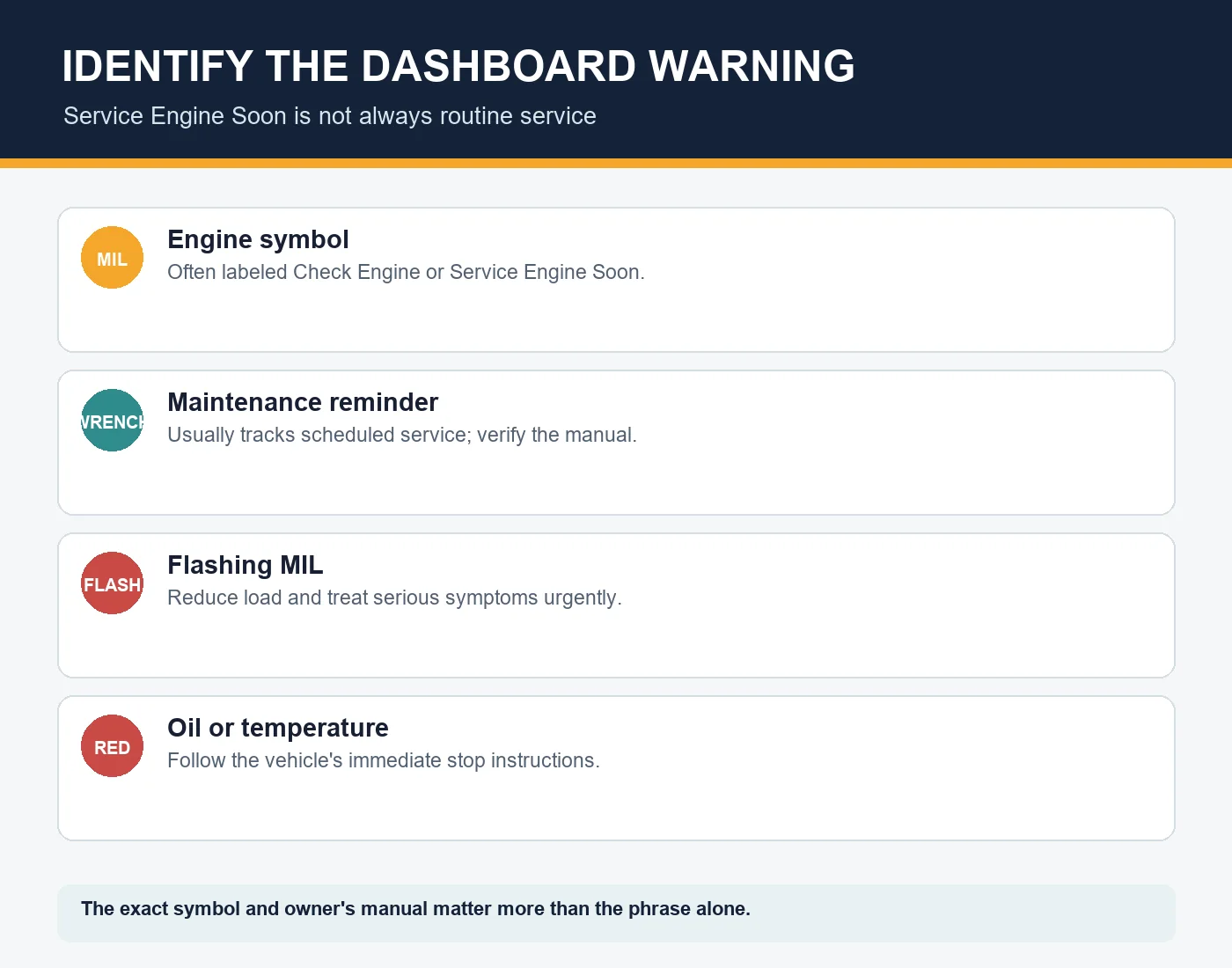
Service Engine Soon vs Check Engine Light: Quick Comparison
| Display | Common function | Best next step |
|---|---|---|
| Engine-shaped MIL | OBD-II detected an emissions-related fault | Check urgency, record codes, diagnose |
| “Check Engine” | Often the MIL label | Follow flash/steady guidance and manual |
| “Service Engine Soon” | Often the MIL label, but vehicle-specific | Confirm exact manual definition |
| Wrench or maintenance reminder | Scheduled service or manufacturer system | Review maintenance schedule and message |
| Oil-pressure or temperature warning | Separate potentially urgent warning | Follow the owner’s manual immediately |
Carvul’s complete check engine light guide covers the broader response once you have identified the MIL.
Why manufacturers use different wording
OBD-II standardizes diagnostic communication and the general function of the malfunction indicator lamp, but dashboard design and message wording vary. EPA materials note that the warning can be labeled “Check Engine,” “Service Engine Soon,” or represented by an engine symbol. A manufacturer may also use “service” language for maintenance systems that are not the MIL.
Model year matters. Do not assume that a label on one brand, generation, or instrument cluster has the same function on another.
Seven facts drivers should know
1. The symbol matters more than the phrase
Match the dashboard icon to the illustration in the owner’s manual. An engine outline generally identifies the MIL. A wrench, oil can, triangle, or information message may belong to another system.
2. A steady MIL still requires diagnosis
A steady light can represent an EVAP leak, sensor circuit, fuel-control issue, catalyst-efficiency result, misfire history, or another monitored fault. If the engine runs normally and no urgent warning is present, arrange diagnosis promptly instead of guessing at parts.
3. A flashing MIL raises urgency
A flashing warning may indicate a condition capable of damaging the catalytic converter. Reduce load, stop safely when serious symptoms occur, and consult the exact manual. The dedicated flashing check engine light guide explains that urgent situation in greater detail.
4. A maintenance reminder is not a diagnosis
Oil-life and scheduled-service systems estimate or track service needs according to manufacturer logic. Resetting one after completed maintenance does not repair an OBD fault, and clearing OBD codes does not complete scheduled maintenance.
5. Scan codes describe detected conditions
An OBD-II code does not automatically name the failed component. The vehicle may need inspection, data analysis, circuit tests, leak tests, or mechanical testing before a repair can be justified.
6. Clearing a message can erase useful evidence
Disconnecting the battery or clearing codes may remove freeze-frame data and reset readiness monitors. Record information first. A light that temporarily disappears can return when the monitor runs again.
7. State inspection consequences vary
An illuminated MIL or incomplete readiness monitors can affect an emissions inspection. Rules differ by state and vehicle type. Check the official program where the vehicle is registered.
How to identify the warning correctly
- Park safely and photograph the instrument cluster.
- Note whether the warning is steady or flashing.
- Record other warning lights and symptoms.
- Find the exact symbol in the owner’s manual.
- Check the message center for additional wording.
- Scan and record codes if it is safe and appropriate.
- Do not reset anything until the information is saved.
If oil pressure, coolant temperature, braking, charging, or another safety-related warning appears, follow its specific instructions. The fact that a Service Engine Soon message is also present does not reduce the urgency of another warning.
What “service” does not mean
“Service” does not guarantee that routine maintenance will turn the light off. An oil change cannot repair a broken wire, EVAP leak, failed heater circuit, or mechanical misfire. Conversely, a maintenance reminder can appear with no OBD fault at all.
Ask a repair facility to separate these jobs on the estimate:
- scheduled maintenance due by time or mileage;
- diagnosis of the warning light;
- confirmed repairs;
- optional preventive work;
- verification after repair.
That separation helps prevent a vague “tune-up” from replacing real diagnosis.
Buying a used car with the light on
Do not accept “it only needs a sensor” without test results. Request the scan report, readiness status, repair documentation, and permission for an independent pre-purchase inspection. Recently cleared monitors can indicate that the vehicle has not completed enough self-tests to prove the fault is gone.
A seller should not clear the warning immediately before inspection. Pending codes, permanent codes, and incomplete monitors can still provide context, but interpretation depends on the vehicle and repair history.
Frequently asked questions
Is Service Engine Soon less serious than Check Engine?
Not necessarily. On many vehicles they identify the same MIL. Urgency depends on whether it flashes, how the vehicle behaves, and what the owner’s manual says.
Does Service Engine Soon mean an oil change?
It can be confused with a maintenance reminder, but many vehicles use that phrase for the MIL. Identify the symbol and consult the exact manual.
Can I drive with the light on?
A steady light with normal operation may allow cautious travel for diagnosis, subject to manufacturer guidance. A flashing light or serious symptoms call for a more conservative response.
Will a scanner tell me what to replace?
No. It retrieves diagnostic information. Testing is required to distinguish among components, circuits, operating conditions, and mechanical causes.
Why did the light turn off by itself?
The fault may not have repeated for enough trips to keep the lamp commanded on. Stored history can remain, and the condition can return. Disappearance is not proof of repair.
Dashboard messages that are easy to confuse
Instrument clusters increasingly combine symbols with text in a message center. One warning can be accompanied by another message, and the text may disappear when the driver changes screens. Photograph the complete cluster before cycling the ignition when it is safe to do so.
Maintenance required
This commonly refers to scheduled service logic, such as oil-life or mileage tracking. It does not necessarily mean an OBD fault exists. The reset procedure should be completed only after the required service is performed.
Reduced power or limp mode
This indicates that the vehicle may be limiting performance in response to a detected condition. Avoid demanding maneuvers, follow the owner’s manual, and obtain diagnosis. The MIL may be steady or flashing at the same time.
Oil-pressure warning
An oil-can symbol can signal dangerously low pressure. It is not a routine oil-change reminder. Follow the manufacturer’s stop instructions immediately; engine damage can occur quickly.
Temperature warning
An overheating warning belongs to the cooling system and can require an immediate safe stop. Never open a hot radiator or coolant reservoir.
Battery or charging warning
This may indicate charging-system operation rather than simply a weak battery. Electrical power can eventually be lost. Follow the manual and arrange testing.
A brand-by-brand assumption is not enough
Owners sometimes learn that one automaker uses “Service Engine Soon” for the MIL and then apply that rule to every car. Even within one brand, wording, icon design, and maintenance systems can change across model years and markets. Imported vehicles and replacement clusters add more variation.
The reliable process is vehicle-specific:
- Record the exact text and symbol.
- Confirm model year and powertrain.
- Check the warning-lights section of the owner’s manual.
- Note whether the lamp is steady or flashing.
- Retrieve diagnostic information if it is the MIL.
What a scan result should include
If the warning is the MIL, ask for more than a verbal code number. A useful record includes code status, description for the exact vehicle, freeze-frame data, readiness monitors, and relevant manufacturer-enhanced information.
Stored codes show faults that met confirmation logic. Pending codes can show a condition detected before full confirmation. Permanent codes follow regulatory clearing logic. History terminology can vary by manufacturer and tool. None should be converted directly into a parts order.
Separating scheduled service from fault diagnosis
It is possible for a car to need both at the same time. A vehicle can be due for an oil change while also having an EVAP leak or misfire. Ask the shop to list them separately:
| Work category | Evidence | Completion proof |
|---|---|---|
| Scheduled maintenance | Time, mileage, oil-life, service history | Service recorded and reminder reset correctly |
| Warning-light diagnosis | Codes, data, inspection, tests | Root cause documented |
| Confirmed repair | Failed component/circuit and procedure | Symptom resolved and test passed |
| Preventive recommendation | Condition or schedule | Customer-authorized maintenance completed |
This separation makes the invoice easier to evaluate and prevents the mistaken belief that routine service automatically fixes the MIL.
Used-car inspection implications
A Service Engine Soon lamp should be treated as unresolved until evidence shows otherwise. Ask the seller when it appeared, whether it flashes, what diagnosis was performed, and why the repair has not been completed. Scan the vehicle with permission and review readiness.
A recently cleared dashboard can stay dark before monitors rerun. That does not prove fraud because legitimate battery or repair work also resets monitors. It does mean the inspection needs records and enough evidence to establish present condition.
Do not accept a promise that the warning is “only maintenance” unless the exact owner’s manual supports that interpretation. An independent pre-purchase inspection should identify the symbol and investigate the underlying message.
What to tell the repair facility
Provide the exact wording, color, symbol, flash behavior, and symptoms. Mention recent battery replacement, maintenance reset, repairs, refueling, stalling, or reduced power. If the warning is intermittent, state when it appears rather than repeatedly trying to force it on.
Ask the facility to preserve diagnostic data and explain whether it is handling a maintenance reminder, an OBD malfunction, or both.
Additional questions
Can Service Engine Soon indicate a transmission fault?
On some vehicles, powertrain faults can command the MIL, while others use separate transmission or reduced-power messages. Retrieve codes from the relevant modules and use manufacturer information.
Why is the light on after an oil change?
The maintenance reminder may not have been reset, an OBD fault may be unrelated to the oil change, or recent work may have affected a connector or hose. Identify the exact symbol before deciding.
Can I reset a maintenance reminder myself?
Many vehicles provide an owner procedure after service, but it varies. Reset only the reminder that corresponds to completed maintenance. Do not erase diagnostic codes to hide a fault.
Does a yellow light always mean it is safe to drive?
No. Color is one clue, not a guarantee. Flashing behavior, severe symptoms, other warnings, and manufacturer instructions determine urgency.
What if the manual is missing?
Use the manufacturer’s official owner-information site and verify the VIN, model year, and powertrain. Avoid relying solely on an image search or a manual from another year.
Is the warning covered by warranty?
Coverage depends on the failed component, vehicle age and mileage, emissions-warranty rules, recalls, and the warranty terms. Diagnosis is needed before coverage can be determined.
When documenting an intermittent message, include a clear dashboard photograph, date, mileage, engine temperature, and driving condition. Those details help a technician identify the correct system even when the warning is no longer visible during the appointment.
Is Service Engine Soon vs Check Engine Light terminology universal?
Service Engine Soon vs Check Engine Light wording is not universal across every model year. Confirm the exact symbol and definition in the owner’s manual before treating it as a fault or maintenance reminder.
Related Carvul Guidance
Continue with flashing check engine light safety steps and reasons a check engine light turns on for the next step in the diagnostic process.
Bottom line
The service engine soon vs check engine light distinction depends on the exact vehicle, symbol and warning behavior.
Service Engine Soon and Check Engine often describe the same OBD-II warning, but not always. Confirm the symbol in the owner’s manual, separate maintenance reminders from faults, preserve diagnostic evidence, and respond according to symptoms and flash behavior.
Before closing the repair order, ask the shop to identify the warning exactly as the manufacturer does, list any retrieved codes, and state separately which scheduled services were completed. That written separation prevents future confusion when the vehicle changes owners or another dashboard message appears.
For ongoing ownership, keep a photograph of the cluster and the matching manual page with the service records. A future driver then has a reliable reference instead of guessing from the word “service.”
If the warning appears during a trip, avoid relying on dashboard color alone. Combine the exact symbol, flashing behavior, engine operation, gauges, messages, and manufacturer instructions. A yellow message can still accompany a condition that limits power, while a separate red oil-pressure or temperature warning can demand an immediate safe stop.
After service, verify that the correct reminder was reset and that no diagnostic information was erased unnecessarily. Ask for an invoice that distinguishes maintenance from fault diagnosis and records any codes found. This small documentation step becomes especially valuable during resale, warranty review, or a later intermittent problem.
Owners who share a vehicle should explain the distinction to every regular driver. Keep roadside-assistance information available and agree that a flashing lamp, severe shaking, smoke, overheating, low oil pressure, or major power loss calls for a safe stop and vehicle-specific guidance, not an attempt to finish the trip. Clear household rules reduce the chance that an ambiguous “service” message is either ignored or treated with unnecessary panic.
Authoritative sources
- U.S. EPA: On-Board Diagnostics questions and answers
- California BAR: OBD and inspection information
- Manufacturer owner’s documentation for the exact model and year