
A midsize truck comparison should begin with your people, cargo and trailer, not a favorite badge. Toyota Tacoma, Ford Ranger, Chevrolet Colorado, Nissan Frontier and Honda Ridgeline all fit the broad U.S. midsize-pickup conversation, yet their construction, powertrains and packaging solve different problems.
This guide compares published 2026 information and gives you a repeatable process for evaluating the exact truck on a dealer lot. It does not declare one universal winner. Maximum towing and payload figures depend on configuration and can be reduced by passengers, accessories and cargo.
Quick answer: Tacoma offers the broadest personality range; Ranger emphasizes available towing and turbo power; Colorado combines high published torque with strong trailering; Frontier keeps a standard V6 and useful cab choices; Ridgeline prioritizes road comfort and cabin/bed flexibility. The best choice is the configuration that passes your payload, seating, budget and test-drive checks.
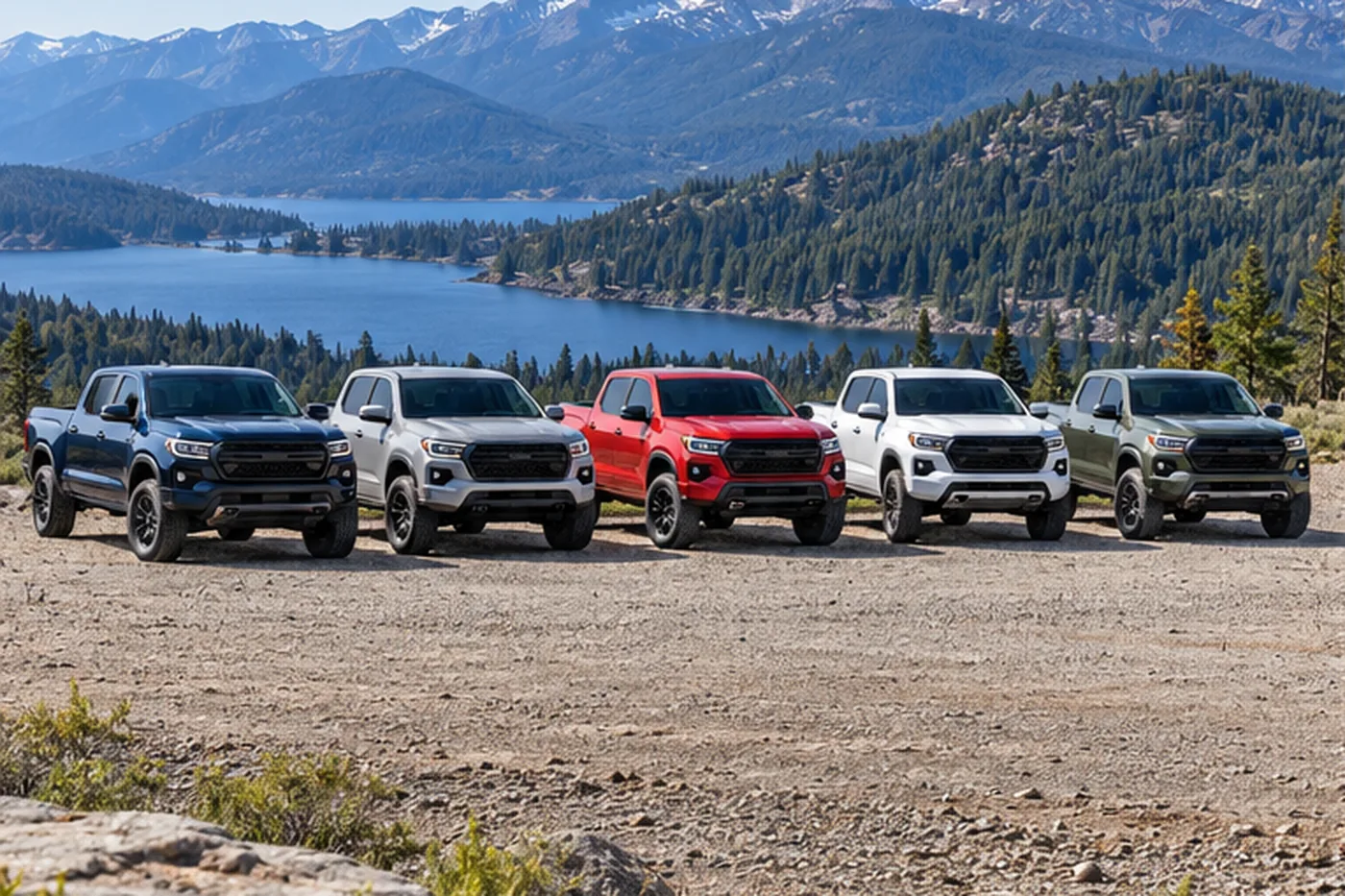
Midsize Truck Comparison Chart
| Truck | Construction | Published capability context |
|---|---|---|
| Toyota Tacoma | Body-on-frame | Up to 6,500 lb towing; up to 1,705 lb payload |
| Ford Ranger | Body-on-frame | Up to 7,500 lb towing; up to 1,767 lb payload |
| Chevrolet Colorado | Body-on-frame | Up to 7,700 lb towing; about 1,710 lb max payload |
| Nissan Frontier | Body-on-frame | Up to 7,150 lb towing; up to 1,620 lb payload |
| Honda Ridgeline | Unibody | 5,000 lb towing; up to 1,583 lb payload |
This midsize truck comparison chart uses headline manufacturer figures only to orient the search. It does not mean the maximum tow and payload numbers occur together. Door-jamb labels and official towing guides control the real comparison.
11 Tests to Compare Midsize Pickup Trucks
1. Define the job
Write down weekly cargo, largest expected trailer, passengers, parking limits and unpaved-road use. Separate “might do someday” from recurring needs. Buying for an unlikely scenario can add cost, weight and discomfort every day.
2. Build a real payload budget
Use the payload label from the actual truck. Subtract occupants, accessories, bed cargo and tongue weight. Leave a margin rather than planning to operate at the limit.
3. Use loaded trailer weight
Brochure dry weight excludes supplies, batteries, water and gear. Verify gross trailer rating and estimate realistic tongue weight. Confirm trailer brakes and hitch requirements.
4. Match cab and rear-seat needs
Bring passengers and child seats. Measure usable knee room, door opening and front-seat compromise. “Crew cab” does not guarantee equal space across brands.
5. Measure the bed
Check length, width, depth, tie-downs, outlet, tailgate and cover compatibility. Bed volume can matter more than a few inches of exterior length.
6. Compare powertrain behavior
Drive cold and warm, in traffic and at highway speed. Smooth response and controllability matter more than an isolated peak number.
7. Separate off-road need from styling
Special tires and suspension can improve trail performance but increase noise, expense and step-in height. Buy hardware that matches actual terrain.
8. Check safety by model year
Review IIHS and NHTSA information for the exact year. Driver-assistance feature names and availability can change by trim.
9. Price insurance and tires
Get VIN-level insurance quotes and replacement-tire prices. A desirable off-road package can carry a meaningful recurring cost.
10. Compare out-the-door cost
Use written, VIN-specific quotes. Separate taxes, fees, installed equipment, financing and optional products.
11. Inspect the exact vehicle
Even a new truck needs a delivery inspection. A used truck needs independent mechanical, frame, tire, hitch, modification and history checks.
Five Midsize Pickup Profiles
Toyota Tacoma
The Toyota Tacoma uses body-on-frame construction and turbocharged four-cylinder choices, including an available hybrid system. Published capability reaches up to 6,500 pounds and up to 1,705 pounds, but those maximums do not necessarily occur on the same truck. Its clearest strength is a broad trim range, multiple off-road personalities and strong buyer familiarity. The main caution is that cab, bed, drivetrain, suspension and hybrid choices change price, payload and daily comfort. It best fits buyers who want configuration choice, trail-focused trims and a truck-shaped ownership experience.
Ford Ranger
The Ford Ranger uses body-on-frame construction and turbocharged gasoline engines, with a high-output Raptor at the top of the range. Published capability reaches up to 7,500 pounds when properly configured and up to 1,767 pounds in Ford’s published model overview, but those maximums do not necessarily occur on the same truck. Its clearest strength is strong available towing, straightforward crew-cab packaging and a performance-oriented Raptor. The main caution is that maximum ratings require the correct configuration and may shrink after passengers, accessories and cargo are added. It best fits buyers balancing towing, turbocharged performance and everyday midsize dimensions.
Chevrolet Colorado
The Chevrolet Colorado uses body-on-frame construction and a 2.7-liter TurboMax gasoline engine across the current range. Published capability reaches up to 7,700 pounds with the required configuration and up to about 1,710 pounds in Chevrolet’s comparison material, but those maximums do not necessarily occur on the same truck. Its clearest strength is high published torque, strong available trailering and distinct off-road trims. The main caution is that ZR2-style off-road hardware can reduce trailering and payload compared with a road-oriented configuration. It best fits buyers prioritizing available torque, trailering technology or specialized off-road hardware.
Nissan Frontier
The Nissan Frontier uses body-on-frame construction and a standard 3.8-liter V6 paired with a nine-speed automatic. Published capability reaches up to 7,150 pounds depending on cab and drivetrain and up to 1,620 pounds in Nissan’s published overview, but those maximums do not necessarily occur on the same truck. Its clearest strength is standard V6 power, relatively simple powertrain choice and useful cab/bed configurations. The main caution is that tow and payload labels vary substantially among King Cab, Crew Cab, long-bed and PRO-4X versions. It best fits buyers wanting a conventional V6 midsize truck with clear work-and-weekend priorities.
Honda Ridgeline
The Honda Ridgeline uses unibody construction and a 280-horsepower 3.5-liter V6 with a nine-speed automatic and standard AWD. Published capability reaches up to 5,000 pounds and up to 1,583 pounds on Honda’s 2026 specification table, but those maximums do not necessarily occur on the same truck. Its clearest strength is road comfort, a wide cabin, dual-action tailgate and lockable in-bed trunk. The main caution is that its lower maximum tow rating and unibody layout target a different use case than the most trail-focused rivals. It best fits buyers who need open-bed utility but value crossover-like road manners and cabin usability.
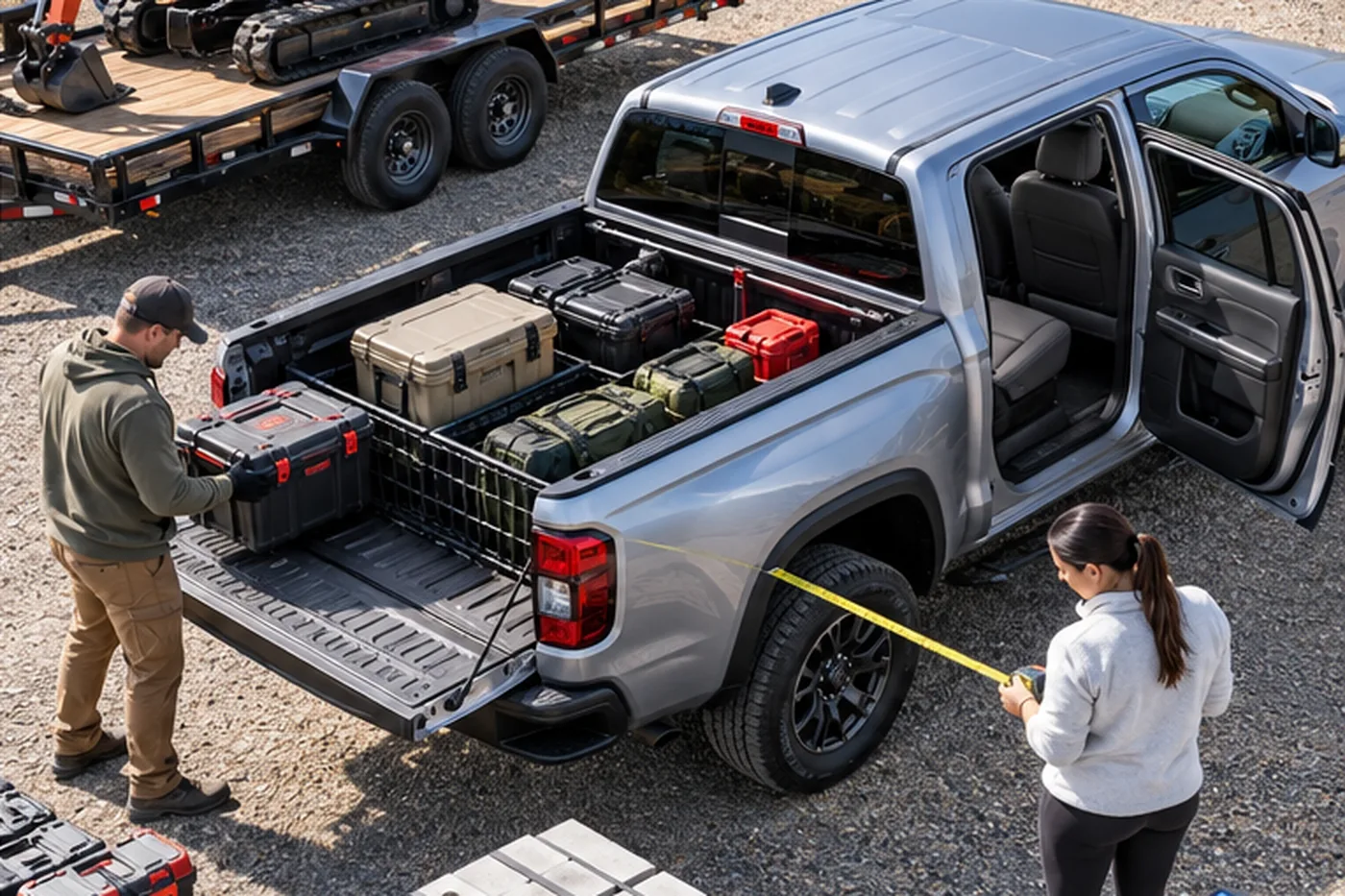
Midsize Pickup Comparison: Towing and Payload
Towing is where headline comparisons become risky. A truck can advertise a high trailer rating while a loaded luxury or off-road configuration has less payload. Payload is consumed by the driver, passengers, hitch, tongue weight, bed cargo and accessories.
Start with the yellow Tire and Loading Information label. If payload is 1,400 pounds and occupants plus accessories use 650, only 750 remains for bed cargo and tongue weight. A trailer placing 700 pounds on the hitch leaves almost no margin.
Also check gross axle weight ratings, gross vehicle weight rating and gross combined weight rating. Confirm the receiver, ball mount, wiring, brake controller and cooling package. The owner’s manual may impose frontal-area, speed or weight-distributing-hitch rules not visible in an advertisement.
For frequent heavy towing, a full-size truck may provide more comfortable capacity. The purpose of a midsize pickup comparison is to find the smallest truck that safely handles the real task, not to force a midsize platform into full-size work.
Cabin, Parking and Family Use
Midsize trucks are easier to place than full-size pickups, but they are not compact cars. Measure garage length, mirror width and turning room. Test the rear camera in darkness and rain if possible, and check whether parking sensors are standard on the trim.
Family buyers should install their own child seats during a serious test drive. Check the front passenger’s remaining legroom, rear ventilation, USB access and door opening. Ridgeline’s unibody packaging has a different feel from the body-on-frame group, but every buyer should judge comfort personally.
Ride quality changes with tire sidewall, pressure, payload and suspension tune. An empty off-road truck can feel busy on concrete highways. Drive the exact wheel-and-tire combination you plan to buy.
Off-Road Trims: Capability With Tradeoffs
Trail-focused Tacoma, Ranger, Colorado and Frontier variants can add locking differentials, underbody protection, specialized dampers, terrain modes and aggressive tires. Those features are valuable for repeated difficult use, but they may reduce towing or payload, increase tire cost and compromise daily refinement.
Do not confuse ground clearance with complete trail suitability. Wheelbase, approach and departure geometry, breakover angle, recovery points, cooling, tire construction and driver skill all matter. Inspect the spare tire and confirm it matches the intended terrain.
If most driving is paved, a moderate four-wheel-drive trim with good tires may be the smarter value. If off-roading is central, compare recovery hardware and low-speed control, not decorative packages.
Price and Total Ownership Cost
Starting price rarely reflects the truck most people compare. Cab, drivetrain, tow package, safety equipment and dealer-installed accessories can move the out-the-door price significantly. Collect comparable written quotes and use the same down payment and loan term.
Estimate fuel, insurance, registration, tires, maintenance and depreciation. Google Ads competition is not organic SEO difficulty, and a high search volume does not prove a truck is a good financial fit. Similarly, popularity does not guarantee a lower local transaction price.
Use Carvul’s financing guide and keep optional products separate from the vehicle decision. A lower monthly payment produced by a longer loan is not the same as a lower total cost.
Used Midsize Truck Inspection Checklist
A used truck can hide harder use than a sedan. Follow the used-car inspection checklist, then add truck-specific checks:
- Inspect frame rails, crossmembers, skid plates and recovery points.
- Check hitch, trailer wiring and brake-controller installation.
- Look for bed damage, overloaded springs and tailgate misalignment.
- Inspect tire size, load rating and uneven wear.
- Test four-wheel drive, locking differential and drive modes.
- Review modifications, tuning, lift geometry and calibration records.
- Check service history, open recalls and technical communications.
- Use an independent shop familiar with trucks and towing.
A clean history report does not prove a truck was never overloaded or used off-road. Physical inspection and a long test drive remain essential. Use Carvul’s vehicle history report guide to understand what records can and cannot show.
Detailed Midsize Truck Comparisons
- Nissan Frontier vs Toyota Tacoma
- Chevy Colorado vs Toyota Tacoma
- Honda Ridgeline vs Toyota Tacoma
- Ford Ranger vs Toyota Tacoma
- Chevy Colorado vs Ford Ranger
- Ford Ranger vs Nissan Frontier
Each head-to-head page compares a distinct search intent. Read the pair that matches your shortlist instead of assuming the class-wide winner applies to every two-truck decision.
Midsize Truck Comparison FAQ
What is the best midsize truck for buyers?
The best midsize truck for buyers is the exact configuration that meets payload, seating and towing requirements at an acceptable out-the-door and ownership cost. There is no universal winner.
Which midsize truck tows the most?
Chevrolet publishes up to 7,700 pounds for the 2026 Colorado, while Ford publishes up to 7,500 for Ranger. Exact configuration and payload still determine whether either fits a trailer.
Which midsize truck is best for families?
Ridgeline emphasizes cabin usability, but every household should install its own child seats and test rear-seat comfort in each finalist.
Which is best off-road?
Several brands offer specialized trims. Compare the terrain, tire, suspension, protection and recovery equipment you actually need rather than relying on trim names.
Should I buy a midsize or full-size truck?
Choose full-size when recurring payload, towing or cabin needs exceed a midsize truck’s comfortable capacity. Choose midsize when parking, maneuverability and lower mass matter and the ratings leave a safe margin.
Can I trust maximum payload figures?
Use them only for initial research. The door-jamb label on the exact vehicle is the practical number for purchase planning.
Midsize Truck Trim-Matching Strategy
Trim names make comparison harder because each manufacturer packages capability differently. Create a minimum-equipment list before opening configurators: cab, driven wheels, bed utility, safety equipment, tow hardware and comfort features. Price the lowest trim from each brand that satisfies that same list. This avoids comparing a basic work truck with a premium off-road model simply because both appear in search results.
Keep factory capability and dealer accessories in separate columns. A bed cover, side step or wheel package may be useful, but it should not hide the price of the underlying truck. Ask whether each accessory affects payload, warranty, sensors or service access. Save the window sticker and VIN-specific quote so another dealer can price an equivalent configuration.
Midsize Truck Comparison by Buyer Type
Commuter and weekend project buyer
Prioritize seating position, visibility, parking, road noise and useful bed features. Do not pay automatically for maximum towing or extreme trail hardware. A road-oriented truck with the right tie-downs and a secure cover may be the more satisfying everyday tool.
Family buyer
Bring passengers and child seats. Evaluate door opening, rear-seat space, charging, cabin storage and step-in height. Check how luggage will remain dry and secure. A nominal crew cab can still require front-seat compromises, so physical fit carries more weight than exterior dimensions.
Frequent towing buyer
Start with the loaded trailer, tongue weight and payload label. Verify the tow package, brake controller, axle and cooling equipment. Leave capacity margin for changing passengers and cargo. Buyers repeatedly approaching midsize limits should include a properly configured full-size truck in the test.
Work and payload buyer
Weigh tools and materials instead of estimating. Account for racks, boxes, steps and permanent equipment. Bed access, tie-down placement and local service support may matter more than acceleration. Compare downtime risk and fleet-friendly maintenance access.
Trail buyer
Match equipment to terrain. Ground clearance is only one input; tires, underbody protection, recovery points, wheelbase and cooling also matter. Specialized trims can be excellent when their hardware is used, but they bring cost and road compromises that should be acknowledged.
How to Test-Drive a Midsize Truck
- Begin with a cold start and listen for abnormal noise.
- Adjust the seat and mirrors without accepting a compromised posture.
- Drive in stop-and-go traffic to assess low-speed transmission behavior.
- Use a rough road to evaluate ride and cabin movement.
- Merge at highway speed and check noise and visibility.
- Park forward and backward in a normal-size space.
- Test rear-seat access with regular passengers or child seats.
- Operate the tailgate, bed outlets, tie-downs and storage.
- Verify four-wheel-drive modes only as directed by the manual.
- Repeat the same route in every finalist.
Use a written scorecard immediately after each drive. Rate seat comfort, control response, visibility, ride, noise, cabin fit, bed access and parking from one to five. Notes collected on the same route are more reliable than memory after several dealership visits.
Payload Calculation Example
Assume the exact truck has a 1,500-pound payload label. Two adults, two children and travel items total 600 pounds. A bed cover, hitch and accessories add 150 pounds. That leaves 750 pounds before trailer tongue weight or bed cargo. If a loaded trailer contributes 650 pounds of tongue weight, only 100 pounds remain. The trailer may be below the advertised tow maximum while the truck is effectively at its payload limit.
Repeat this calculation with real weights. Do not borrow the payload number from a different trim in an online review. Options can alter curb weight, and the label on the selected truck is the practical reference. Confirm axle and combined ratings as a separate step.
Negotiation and Purchase Documentation
Request an itemized out-the-door quote tied to a VIN. It should separate vehicle price, accessories, dealer fees, government charges, financing and optional products. Compare offers with the same loan term and down payment. A payment can be lowered by extending the term without reducing total cost.
Before delivery, verify that the VIN matches every document and that promised accessories are installed correctly. Inspect paint, glass, wheels, tires, bed, cabin and warning lights. Confirm both keys, manuals and charging or towing equipment. Photograph the odometer and condition, and keep signed due-bill commitments.
When a Midsize Truck Is the Wrong Answer
A full-size pickup may be more appropriate when heavy towing, high payload or spacious rear seating is routine. A crossover or minivan may be more comfortable and efficient when the bed is rarely used. Renting a truck for occasional projects can cost less than owning capability every day.
The goal is not to justify a midsize pickup after deciding emotionally. It is to test whether open-bed utility and truck capability solve enough recurring problems to offset fuel, tire, insurance and parking costs. A disciplined midsize truck comparison can therefore end with a truck, a different vehicle type or a decision to wait.
Safety Comparison: Use the Exact Model Year and Trim
Safety equipment and crash-test results should be matched to the exact model year. A rating for an earlier generation, another cab or a differently equipped trim may not describe the vehicle in front of you. Review IIHS small-pickup results and NHTSA vehicle pages, then confirm which driver-assistance features are standard, optional or absent on the chosen VIN.
During the test drive, evaluate more than the feature list. Confirm that forward visibility, mirror coverage, camera image and control placement work for the driver. Ask the dealer to demonstrate automatic emergency braking, blind-spot monitoring, lane-related systems, trailer coverage and parking sensors without assuming every brand uses the same operating logic.
Check NHTSA recalls by VIN shortly before purchase. A model-level recall search can establish context, but only the VIN identifies whether a particular truck has an open campaign. Ask for written repair completion when a recall was previously addressed. A recall does not automatically make a model a bad purchase; unresolved safety work and poor documentation are the actionable concerns.
Reliability and Repair-Cost Research
Reliability cannot be decided from brand reputation or a single owner story. Separate the model year, engine, transmission, drivetrain and use history. A redesigned truck may not share the long-term record of the version it replaced. Likewise, a familiar powertrain does not guarantee that every used example was maintained correctly.
Review maintenance schedules and price common wear items before buying. Ask a local shop about labor access, parts availability and diagnostic experience. Price the exact tire size, battery, brakes and major fluids. Off-road tires, electronic dampers and specialized body parts can make a halo trim more expensive to restore after normal wear or minor damage.
For a used truck, documentation is stronger evidence than a clean-looking engine bay. Seek dated oil-change records, transmission and driveline service where specified, cooling-system work, brake history and tire replacement. Compare mileage entries across invoices, title records and vehicle-history data. Have an independent technician scan modules and inspect underneath before the purchase becomes final.
Fuel Economy and Range Planning
EPA estimates allow standardized comparisons, but real use changes results. Short trips, winter temperatures, speed, payload, towing, aggressive tires, racks and elevation can reduce economy. Compare the exact engine, drivetrain and body configuration on FuelEconomy.gov rather than relying on the best number advertised for the lineup.
Estimate annual fuel cost with your mileage and a realistic local price. A three-mpg difference matters more to a 20,000-mile commuter than to a household driving 6,000 miles per year. Also compare tank capacity and practical range if towing or traveling in rural areas. A theoretical efficiency advantage may be less useful if the intended route requires frequent fuel stops.
Hybrid availability should be evaluated as a complete configuration, not only as a fuel-saving label. Added power, equipment, payload, price and driving pattern all influence value. Calculate the purchase-price difference against realistic annual fuel savings and expected ownership period.
Bed, Cab and Accessory Planning
List the objects the truck must carry and measure them. Compare bed length with the tailgate closed, width between wheel housings, bed depth, tie-down locations and outlet capacity. Test whether a toolbox, bicycle mount, camping system or tonneau cover can coexist with the required cargo. An accessory catalog does not prove that every combination fits together.
Accessories consume money and sometimes payload. Steps, racks, winches, skid plates, larger tires and bed systems can also affect clearance, noise, sensors or warranty discussions. Ask for installed weights and keep invoices. When shopping used, inspect attachment points and wiring rather than judging accessories only by appearance.
Cab selection creates another tradeoff. More rear-seat space may come with a shorter bed or longer overall truck. A longer wheelbase can improve some highway behavior while making tight trails and urban parking harder. Measure the garage with the door closed and include hitch or rack extensions.
New-Truck Delivery Checklist
- Match VINs on the truck, window sticker, purchase agreement and insurance binder.
- Confirm trim, drivetrain, cab, bed and factory option packages.
- Inspect paint, panels, glass, lights, wheels, tires and the bed in daylight.
- Check tire pressures against the door label, not a generic target.
- Test keys, cameras, infotainment and driver-assistance alerts.
- Verify jack, tools, spare tire and promised towing equipment.
- Review warranty start date and obtain every signed document.
- Record missing accessories or repairs on a signed due bill.
Do not let delivery excitement replace inspection. Report transport damage or missing equipment before accepting the truck. If a warning light is active, request diagnosis and documentation instead of accepting a verbal promise that it will clear later.
Used-Truck Comparison Scorecard
| Evidence | Candidate A | Candidate B |
|---|---|---|
| VIN/title/history consistency | Pass / review | Pass / review |
| Service records | Complete / partial / absent | Complete / partial / absent |
| Independent inspection | Findings | Findings |
| Frame and underbody | Condition | Condition |
| Tires and brakes | Remaining life | Remaining life |
| Modifications | Documented / unknown | Documented / unknown |
| Open recalls | Yes / no | Yes / no |
| Immediate repair budget | $____ | $____ |
| Out-the-door price | $____ | $____ |
Use the scorecard to compare condition-adjusted cost. A cheaper truck that immediately needs tires, brakes, fluid service and modification correction may cost more than a cleaner candidate. Do not assign a dollar value to missing evidence without inspection; uncertainty itself is a reason to slow down or walk away.
Common Midsize Truck Comparison Mistakes
Comparing maximums from incompatible trims
The highest towing and payload figures may come from different configurations. Use the exact labels and guides for the truck being purchased.
Choosing a monthly payment
Loan term, rate, down payment and optional products can hide total cost. Compare itemized price and financing separately.
Buying an off-road image
Specialized hardware is worthwhile when terrain demands it. For pavement-heavy use, tire and ride tradeoffs may reduce value.
Assuming every crew cab fits a family
Seat geometry differs. Install child seats and test adult comfort before signing.
Ignoring payload while discussing towing
Passengers and tongue weight can exhaust payload before the trailer reaches the advertised maximum.
Skipping the exact-VIN review
Marketing pages describe a lineup. The VIN, window sticker, payload label and service records describe the vehicle.
A 30-Minute Final Comparison Routine
Spend five minutes confirming VIN, equipment and payload. Spend five minutes checking seating and cargo fit. Use ten minutes for the same mixed-road test route, including parking. Spend five minutes reviewing the itemized price, and five minutes listing unanswered questions. Repeat without changing the scorecard.
Do not decide until both candidates have complete written information. If one seller supplies labels, records and an inspection while another relies on broad claims, that difference is part of the comparison. Transparency reduces purchase risk even when two trucks look similar on paper. Keep the completed worksheet with the purchase records and revisit the assumptions before signing, especially when the price, configuration or intended trailer changes.
Final Recommendation
A strong midsize truck comparison produces a shortlist, not a trophy. Define the work, compare equivalent trims, calculate payload, price insurance, test the cabin and inspect the exact vehicle. Tacoma, Ranger, Colorado, Frontier and Ridgeline are credible options when matched to the right use.
Sources reviewed October 3, 2026: official 2026 information from Toyota, Ford, Chevrolet, Nissan and Honda; plus IIHS, NHTSA and EPA FuelEconomy.gov. Verify the exact VIN and current manufacturer documents.