
Nissan Frontier vs Toyota Tacoma is not a one-number contest. Both trucks can handle commuting, home projects and recreation, but they reach those goals with different powertrains, packaging and configuration choices. The right answer depends on the trailer you actually pull, the people you actually carry and the price of the exact VIN on the dealer lot.
This independent U.S. buyer comparison uses published 2026 manufacturer information. Maximum ratings are not universal: passengers, cargo, accessories, tires, drivetrain, cab, bed and option packages can change the final capacity. Always verify the door-jamb payload label, owner’s manual and VIN-specific equipment before buying or towing.
Quick answer: Choose the Frontier when buyers wanting a conventional V6 midsize truck with clear work-and-weekend priorities. Choose the Tacoma when buyers who want configuration choice, trail-focused trims and a truck-shaped ownership experience. Neither is automatically better for every buyer; compare the exact trims at the same out-the-door price and test them with your real cabin, cargo and towing needs.
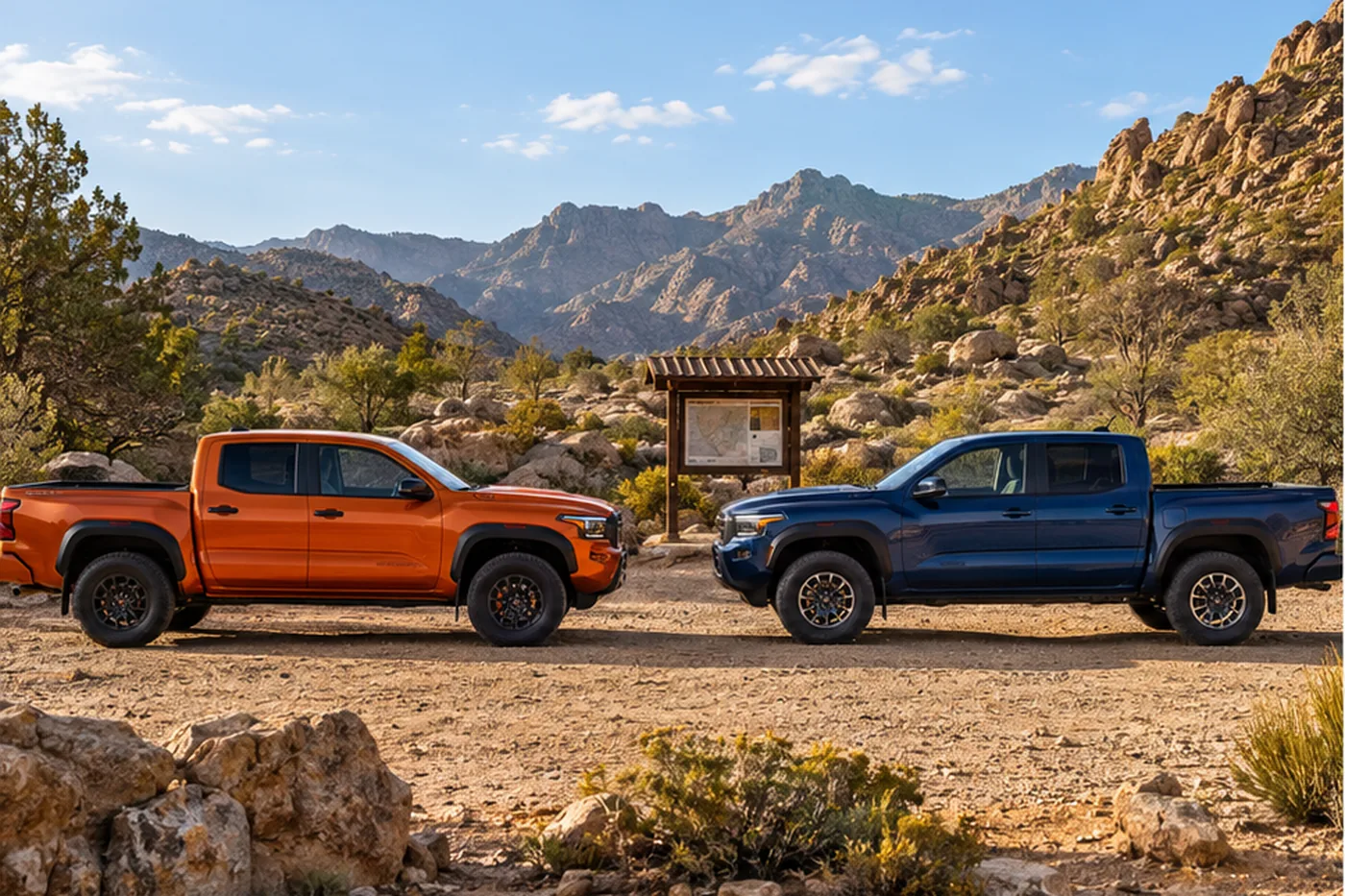
Nissan Frontier vs Toyota Tacoma: 9 Smart Buyer Tests
| Buyer test | Frontier | Tacoma |
|---|---|---|
| Construction | body-on-frame | body-on-frame |
| Powertrain approach | a standard 3.8-liter V6 paired with a nine-speed automatic | turbocharged four-cylinder choices, including an available hybrid system |
| Published max towing | up to 7,150 pounds depending on cab and drivetrain | up to 6,500 pounds |
| Published max payload | up to 1,620 pounds in Nissan’s published overview | up to 1,705 pounds |
| Best-known advantage | standard V6 power, relatively simple powertrain choice and useful cab/bed configurations | a broad trim range, multiple off-road personalities and strong buyer familiarity |
| Main configuration warning | tow and payload labels vary substantially among King Cab, Crew Cab, long-bed and PRO-4X versions | cab, bed, drivetrain, suspension and hybrid choices change price, payload and daily comfort |
The table is a starting point, not a substitute for a build-sheet comparison. A base work truck and a high-clearance off-road trim can carry different loads even when the badge is the same. Compare equivalent cab, drivetrain and equipment levels rather than a low-priced version of one truck with a loaded version of the other.
Compare the Exact Frontier and Tacoma Configurations
Online comparison pages often place the largest number from each lineup side by side. That can be useful for screening, but it can also create a combination that no local dealer stocks. Start by writing down five non-negotiables: seating, bed length, four-wheel drive, realistic payload and loaded trailer weight.
Then request the Monroney label or original build sheet for both vehicles. Confirm axle, factory tow equipment, wheel and tire package, spare tire, driver-assistance features and any dealer-installed accessories. Heavy steps, racks, bed covers and off-road equipment consume payload even when they improve utility.
The Frontier’s standard V6 and the Tacoma’s wider powertrain/trim strategy make this a choice between simplicity and breadth. Do not assume a powertrain layout predicts reliability; condition, service and model-year evidence matter more.
Powertrain, Acceleration and Everyday Driving
The Nissan Frontier uses a standard 3.8-liter V6 paired with a nine-speed automatic. Its central appeal is standard V6 power, relatively simple powertrain choice and useful cab/bed configurations. The Toyota Tacoma takes a different route with turbocharged four-cylinder choices, including an available hybrid system; its strongest case is a broad trim range, multiple off-road personalities and strong buyer familiarity.
Horsepower and torque peaks do not describe throttle response, transmission behavior or noise. Drive both trucks cold, in traffic and on a highway entrance. Look for smooth low-speed shifts, predictable brake response, clear forward visibility and a seating position you can tolerate for two hours. If you live at altitude or tow regularly, ask how the chosen engine delivers torque under load rather than comparing brochure peaks alone.
Fuel cost should be based on the exact EPA listing and your own route. Tires, four-wheel drive and off-road packages can change consumption. Use FuelEconomy.gov for a like-for-like model-year check; do not transfer a rating from one trim to every version.
Towing Capacity and Payload: The Math That Matters
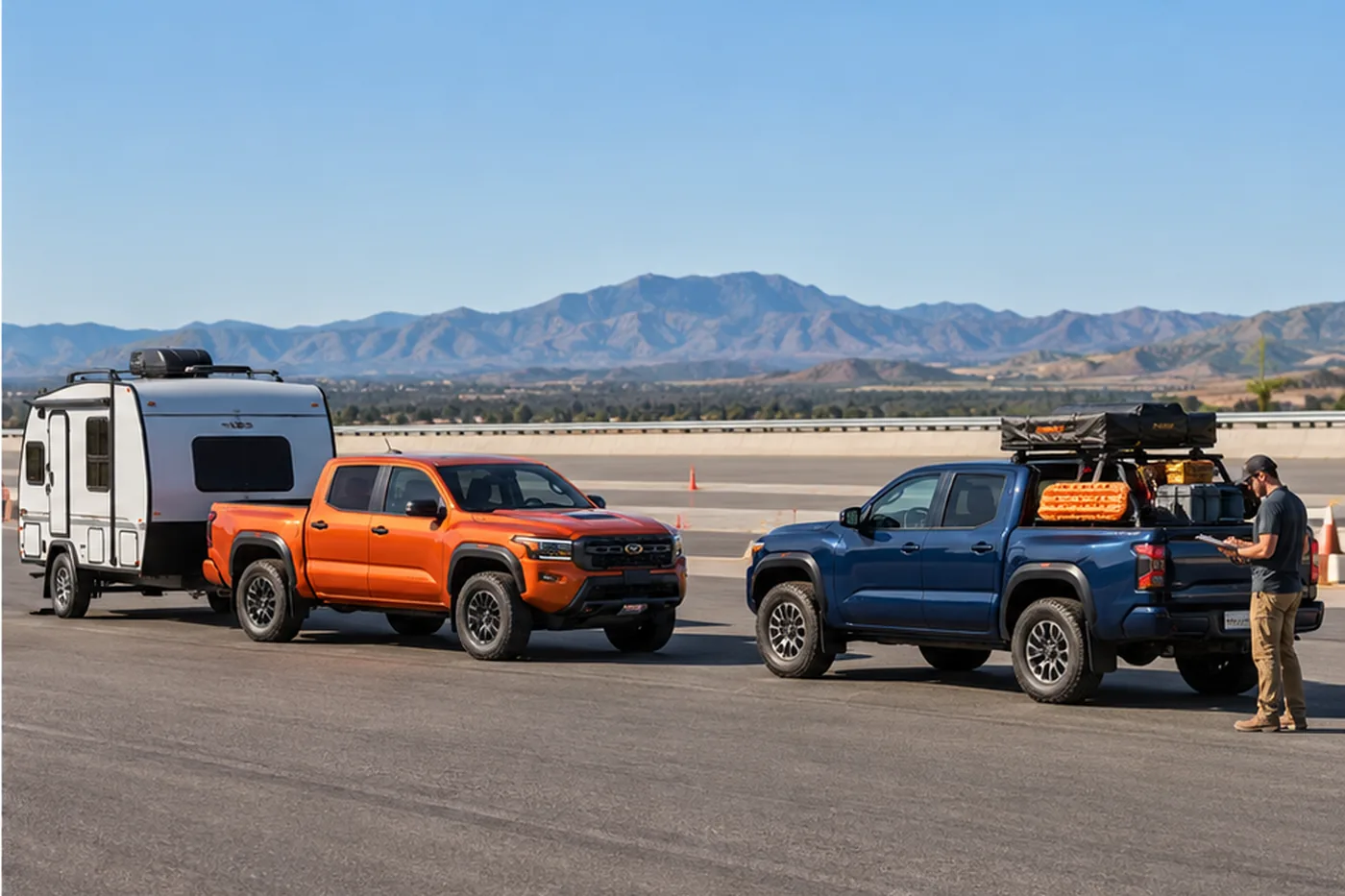
The Frontier is advertised at up to 7,150 pounds depending on cab and drivetrain, while the Tacoma is advertised at up to 6,500 pounds. Those are maximum figures under specific conditions. The more useful number is the payload printed on the Tire and Loading Information label of the truck you will buy.
Payload must absorb occupants, cargo, accessories and trailer tongue weight. A 6,000-pound trailer with 12% tongue weight places roughly 720 pounds on the truck before people or luggage are counted. Subtract the driver, passengers, tools, bed cover and hitch hardware from the label’s payload to estimate remaining capacity.
- Record the truck’s actual payload label.
- Add the weight of every occupant.
- Add bed cargo and permanent accessories.
- Estimate loaded, not empty, trailer tongue weight.
- Confirm gross axle, vehicle and combined ratings.
- Check hitch class, wiring, brake controller and cooling requirements.
A truck with the larger headline tow figure can still be the wrong tow vehicle if its payload, rear-axle rating or hitch equipment is insufficient. Read the manufacturer towing guide and owner’s manual before connecting a trailer.
Cabin, Rear Seat and Bed Utility
The Crew Cab is the family-oriented choice; the King Cab prioritizes bed and work utility over rear-seat comfort. Rear-seat room and driving position should be tested in the exact cab, especially for tall adults or child seats.
Bring the tallest regular passenger and any child seat to the test drive. Check rear-door opening, step-in height, headroom, knee clearance and whether a rear-facing seat forces the front passenger too far forward. Storage should be tested with the gear you really carry: laptop bag, recovery equipment, groceries, tools or sports equipment.
Bed length alone is not the whole utility story. Measure width between wheel housings, tailgate height, tie-down placement, outlet availability and tonneau-cover compatibility. If you carry bicycles or motorcycles, confirm tie-down geometry. If you haul building material, confirm bed support and payload before assuming a midsize truck can replace a full-size model.
Off-Road Hardware Versus Daily Comfort
Both lineups may offer trail-oriented equipment, but aggressive tires, lifted suspension and underbody protection have tradeoffs. They can increase noise, cost, step-in height and replacement-tire expense. They may also reduce payload or towing compared with a road-oriented trim.
For occasional maintained dirt roads, a moderate four-wheel-drive trim may be a better value than the halo off-road model. For repeated rocky or sandy use, compare low-speed control, recovery points, spare-tire accessibility, camera views and underbody protection. Never infer capability from appearance alone.
On pavement, test steering correction, ride motion over broken surfaces and emergency-braking feel. A truck that looks exciting in a showroom still needs to work during a rainy commute or a long family trip.
Price, Financing, Insurance and Resale
Compare out-the-door prices, not starting MSRPs or monthly payments. Ask each dealer for a VIN-specific written quote that separates selling price, installed equipment, government charges, dealer fees, financing and optional products. Use Carvul’s used-car financing guide to compare loan structure without confusing advertiser demand with loan quality.
Insurance can differ by trim, safety equipment, repair cost and location. Quote both VINs before signing. Also price the tires fitted to each truck, because specialized all-terrain sizes can materially change operating cost. Resale predictions are uncertain; buy the configuration that fits your use rather than paying solely for a hoped-for future value.
Used Frontier vs Tacoma: Inspection Priorities
A used comparison needs condition evidence, not only model reputation. Review title and ownership history, open recalls, service records and modification quality. Follow the used-car inspection checklist and used-car test-drive checklist.
- Inspect frame rails, skid plates, hitch receiver and recovery points for impact or overload evidence.
- Check bed seams, tie-downs and tailgate alignment.
- Look for mismatched tires and uneven wear.
- Test four-wheel-drive modes and warning lights.
- Scan all modules and inspect fluid leaks.
- Verify aftermarket suspension, lighting and towing wiring.
- Run the VIN through NHTSA and compare it with the title and labels.
Modified trucks deserve extra scrutiny. A lift, oversized tire or tune can alter braking, gearing, warranty coverage and driver-assistance calibration. Ask for receipts and installation records, then let an independent technician judge the work.
How This Pair Fits the Midsize Truck Class
See Carvul’s midsize truck comparison for a five-truck framework covering Tacoma, Ranger, Colorado, Frontier and Ridgeline. Useful adjacent comparisons include Ford Ranger vs Nissan Frontier and Chevy Colorado vs Toyota Tacoma.
The purpose of cross-shopping is not to produce a tournament bracket. It is to identify which engineering tradeoffs match a real household. A commuter who tows twice a year, a contractor carrying payload every day and a trail user can reach three different correct decisions.
Nissan Frontier vs Toyota Tacoma FAQ
Which truck is better for towing?
Compare the exact payload label, loaded trailer, tongue weight and factory tow equipment. The larger advertised maximum does not automatically make every trim the stronger tow vehicle.
Which truck is more reliable?
Carvul does not assign a reliability winner without comparable long-term, model-year-specific evidence. Inspect service history, recalls, condition and known technical bulletins for the exact year and powertrain.
Which truck is better for daily driving?
Test seat comfort, rear-seat space, ride, visibility, parking and road noise on your normal route. Daily comfort is use-specific and can change with wheel and tire choice.
Should I buy new or used?
Compare warranty, financing, depreciation and condition. A well-inspected used truck can offer value, while a new truck provides current safety equipment and clearer history.
Is a maximum tow rating enough?
No. Payload, axle ratings, combined rating, hitch limits, frontal area, trailer brakes and cooling requirements all matter.
Final Verdict
Nissan Frontier vs Toyota Tacoma comes down to configuration and use. The Frontier is the stronger fit for buyers wanting a conventional V6 midsize truck with clear work-and-weekend priorities; the Tacoma deserves priority for buyers who want configuration choice, trail-focused trims and a truck-shaped ownership experience. Build two comparable trims, verify the labels, drive both and choose the truck that meets the requirement with capacity and budget left over.
Sources reviewed October 3, 2026: Nissan Frontier official information, Toyota Tacoma official information, IIHS small-pickup ratings, NHTSA recall lookup and EPA FuelEconomy.gov. Specifications can change; verify the exact model and VIN.
Nissan Frontier vs Toyota Tacoma: Real-World Decision Scenarios
Scenario 1: Daily commuting with occasional home projects
Start with seat comfort, visibility, parking effort and the out-the-door price. Occasional mulch, furniture or hardware-store runs rarely require the most aggressive suspension or tire package. Compare a road-oriented Frontier with a similarly equipped Tacoma, then reserve money for a bed liner, secure tie-downs and the first year of maintenance. A quieter tire and a comfortable seat can deliver more daily value than hardware used twice a year.
Scenario 2: Family travel with an open bed
Install the actual child seats and place normal travel bags in the cab and bed. Check rear-door access, rear ventilation, charging ports and whether a tonneau cover leaves enough usable height. The Frontier and Tacoma may both be sold as crew cabs, but labels do not guarantee equal passenger space. Drive over broken pavement with every regular passenger before choosing.
Scenario 3: Regular towing
Build the calculation from the loaded trailer and the door-jamb payload label. Ask the dealer to identify the factory tow equipment in writing. Confirm the brake controller, hitch rating, cooling requirements and owner’s-manual limits. If the estimated combination leaves little payload or axle margin, compare a lighter trailer or a full-size truck rather than relying on the highest published number.
Scenario 4: Trail and outdoor use
Describe the actual terrain: maintained forest road, sand, mud, rocks or snow. Compare tire construction, spare tire, recovery points, underbody protection and low-speed control. A specialized Frontier or Tacoma can be justified for repeated difficult use, but a moderate trim may ride better, tow more and cost less for buyers whose outdoor trips stay on graded roads.
Dealer Worksheet for Nissan Frontier vs Toyota Tacoma
| Record before signing | Frontier | Tacoma |
|---|---|---|
| VIN and exact trim | Write it here | Write it here |
| Door-jamb payload | ____ lb | ____ lb |
| Factory tow equipment | Verified / not verified | Verified / not verified |
| Out-the-door price | $____ | $____ |
| Insurance quote | $____ per term | $____ per term |
| Replacement tire cost | $____ | $____ |
| Rear-seat fit | Pass / review | Pass / review |
| Independent inspection | Pass / findings | Pass / findings |
Complete the worksheet with documents, not sales estimates. Photograph the payload label and window sticker, retain the written quote and compare financing at the same term and down payment. If a dealer cannot confirm equipment tied to a capacity claim, pause the transaction until the build information is available.
New Versus Used: How the Comparison Changes
A new truck provides a factory warranty and a clearer starting history, but trim availability and dealer-installed products can make the transaction expensive. A used truck can lower acquisition cost, yet condition can overwhelm the model-level comparison. One well-maintained Frontier may be a safer purchase than a neglected Tacoma, and the reverse is equally possible.
For used candidates, compare model year, mileage, service documentation, tire age, recall status and modification history. Look underneath for off-road impacts and corrosion. Inspect the receiver and wiring for signs of towing, but do not assume towing alone is abuse. The important questions are whether the truck stayed within ratings and received appropriate service.
Questions to Ask Before Choosing
- What recurring job requires a truck rather than a crossover?
- What is the heaviest realistic trailer after cargo is loaded?
- How much payload remains after people and accessories?
- Will adults or rear-facing child seats regularly use the second row?
- Can the truck fit the garage and normal parking spaces?
- Which factory equipment is confirmed by the VIN?
- What do insurance and replacement tires cost locally?
- Does an off-road package solve a recurring need?
- For a used truck, who will perform the independent inspection?
Answers to these questions make the Nissan Frontier vs Toyota Tacoma decision defensible. They also prevent a high headline rating, a promotional payment or an appearance package from replacing the practical evidence that should guide a purchase.
Related Frontier and Tacoma Buyer Questions
Tacoma vs Frontier
This shorter search asks the same core question: compare equivalent configurations, calculate real payload and test both trucks on the same route before choosing.
Nissan Frontier vs Tacoma reliability
Reliability claims need model-year, powertrain, maintenance and condition evidence. Do not assign a winner from brand reputation alone.
Frontier vs Tacoma off road
Specialized trim comparisons should include tires, suspension, protection, recovery hardware, road comfort and the actual terrain the buyer expects to use.
Nissan Frontier or Toyota Tacoma
The answer depends on passengers, cargo, towing, parking, budget and local inventory. Use the VIN-level worksheet rather than a universal ranking.