Timing Belt Replacement Used Car: Critical 9 Checks

Timing belt replacement used car checks can prevent one of the most expensive surprises in used-car ownership. A timing belt is usually hidden behind engine covers, so a buyer cannot judge it like tire tread or brake pads. If it is overdue, the car may look clean, drive normally, and still carry major engine-risk exposure.

The timing belt keeps the crankshaft and camshaft synchronized so the engine valves and pistons move in the correct order. On some engines, a broken or slipped belt can bend valves, damage pistons, and turn a budget-friendly used car into a repair nightmare. This guide explains how U.S. buyers should evaluate a timing belt replacement used car before purchase or before approving service.

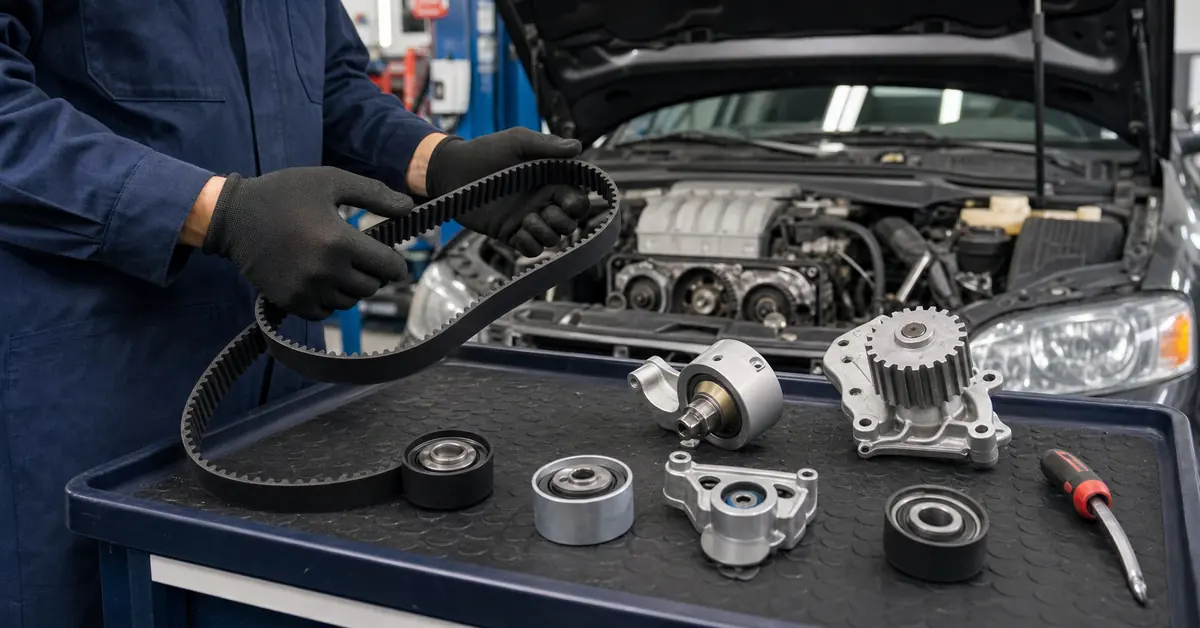
Mechanic inspecting timing belt kit before used car timing belt replacement
Timing belt service should be verified with records, interval, engine type, and related parts, not seller promises.

Quick Answer: What Should Buyers Check First?

First, confirm whether the vehicle has a timing belt or timing chain. If it has a belt, check the manufacturer interval, mileage, age, service records, and whether the engine is interference or non-interference. If the belt is due or undocumented, treat replacement as part of the buying budget or negotiation.

Consumer Reports notes that many timing belts are replaced based on manufacturer intervals, often around 60,000 to 120,000 miles depending on the model. AAA warns that timing belt failure can stop the engine and may cause serious internal damage on interference engines. That is why documentation matters more than guesswork.

Add timing belt service to your broader used car maintenance cost plan. It is not a small cosmetic item; it can be one of the largest scheduled maintenance jobs on an older vehicle.

Timing Belt vs. Timing Chain: Do Not Mix Them Up

A timing belt is a reinforced rubber belt with teeth. It usually runs behind a cover and has a scheduled replacement interval. A timing chain is metal and often lasts much longer, although chains, guides, tensioners, and oil-related components can still fail. The maintenance decision is different.

Do not rely on the seller’s memory. Look up the engine by year, make, model, and engine size. Some vehicles changed from belt to chain across generations. Some trim levels use different engines in the same model year. A listing that says “timing chain, no maintenance needed” may be wrong if the car has a different engine.

System Typical Buyer Concern Best Question
Timing belt Scheduled replacement interval When was it replaced, with receipt?
Timing chain Noise, guides, tensioner, oil history Any startup rattle or chain codes?
Unknown system Wrong assumption can cost money Which engine is in this exact VIN?

Timing Belt Replacement Used Car: 9 Checks Before Buying

1. Confirm Belt or Chain by VIN

Use the VIN, engine code, owner manual, dealer parts lookup, or trusted repair database. Do not decide based only on forum comments or the seller’s claim.

2. Check the Replacement Interval

Intervals vary by vehicle. Some belts are due around 60,000 miles, others later. Age can matter too, especially on low-mileage older cars where rubber degrades over time.

3. Demand Real Service Records

A receipt should show the date, mileage, parts, labor, and shop. A handwritten note or verbal promise is weak evidence. If there is no proof, budget as if it was not done.

4. Ask Whether the Water Pump Was Replaced

On many engines, the water pump, tensioner, idlers, seals, and belt are accessed together. AAA advises replacing several related items while the engine is partially disassembled. Skipping them can create repeat labor later.

5. Know Whether the Engine Is Interference

In an interference engine, valves and pistons can collide if timing is lost. That can make belt failure far more expensive than the belt service itself.

6. Listen for Related Noises

Timing belts are hidden, but tensioners, idlers, water pumps, and accessory belts can make noise. Whining, chirping, rattling, or coolant leaks near the timing cover deserve inspection.

7. Inspect for Oil or Coolant Leaks

Oil or coolant contamination can shorten belt life. If the front engine cover area is wet, ask whether cam seals, crank seal, water pump, or valve cover leaks are present.

8. Price the Job Before Buying

Timing belt service can be labor-intensive. Get a real quote for your exact engine before negotiating. Do not accept a generic “it is cheap” estimate.

9. Avoid Cars With Overdue Belts and No Discount

If the belt is overdue and the seller will not reduce the price, walk carefully. A clean interior does not offset major scheduled maintenance risk.

Interference Engine Risk Explained

AAA explains that some engines have clearance built in so a timing belt malfunction will not cause internal damage; these are non-interference engines. Other engines can suffer bent valves and piston damage if the belt slips or breaks; these are interference engines. That difference changes the risk profile of a used car.

A buyer does not need to memorize every engine. The practical step is to identify the exact engine and ask a mechanic whether belt failure can damage it. If the answer is yes, missing belt records become a serious negotiation point.

Even on non-interference engines, a broken belt can leave you stranded, require towing, and create repair costs. On interference engines, the stakes are higher because the engine may need major internal work.

What a Proper Timing Belt Service Should Include

A timing belt service should be more than just a rubber belt. Depending on the engine, it may include the belt, tensioner, idlers, water pump, coolant, camshaft seals, crankshaft seal, drive belts, and inspection of nearby components. The correct parts depend on the vehicle.

Item Why It Matters Ask the Shop
Timing belt Main scheduled item OEM or equivalent quality?
Tensioner Keeps belt tension stable Is it included in the kit?
Idler pulleys Can seize or wear Will pulleys be replaced?
Water pump Often accessed during service Is replacement recommended on this engine?
Seals Oil leaks can damage belt Any cam or crank seal leaks?
Coolant Needed if water pump is replaced What coolant type will be used?

If the car also needs cooling-system service, compare the estimate with our coolant flush used car guide. Timing belt and water pump work often overlap.

Cost Factors U.S. Buyers Should Understand

The cost of a timing belt replacement used car service depends on labor access, engine layout, parts quality, whether the water pump is included, local labor rates, and whether seals or coolant are needed. Consumer Reports lists timing belt replacement as an involved job and gives a broad service-cost range in its maintenance checklist, but real pricing depends on the exact vehicle.

A compact four-cylinder may be less expensive than a transverse V6, luxury model, or vehicle where access is tight. The cheapest quote may also exclude water pump, tensioners, idlers, seals, or coolant. Always compare itemized quotes.

When negotiating a used car, do not ask only “how much is the belt?” Ask for the total timing belt kit job. If the belt is overdue, the car should be priced accordingly.

Timing Belt Records: What Counts as Proof?

Good proof includes an invoice from a repair shop, dealer, or qualified technician showing date, mileage, vehicle details, parts, and labor. A sticker under the hood can help, but it is not as strong as a receipt because stickers can be wrong or incomplete.

Weak proof includes seller memory, “previous owner said so,” a clean-looking belt cover, or a listing phrase like “all maintenance done.” If the vehicle is worth buying but records are missing, use that uncertainty in your offer.

Keep your own receipt after service. Future buyers will pay more attention to a documented timing belt job because it removes a major unknown.

Symptoms and Red Flags Before Failure

Timing belts often fail without a clear warning. Still, related symptoms can appear from tensioners, pulleys, water pumps, leaks, or incorrect previous installation. Do not ignore noises near the timing cover, coolant leaks from the front of the engine, oil leaks into the belt area, or engine codes related to timing.

AAA notes that if a timing belt snaps while driving, the engine can suddenly shut down. If it breaks when the engine is off, the engine may crank irregularly and fail to start. Those symptoms are serious and should not be confused with a simple battery issue.

If the car has starting problems, compare symptoms with used car battery replacement cost. A weak battery and a broken timing belt can both create no-start complaints, but the repair paths are very different.

How Timing Belt Risk Should Affect a Used-Car Deal

Timing belt risk should change your offer. If the interval is due soon, subtract the realistic service cost from your budget. If it is overdue, add risk because the seller may have been driving on borrowed time. If the car is an interference-engine model with no proof, treat the decision seriously.

For private-party purchases, ask the seller before the inspection: “Does this engine have a timing belt, and do you have the receipt?” A prepared seller may provide records quickly. A vague answer does not prove the car is bad, but it does mean you should verify.

This is part of the same buying discipline explained in how to avoid buying a bad used car. Expensive hidden maintenance should be found before purchase, not after registration and insurance are paid.

Low-Mileage Older Cars Still Need Timing Belt Attention

A common mistake is assuming a low-mileage older car is automatically safe. Timing belts are made from rubber and reinforced materials that age with heat cycles, time, oil exposure, coolant leaks, and long periods of sitting. A 12-year-old vehicle with only 55,000 miles can still be close to or past the age side of the service recommendation.

This matters for retirees’ cars, second vehicles, convertibles, and low-mileage one-owner listings. The odometer can look attractive, but the belt may not know that the car was barely driven. Ask whether the manufacturer lists a time interval as well as a mileage interval. If the answer is unclear, let a mechanic look up the service schedule by VIN.

What to Do Immediately After Buying an Undocumented Belt Car

If you already bought a used car and then discovered the timing belt history is missing, do not panic, but do not ignore it. First, confirm the engine uses a belt. Second, find the official interval. Third, inspect for leaks, noises, and related cooling-system issues. Fourth, price a proper timing belt kit service from a reputable shop.

If the car is overdue, avoid long road trips, towing, aggressive driving, or high-heat use until the service is handled. A local commute is still a risk if the belt is truly overdue, but a cross-country drive with an unknown belt is worse. The point is to reduce exposure while you turn an unknown into a documented maintenance item.

How to Compare Two Used Cars With Timing Belt Risk

If two used cars look similar, timing belt records can decide which one is the smarter buy. A car priced $900 higher but showing a complete timing belt, water pump, tensioner, idler, and coolant receipt may be better than a cheaper car with no proof. The documented car reduces your immediate maintenance risk and may be easier to resell later.

Build a simple comparison: purchase price, timing belt status, tire condition, brake condition, battery age, coolant history, inspection results, and insurance cost. Used-car value is not just the listing price; it is the listing price plus the work needed to make the car dependable.

DIY Timing Belt Replacement: Usually Not Beginner-Friendly

Timing belt service requires accurate mechanical timing. A small mistake can cause poor running, check-engine lights, no-start, or internal engine damage. Many jobs require special tools, torque procedures, engine support, coolant handling, and careful alignment marks.

DIY may make sense for experienced mechanics with service information and tools. For most used-car buyers, a qualified shop is safer. The labor cost exists because the job is precise and access can be difficult.

Questions to Ask the Shop

  • Does this exact engine use a timing belt or timing chain?
  • What is the manufacturer replacement interval?
  • Is this an interference engine?
  • Does the quote include water pump, tensioner, idlers, seals, and coolant?
  • What brand or quality level are the parts?
  • Will you inspect for oil and coolant leaks?
  • What warranty covers parts and labor?
  • Will the invoice show date, mileage, and all replaced parts?
  • Should any drive belts or hoses be replaced while access is open?

The FTC recommends written estimates and completed repair orders. For timing belt work, documentation protects both your engine and future resale value.

Common Mistakes Buyers Make

  • Assuming every engine has a chain: Many older and some newer vehicles still use belts.
  • Trusting verbal claims: Timing belt service needs receipts.
  • Ignoring age: Low mileage does not stop rubber from aging.
  • Pricing only the belt: A proper kit may include tensioners, idlers, water pump, seals, and coolant.
  • Skipping leak checks: Oil or coolant leaks can shorten belt life.
  • Buying overdue without discount: The seller’s deferred maintenance becomes your bill.
  • Attempting DIY without tools: Incorrect timing can create expensive engine damage.

How Timing Belt Service Fits With Other Maintenance

Timing belt service often overlaps with cooling-system and ignition maintenance. If the water pump is replaced, coolant service may be part of the job. If the engine has misfires, rough starting, or overdue tune-up parts, review spark plug replacement used car as a separate issue.

For a full ownership plan, pair this article with the used car inspection checklist, coolant checks, battery planning, and brake fluid review. One overdue service is manageable; several overdue services can change whether the car is still a good deal.

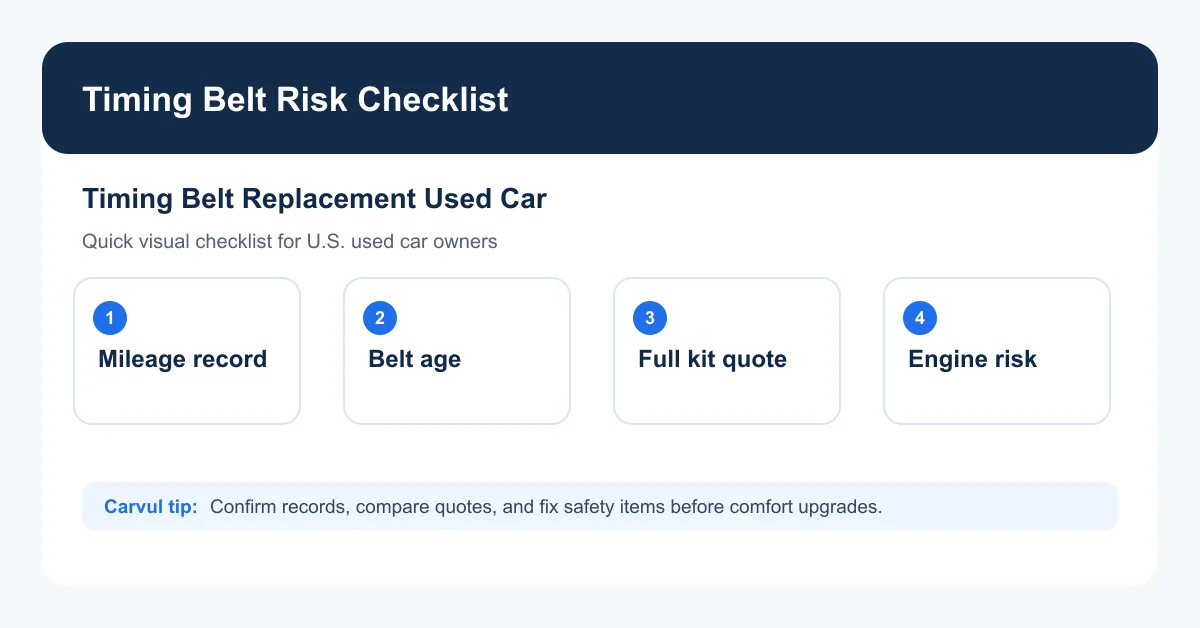
timing belt replacement used car risk checklist chart for U.S. drivers
Timing belt risk depends on engine design, age, mileage, records, and whether the service can be proven with receipts.

FAQ

How do I know if a used car needs a timing belt?

Confirm whether the exact engine uses a timing belt, then compare mileage, age, and service records with the manufacturer interval. If there is no proof, budget for replacement.

Is a timing chain better than a timing belt?

A chain often lasts longer and may not have a normal replacement interval, but it can still have problems with guides, tensioners, oil neglect, or noise. Verify the exact system before buying.

Can I inspect a timing belt before buying?

Usually not fully. Timing belts are often hidden behind covers. A mechanic may inspect related leaks or noises, but records and interval matter more than a quick visual check.

What happens if a timing belt breaks?

The engine can stop suddenly. On interference engines, valves and pistons may collide, causing costly internal damage. Non-interference engines may avoid internal damage but still need repair and towing.

Should the water pump be replaced with the timing belt?

Often yes, if the water pump is driven by or located behind the timing belt and access overlaps. The correct answer depends on the engine and service procedure.

Bottom Line

A timing belt replacement used car check is one of the smartest things a U.S. buyer can do before purchase. Confirm belt vs chain, verify the interval, demand receipts, understand interference-engine risk, and price the full kit job before negotiating.

If the belt is overdue or undocumented, do not treat it as a small detail. Either get the seller to document the service, negotiate the price, or budget for the work immediately after purchase. The engine you protect may be worth far more than the service you were tempted to delay.

Sources: FTC Auto Repair Basics, AAA belt maintenance guide, Consumer Reports maintenance checklist, and AAA essential maintenance checklist.

Leave a Comment

Your email address will not be published. Required fields are marked *

Scroll to Top