
Quick answer: A 2WD truck or SUV is often the better-value choice for maintained roads, predictable weather, and towing that stays on paved surfaces. A properly equipped 4WD version may justify its added price when work, winter access, boat ramps, unpaved roads, or difficult terrain repeatedly demand more propulsion traction. Tow rating and payload must still be verified for the exact configuration.
A practical 2WD vs 4WD decision starts with the surfaces, loads, ramps, job sites, and winter roads you encounter repeatedly.
Buyers comparing automatic all-wheel drive with truck-style four-wheel drive can use Carvul’s AWD vs 4WD guide for the broader distinction.
Table of Contents
Buying 4WD “just in case” can add capability, but it may also change price, curb weight, payload, fuel economy, tires, maintenance, and resale. The right comparison uses exact trucks—not generic claims about badges.
2WD vs 4WD at a glance
| Buyer factor | 2WD | 4WD |
|---|---|---|
| Paved commuting | Usually sufficient | Added hardware may be unused |
| Loose-surface starts | One axle propels | Both axles can propel in an approved mode |
| Tow rating | Configuration-specific | Configuration-specific |
| Payload | May benefit from lower vehicle weight | Added hardware may reduce available payload |
| Low range | Normally absent | Available on many systems, not all |
| Purchase/service cost | Often lower | Often higher and may add fluid service |
What 2WD and 4WD mean
On most pickups, 2WD means rear-wheel drive, although the term only confirms that one axle propels the vehicle. Traditional 4WD adds a transfer case or equivalent system that can connect both axles. Available modes vary: some vehicles offer 2H, 4A, 4H, and 4L; others offer only part of that list.
Do not infer low range, dry-pavement permission, locking behavior, or shift procedures from “4×4.” Read the exact owner’s manual and identify the actual hardware and controls.
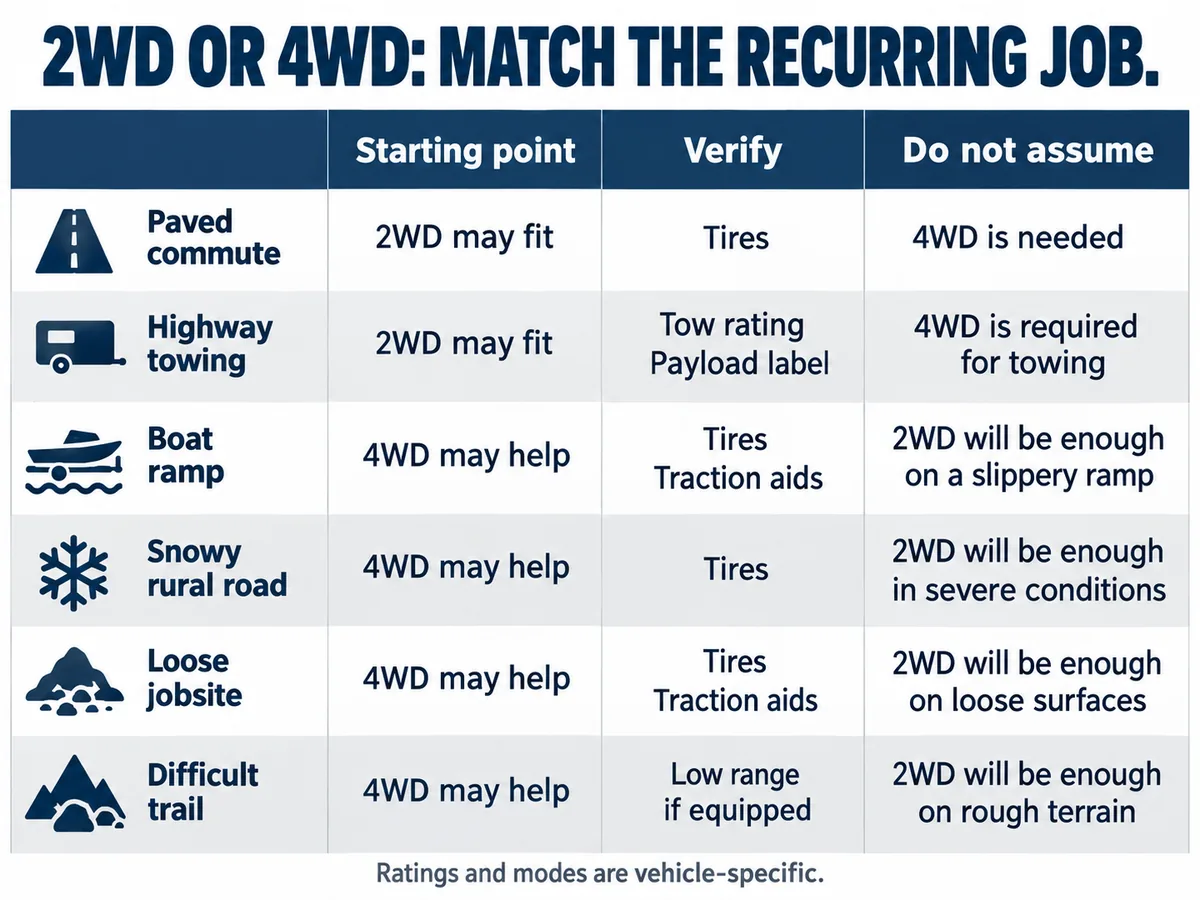
Use this 2WD vs 4WD comparison to define the recurring job before paying for capability you may rarely use.
Eight checks before buying
1. Map recurring surfaces
List pavement, gravel, mud, sand, snow, steep grades, jobsite access, fields, and ramps. Frequency matters. One annual campground trip should not carry the same weight as daily rural work.
2. Verify the exact 4WD hardware
Identify the controls and modes using the owner’s manual and build data. Confirm whether the vehicle has automatic four-wheel drive, high range, low range, a locking differential, terrain modes, or none of those features.
3. Check tow rating by configuration
Towing capacity can vary with engine, transmission, axle ratio, cab, bed, wheelbase, hitch, cooling package, wheels, and options. Use manufacturer data for the exact VIN or configuration. Ford’s towing resources show why a model name alone is insufficient.
4. Calculate real payload
Read the certification and tire-loading labels on the vehicle. Passengers, cargo, accessories, hitch equipment, and trailer tongue weight consume payload. Added 4WD hardware can change curb weight and available payload.
5. Compare price and financing
Get written out-the-door quotes for genuinely comparable trims. If 4WD requires a larger engine or option package, separate those costs from the drivetrain decision. Compare financing using the same term and down payment.
6. Compare fuel economy and insurance
Use the exact EPA vehicle listings, not a generic MPG penalty. Request insurance quotes using exact VINs and identical coverage.
7. Inspect tires and service history
Four driven wheels cannot compensate for unsuitable or worn tires. Review the manufacturer schedule for transfer-case and differential service. Inspect for leaks, mismatched tires, impact damage, and poorly installed suspension modifications.
8. Test the system correctly
Follow the owner’s manual and test only in legal, suitable conditions. Check indicators, warnings, noises, vibration, and mode engagement. A qualified independent technician should inspect a used vehicle.
Towing and payload checks
4WD can help a tow vehicle launch on a loose ramp, wet grass, snow, or a rough site. It does not increase every configuration’s tow rating and cannot correct excessive trailer weight, poor hitch setup, overloaded payload, inadequate brakes, or unsafe speed.
A 2WD truck may offer competitive payload, lower purchase cost, and adequate highway towing when traction conditions are controlled. Buyers should weigh where the trailer starts and stops, not only highway miles.
Snow, rural roads, and off-road use
4WD may earn its cost for unplowed roads, repeated steep access, loose jobsite surfaces, or remote recreation. Tires, clearance, recovery points, cooling, and driver judgment remain essential.
For routine plowed roads, 2WD with appropriate tires may meet the need. Follow NHTSA TireWise and local chain laws. Never treat 4WD as permission to drive faster on ice.
Ownership-cost worksheet
- 2WD and 4WD out-the-door prices
- exact EPA ratings
- annual miles and fuel price
- insurance quotes
- payload labels
- tire sizes and replacement requirements
- transfer-case/differential service
- inspection findings
- local resale demand
Do not assume resale will recover the full premium.
Buyer profiles
2WD often fits: urban/suburban commuters, highway towers with controlled launch surfaces, warm-climate buyers, and shoppers prioritizing payload or price.
4WD often fits: rural households, snow-belt drivers on unplowed roads, jobsite users, boat-ramp users, and owners who repeatedly access loose or uneven terrain.
The best 2WD vs 4WD choice must still satisfy the exact vehicle's tow rating, payload label, tires, and operating instructions.
FAQs
Does 4WD increase towing capacity?
Not automatically. Compare manufacturer ratings for the exact configuration. Added hardware can also affect curb weight and payload.
Is a 2WD truck bad in snow?
Not necessarily. Tires, load placement within limits, road treatment, ground clearance, and driving matter. 4WD can improve acceleration traction but not stopping grip.
Can 4WD be used on dry pavement?
It depends on the system and mode. Some part-time modes should not be used on high-traction pavement. Follow the exact owner’s manual.
Is 4WD worth it for resale?
Local demand may help resale, but future value is uncertain. Buy it for a recurring need, not a guaranteed return.
Final verdict
Choose 2WD when maintained roads and controlled towing conditions dominate and its savings improve the overall purchase. Choose 4WD when verified hardware solves recurring snow, work, ramp, or terrain problems. In both cases, ratings, tires, condition, and payload matter more than the badge.