
Quick answer: AWD is usually the easier choice for paved-road driving in changing rain and snow because it generally works without driver input. 4WD is usually better suited to recurring work on loose surfaces, difficult trails, deep snow, or situations where the exact vehicle provides low range. Neither system guarantees shorter stops, replaces suitable tires, or tells you the vehicle’s tow rating. Before buying, verify the actual hardware and operating instructions in the owner’s manual.
The familiar AWD vs 4WD question is more complicated than two badges. Manufacturers use different couplings, differentials, motors, transfer cases, software, and marketing names. Some systems drive both axles most of the time; others send torque to a second axle only when conditions or driver settings call for it. Some four-wheel-drive vehicles offer 2H, 4A, 4H, and 4L, while others do not.
The right choice depends on the roads you use repeatedly, the tires you will run, the exact trim you can afford, and the work the vehicle must perform. Use the same decision criteria when you compare cars across categories: verify the configuration first, then compare capability and total ownership cost.
AWD vs 4WD at a glance
The table below describes common arrangements, not rules that apply to every vehicle. The owner’s manual and build information for the exact year, model, powertrain, and trim take precedence.
| Buyer factor | AWD, usually | 4WD, usually | What to verify |
|---|---|---|---|
| Driver input | Operates automatically or stays available continuously | May require selecting 4A, 4H, or 4L | Controls, modes, and manual instructions |
| Low range | Usually absent | Available on many purpose-built systems, but not all | Whether the exact vehicle has a true low range |
| Paved-road use | Designed for normal paved-road operation | Full-time or automatic modes may allow it; some part-time modes do not | Which modes are permitted on dry pavement |
| Snow and rain | Can improve the ability to accelerate when grip is limited | Can provide strong traction when the selected mode suits the surface | Tires, ground clearance, mode restrictions, and speed |
| Off-road use | Often intended for light-duty or on-road traction | Common on vehicles designed for loose, steep, or uneven terrain | Clearance, tires, recovery points, low range, and protection |
| Towing | Does not establish a tow rating | Does not establish a tow rating | Exact tow rating, payload, hitch, axle ratio, and cooling equipment |
| Ownership cost | May add purchase price, weight, tires, and service needs | May add similar costs plus transfer-case service | Exact trim prices, EPA ratings, tire rules, and maintenance schedule |
| Common applications | Cars, crossovers, minivans, SUVs, performance vehicles | Pickups and off-road-oriented SUVs | Actual hardware, not the body style or badge |
There is no universal winner. An AWD crossover with good winter tires may fit a paved snow-belt commute better than a heavier off-road vehicle. A pickup with the correct 4WD hardware may fit a jobsite, boat ramp, or remote trail better. A 2WD model may remain the sensible option for a warm-climate commuter who rarely leaves pavement.
What AWD and 4WD actually mean
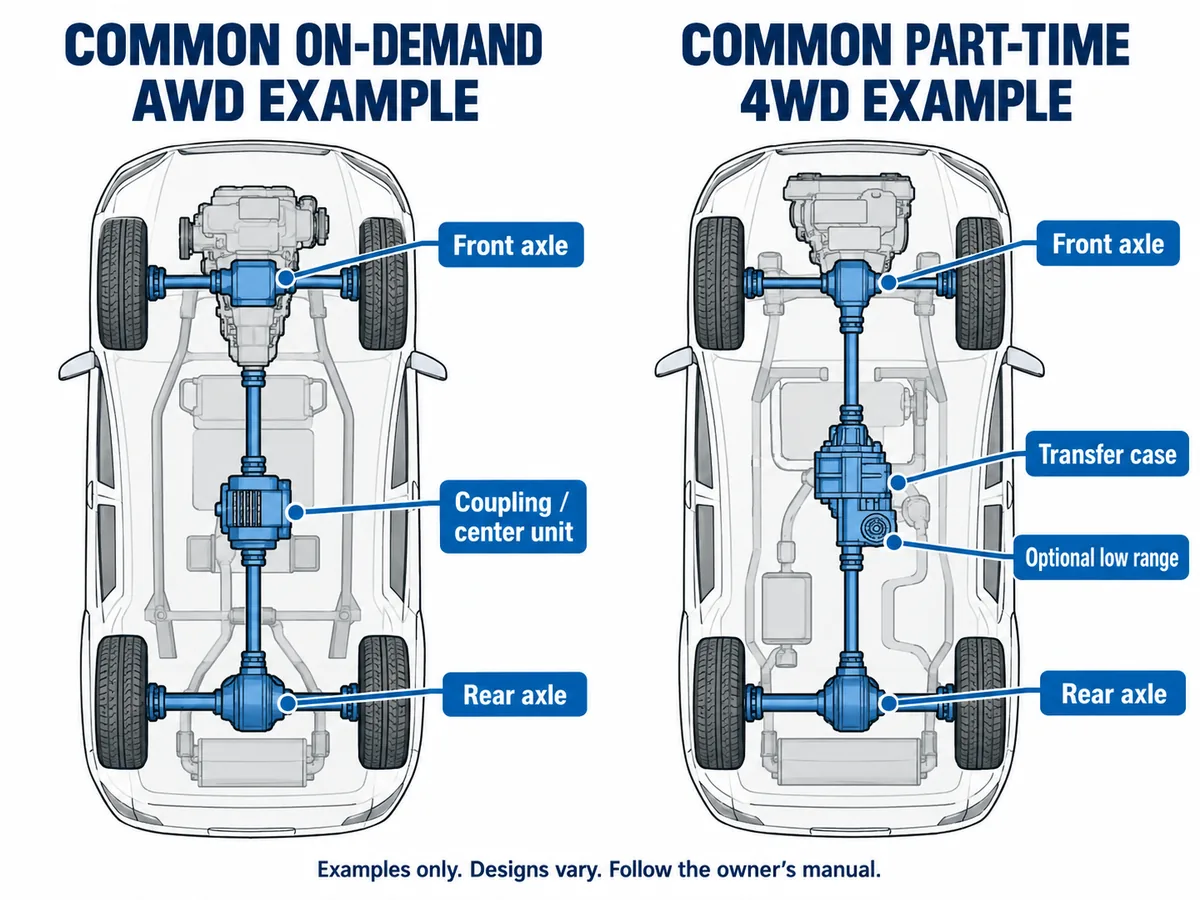
The EPA vehicle-data glossary uses a practical reporting convention: AWD is four-wheel drive automatically controlled by the powertrain system, while 4WD is driver-selectable four-wheel drive with a two-wheel-drive option. That distinction is useful, but modern vehicles do not always fit neatly into two boxes.
How common AWD systems operate
An AWD system can distribute engine or motor torque to both axles without requiring the driver to select a traditional four-wheel-drive range. Some systems deliver torque to both axles continuously. Others favor one axle during ordinary driving and engage or increase torque to the other axle when software detects a need. The hardware may use a center differential, an electronically controlled clutch, separate electric motors, or another design.
That last point matters for hybrids and electric vehicles. An electric AWD vehicle may power the front and rear axles with separate motors and have no mechanical driveshaft connecting them. Its badge may look familiar even though its hardware and response differ from a conventional system.
AWD does not mean every wheel always receives equal torque. It also does not mean every AWD vehicle has the same ability in deep snow, sand, mud, or on steep grades. Tires, clearance, thermal limits, software calibration, and the available drive modes all matter.
How common 4WD systems operate
Many 4WD systems use a transfer case to deliver power to both axles. A part-time system may provide 2H for ordinary driving, 4H for approved low-traction surfaces, and 4L for slow work requiring low gearing. A full-time or automatic 4WD system may also offer a mode suitable for varied paved conditions.
Low range is a gearing function, not simply “more traction.” It can provide slower vehicle movement and greater torque multiplication for specific work. Not every vehicle labeled 4WD has the same ranges, locks, or operating limits.
Manufacturer instructions can be highly specific. For example, the 2024 Toyota Tacoma owner’s manual assigns different surfaces and procedures to 2H, 4H, and 4L, including a particular process for shifting between high and low range. Those instructions should not be copied to a different truck or SUV. Follow the manual for the vehicle in front of you.
Why badges and marketing names can mislead
Terms such as “full-time 4WD,” “4WD Auto,” “4A,” and brand-specific AWD names can blur the traditional line. A listing may also use AWD and 4WD interchangeably even when the manufacturer does not.
Use four sources to identify the system: the owner’s manual, the original build or window-sticker information, the controls inside the vehicle, and VIN-specific equipment data when available. If those sources conflict with the seller’s description, pause the purchase until the configuration is confirmed.
Nine AWD vs 4WD checks before you buy
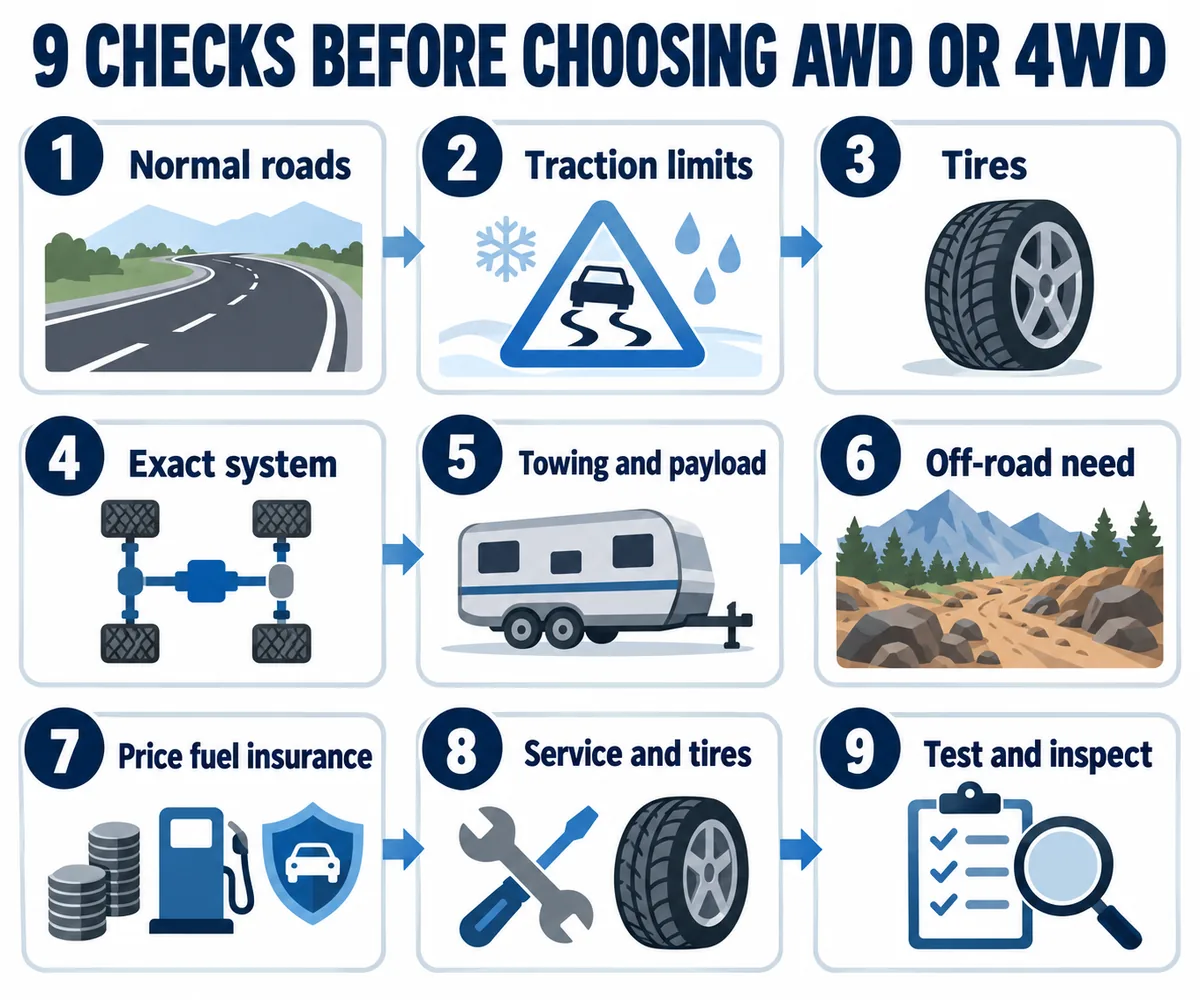
The following checks turn a technical comparison into a purchase decision. Complete them for the exact vehicles and trims on your shortlist.
1. Map your normal roads, not your rarest trip
Write down where the vehicle will operate during an ordinary month. Estimate the share of driving on dry pavement, wet highways, plowed snow, unplowed roads, gravel, steep grades, mud, sand, or jobsite surfaces. Add how often you encounter each condition rather than treating every possibility as equally important.
A commuter who sees several winter storms but stays on maintained roads has a different need from a rural driver who regularly crosses deep, loose, or uneven surfaces. Likewise, one annual camping trip does not automatically justify buying around maximum off-road capability.
Record the recurring problem the drivetrain must solve. If you cannot name one, compare the 2WD version too. Money saved on unnecessary hardware may be more useful for better tires, maintenance, insurance, or a newer vehicle in better condition.
2. Separate getting moving from stopping and turning
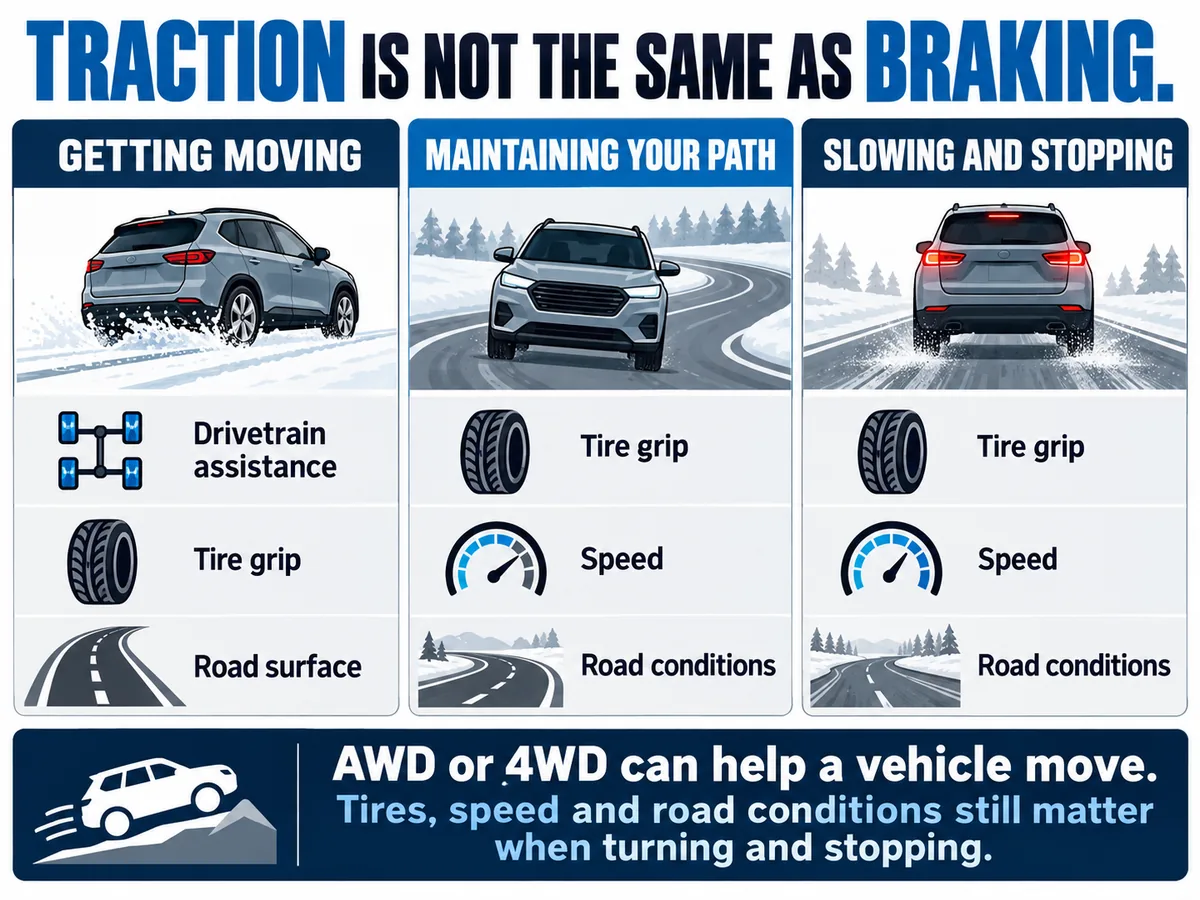
AWD and 4WD can help a vehicle use available tire grip to accelerate, especially when one or more tires are on a slippery surface. That benefit can feel dramatic when pulling away from a stop or climbing a grade.
It does not create extra tire grip. Braking and cornering still depend heavily on tire condition and type, road surface, speed, temperature, vehicle dynamics, and driver input. A vehicle that accelerates confidently can still slide when asked to stop or turn too quickly.
Do not buy from a claim that AWD or 4WD makes a vehicle universally “safer.” Ask what system is fitted, what tires are installed, how much tread remains, and which conditions the manufacturer approves. Electronic stability and traction controls also assist the driver, but they cannot repeal the limits of adhesion.
3. Match the tires to the climate
Drivetrain choice and tire choice solve different parts of the traction problem. The NHTSA TireWise guide notes that all-season tires cover varied conditions, winter tires are more effective than all-season tires in deep snow, and summer tires are not designed for snow, ice, or below-freezing operation. The right answer depends on local weather and the vehicle manufacturer’s specifications.
Inspect all four tires, not just the driven axle. Confirm size, load and speed ratings, type, condition, tread depth, and inflation. On some AWD vehicles, differences in tire circumference or wear can affect system operation. The allowed variation and replacement method are manufacturer-specific; for example, Subaru directs owners back to the exact owner’s-manual tire requirements. Check the applicable manual before assuming one damaged tire can be replaced by itself.
If severe winter conditions are routine, price the correct tire solution before comparing vehicles. AWD on unsuitable or worn tires is not a substitute for tires designed and maintained for the conditions.
4. Verify the exact system and allowed modes
Sit in the vehicle and inventory the controls. Does it have only an automatic AWD mode? Are there 2H, 4A, 4H, or 4L selections? Is a center lock available? Do terrain modes change throttle, transmission, braking, stability control, or torque distribution?
Then read the matching owner’s-manual sections. Confirm which modes are allowed on dry pavement, how they are engaged, which indicators should appear, and what conditions prohibit a shift. Never use a generic internet speed limit or shifting sequence. Even two models from the same manufacturer can have different hardware and procedures.
Finally, confirm that the controls match the seller’s listing and VIN/build information. “AWD,” “4×4,” and “off-road package” should not be treated as interchangeable claims.
5. Check towing, payload, and work requirements separately
Drivetrain type alone does not establish how much a vehicle can tow or carry. Ratings can change with engine, transmission, cab, wheelbase, axle ratio, cooling equipment, hitch, wheels, trim, options, and the weight of passengers and cargo.
Use the manufacturer documentation for the exact configuration. Check the certification and cargo labels on the vehicle, then calculate the load created by people, cargo, accessories, hitch hardware, and trailer tongue weight. Manufacturer guides illustrate why configuration matters; Ford’s towing resources separate ratings by equipment and vehicle configuration. A higher advertised tow number from another configuration does not transfer to the vehicle you are buying.
Four-wheel drive may help on a slippery ramp, loose jobsite, or unpaved access road, but it does not increase every rating and it does not correct an overloaded combination. Shoppers comparing pickups can apply these checks to Carvul’s midsize truck comparison.
6. Decide how much real off-road capability you need
Separate a maintained gravel road or trailhead from deep sand, mud, rocks, water crossings, ruts, and steep climbs or descents. The latter conditions may require more than driven wheels: suitable tires, clearance, low gearing, underbody protection, recovery points, cooling capacity, and driver training can matter.
AWD may be entirely adequate for maintained roads and light-duty access. A purpose-built 4WD system may be more appropriate for repeated low-speed work on loose or uneven terrain. Neither label guarantees that a vehicle can safely handle a particular obstacle.
Do not rely on promotional footage as an operating guide. Check the owner’s manual for water depth, terrain modes, shift procedures, towing restrictions, and warnings. If serious off-road driving is new to you, seek qualified instruction rather than learning recovery or low-range techniques from a buying article.
7. Compare purchase price, fuel economy, and insurance
Build pairs of exact configurations. Compare the same model year, engine, transmission, battery or hybrid system, body style, trim, wheel size, and equipment wherever possible. Otherwise, a price or fuel-economy difference may come from more than the drivetrain.
Use the EPA vehicle comparison tool for the specific configurations. Do not apply a generic MPG penalty to every AWD or 4WD vehicle. System design, vehicle mass, aerodynamics, tires, gearing, powertrain, and test configuration can all affect the rating.
Request insurance quotes using the exact VINs or complete vehicle descriptions and identical coverage. The drivetrain badge alone does not determine the premium. Vehicle value, repair technology, claim history, location, driver profile, mileage, and coverage choices also matter.
8. Budget for tires, fluids, and driveline service
Read the maintenance schedule for each finalist. An AWD or 4WD vehicle may have differentials, a transfer case, couplings, electric drive units, or other components with inspection or fluid requirements. Intervals and approved fluids are vehicle-specific.
Ask whether the tires must remain closely matched in size, type, circumference, or wear. If the manufacturer requires a matched set, a nonrepairable tire can create a larger expense than it would on a vehicle that permits a single replacement. Do not guess the rule from the badge.
For a used vehicle, look for records showing that specified driveline service was performed. Fluid leaks, warning lights, mismatched tires, binding, clunks, or vibration justify professional inspection; none identifies a failed component by itself. Obtain vehicle-specific estimates before treating a symptom as minor.
9. Test and inspect the system before signing
Start with a cold vehicle when possible and watch the instrument-panel bulb check. Confirm that drivetrain warnings illuminate and then behave as the manual describes. Inspect all four tires and look underneath for leaks, impact damage, or poorly installed modifications.
During a lawful test drive, use only modes and surfaces approved by the manufacturer. Listen for unusual clunks, grinding, humming, or vibration during acceleration, steady cruising, deceleration, and low-speed turns. Confirm that indicators stop flashing and show the selected mode as described. Do not engage a prohibited mode on dry pavement just to “test” it.
Have a qualified independent shop perform a pre-purchase inspection. Ask the technician to identify the actual drivetrain, scan relevant modules, inspect tires and driveline components, review leaks and modifications, and test the system within manufacturer procedures. Check the VIN through the NHTSA recall lookup and confirm the status of any open campaign with an authorized dealer.
Write your final decision in one sentence: “My recurring need is ; the required hardware is ; the verified extra ownership cost is ___; I will walk away if ___ cannot be confirmed.”
AWD vs 4WD for snow and rain
For a paved commute with rain, changing grip, and routinely plowed snow, AWD is often convenient because it can respond without the driver selecting a traditional transfer range. That does not make every AWD vehicle equally capable. Calibration, tires, clearance, stability-control behavior, and vehicle condition influence the result.
Part-time 4WD can provide strong acceleration traction on surfaces the manufacturer approves. However, some locked or part-time modes are not intended for dry, high-traction pavement because the front and rear axles need to rotate at different average speeds while turning. Other vehicles provide a full-time or automatic 4WD mode intended for mixed conditions. Read the exact manual instead of generalizing from another model.
The critical safety distinction is between propulsion and grip. AWD or 4WD may help get the vehicle moving, but all vehicles rely on their tires for braking and cornering. Slow down for visibility and surface conditions, leave additional following distance, and avoid abrupt inputs. Suitable, correctly inflated tires with adequate tread remain essential.
Ground clearance also matters in deep or rutted snow. Four driven wheels cannot move a vehicle whose body is supported by packed snow or whose tires cannot reach a useful surface. Likewise, a taller vehicle does not guarantee more control on ice.
For the purchase decision, compare the worst condition you face routinely, not a vague promise of “all-weather confidence.” If roads are normally plowed and the vehicle wears suitable tires, AWD may be the practical choice. If deep, loose conditions are recurring and the vehicle’s manual approves the relevant 4WD mode, 4WD may provide the hardware you need.
AWD vs 4WD for towing and off-road use
Towing and off-road capability overlap, but they are not the same. A tow vehicle must first meet the manufacturer’s ratings for the exact configuration and load. A capable drivetrain cannot compensate for excessive trailer weight, inadequate payload, an incorrect hitch, poor brake setup, or missing cooling equipment.
Four-wheel drive can be useful when launching on a slippery ramp, moving across a loose jobsite, or reaching a remote campsite. Low range, where fitted, may allow slower, more controlled work in conditions approved by the manufacturer. It is not a general towing mode for every road, and its engagement procedure varies.
AWD can suit towing on paved roads when the vehicle is properly rated and equipped. The system may help distribute propulsion when grip changes, but it does not raise the published limit. Compare tongue-weight effects, passengers, cargo, accessories, and the vehicle’s payload label before choosing a trailer.
For off-road use, evaluate the complete package: tire type and sidewall, ground clearance, approach and departure geometry, cooling, underbody protection, recovery points, spare tire, and the owner’s-manual restrictions. A badge cannot confirm those features.
Buy for the work you will actually perform. If your shortlist includes pickups, use the same buyer criteria to narrow the models, then verify the configuration-specific ratings.
Fuel economy, maintenance, and total ownership cost
The extra cost of AWD or 4WD is not one universal number. It may include a higher purchase price, a different trim or engine requirement, fuel or electricity use, insurance, tires, scheduled service, and potential repairs. Local resale demand can offset part of that cost, but future value is not guaranteed.
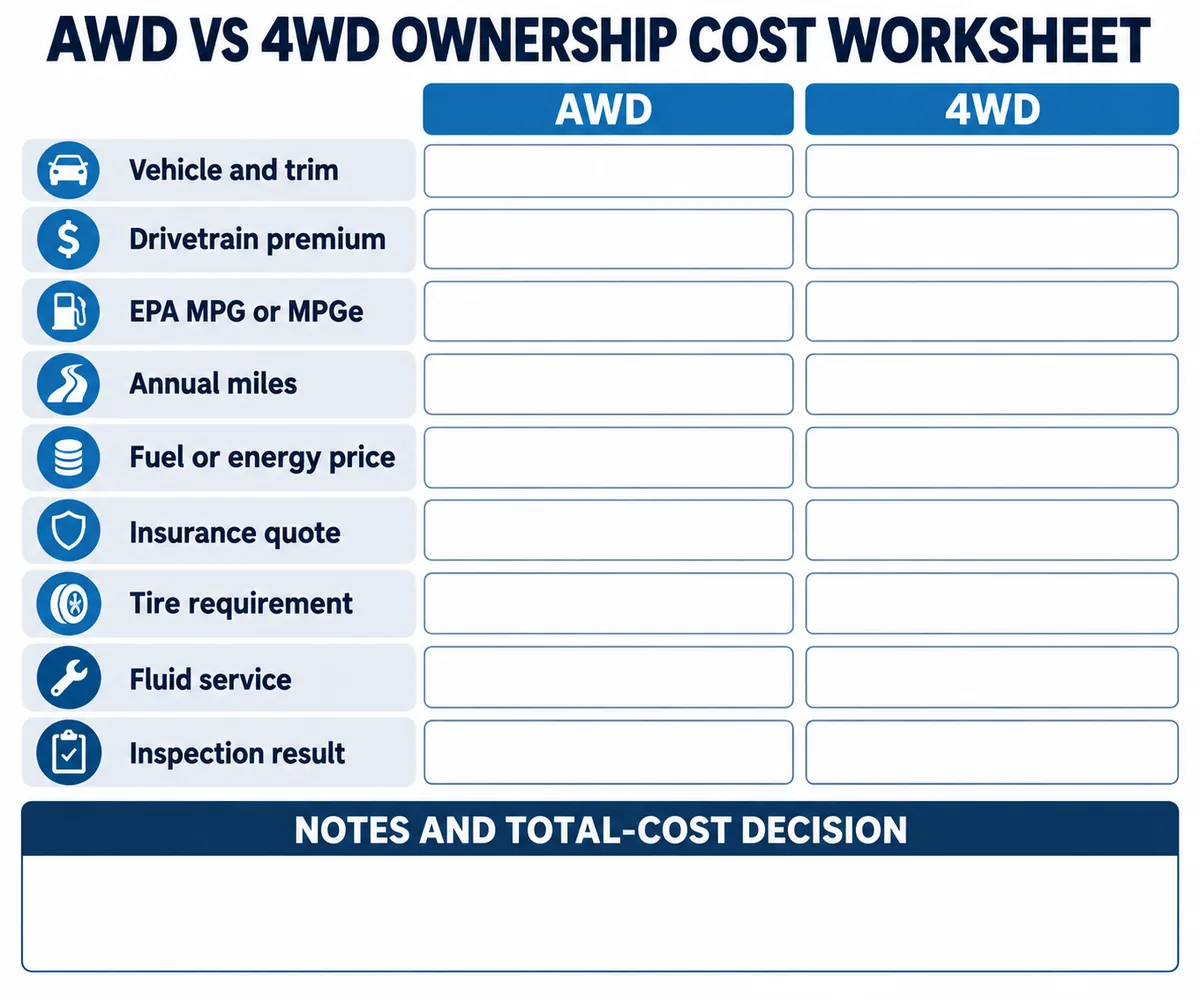
Use this worksheet for two actual vehicles. Enter verified figures rather than estimates copied from a different trim.
| Cost item | Vehicle A | Vehicle B | Verification source |
|---|---|---|---|
| Model year, trim, engine, transmission | VIN/build sheet | ||
| Drivetrain and available modes | Owner’s manual and controls | ||
| Negotiated out-the-door price | Written buyer’s order | ||
| EPA combined MPG or MPGe | EPA exact-vehicle listing | ||
| Annual miles and local fuel/energy price | Your driving records and local price | ||
| Annual insurance quote | Same insurer, driver, limits, and deductibles | ||
| Tire size and matched-replacement rule | Tire label and owner’s manual | ||
| Required driveline service | Maintenance schedule | ||
| Pre-purchase inspection findings | Qualified independent shop | ||
| Expected local resale relevance | Multiple comparable local listings |
Calculate fuel cost with the same annual mileage and a realistic local price. For an EV, include home/public charging assumptions that match the buyer’s real pattern. Treat the result as a planning estimate, not a guarantee.
Compare insurance on equal terms. A lower quote created by weaker limits or a larger deductible is not a fair comparison. For maintenance, list required services and obtain local quotes where the schedule identifies specialized fluids or procedures.
The drivetrain decision also interacts with the powertrain. Carvul’s hybrid SUV comparison can help shoppers compare hybrid candidates, but the EPA listing and owner documentation for the exact drivetrain remain the final references.
Used AWD or 4WD inspection checklist
Use this list before committing to a used vehicle. It is a screening tool, not a substitute for professional diagnosis.
- [ ] The VIN, title, listing, build data, and visible controls identify the same drivetrain.
- [ ] The owner’s manual is available for the exact model year and explains every relevant mode.
- [ ] No AWD, 4WD, ABS, stability-control, powertrain, or tire-pressure warning remains active.
- [ ] All four tires meet the manufacturer’s specifications for size, type, load rating, condition, and permitted wear variation.
- [ ] Mode indicators engage and disengage only under the conditions described in the manual.
- [ ] No unexplained binding, clunk, grinding, hum, vibration, or leak appears during an appropriate test.
- [ ] Differential, transfer-case, coupling, or drive-unit service records match the maintenance schedule where applicable.
- [ ] Lift kits, wheel/tire changes, skid plates, tow equipment, and off-road modifications receive professional inspection.
- [ ] The VIN has been checked for open recalls, and completion is confirmed with the manufacturer or dealer.
- [ ] A qualified independent technician has inspected the vehicle and documented material findings.
Do not accept “they all do that” as a diagnosis. At the same time, do not assume every noise proves an expensive failure. Record the condition, obtain a professional explanation, and price the decision before signing.
Choose AWD, 4WD, or 2WD by buyer profile
These are starting points, not substitutes for checking the exact vehicle.
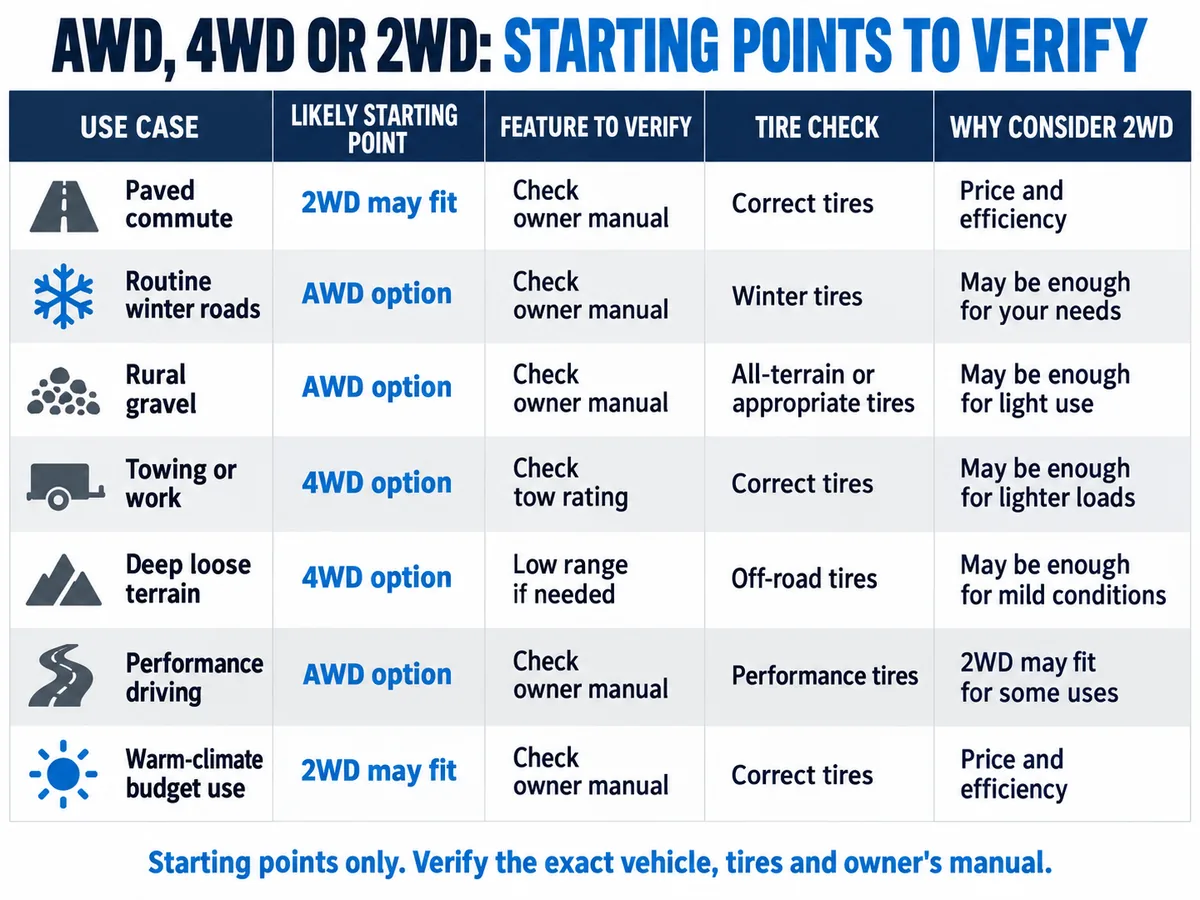
| Buyer profile | Likely starting point | Feature to verify | Why another drivetrain may win |
|---|---|---|---|
| Urban or suburban commuter | 2WD or AWD | Tire suitability and automatic operation | 2WD may cost less if severe conditions are rare |
| Snow-belt paved-road commuter | AWD | Winter tires, clearance, and system behavior | A full-time/automatic 4WD mode may fit some vehicles and routes |
| Rural gravel-road household | AWD or approved automatic/full-time 4WD | Surface restrictions, tires, clearance | Part-time 4WD may be unnecessary if roads stay maintained |
| Mountain resident | AWD or 4WD | Tires, grades, clearance, local chain rules, manual | The better system depends on paved versus loose recurring routes |
| Towing or jobsite buyer | Configuration-specific 4WD or AWD | Tow rating, payload, cooling, hitch, surface | A properly rated 2WD vehicle may tow well on pavement |
| Serious off-road user | Purpose-built 4WD | Low range, clearance, protection, recovery points | AWD may suit only lighter access conditions |
| Performance-road buyer | Vehicle-specific AWD or RWD | Torque strategy, tires, handling calibration | The badge alone cannot predict handling |
| Warm-climate budget shopper | 2WD | Actual recurring traction need | AWD/4WD costs may not solve a regular problem |
Families should also decide whether body style matters more than drivetrain. Compare packaging through Carvul’s three-row SUV guide and minivan vs three-row SUV comparison before paying for capability that does not address the household’s main constraint.
Related drivetrain comparisons
Use these focused Carvul comparisons to move from the broad AWD-versus-4WD decision to the exact drivetrain, road, weather, and operating question that applies to your next vehicle.
- AWD vs FWD: compare everyday traction, tires, efficiency, price, and maintenance.
- FWD vs RWD: understand packaging, propulsion, handling, snow, and towing differences.
- RWD vs AWD: compare launch traction, performance balance, weather, and ownership cost.
- 2WD vs 4WD: match trucks and SUVs to towing, work, winter roads, and difficult surfaces.
- 4H vs 4L: learn the broad mode distinction and why the exact owner’s manual controls.
- AWD vs winter tires: separate propulsion assistance from the tire grip used to turn and stop.
Frequently asked questions
Is AWD the same as 4WD?
Not necessarily. In common U.S. usage, AWD generally manages torque to both axles automatically, while 4WD often gives the driver selectable modes and may include low range. Modern designs overlap, however, and manufacturers use different names. Verify the hardware and instructions for the exact vehicle instead of relying on the badge.
Is AWD or 4WD better in snow?
It depends on the road, snow depth, tires, clearance, and system. AWD is often convenient on maintained paved roads because it works automatically. A suitable 4WD mode may help in deeper or looser conditions. Neither system replaces appropriate tires, careful speed, or adequate following distance.
Does AWD or 4WD help a vehicle stop faster?
Do not assume so. AWD and 4WD primarily change how propulsion reaches the road. Braking depends on the tires, surface, speed, brake system, vehicle dynamics, and driver input. Four driven wheels can help acceleration without producing a matching reduction in stopping distance.
Can you drive a 4WD vehicle on dry pavement?
The vehicle may be driven on dry pavement, but the permitted mode varies. Some full-time or automatic 4WD modes are designed for pavement. Some part-time 4H or 4L modes should not be used on dry, high-traction surfaces. Follow the owner’s manual for the exact vehicle.
Does AWD use more fuel than 2WD?
Sometimes, but there is no responsible universal number. Added hardware, mass, tires, gearing, powertrain, aerodynamics, and test configuration can affect fuel use. Compare the exact vehicles through the EPA tool rather than applying a generic penalty.
Is AWD or 4WD more expensive to maintain?
Either system can add components, fluids, tire requirements, and potential repair exposure compared with a simpler drivetrain. The actual schedule and cost depend on the design and vehicle. Read the maintenance schedule, inspect service records, and obtain local estimates for the exact model.
Final buyer verdict
The difference between AWD and 4WD matters, but the label is only the start. Choose AWD when automatic paved-road traction fits your recurring weather and the exact vehicle works with your tires, budget, and maintenance plan. Choose 4WD when recurring work or terrain requires verified features such as approved selectable modes or low range. Keep 2WD on the shortlist when neither system solves a regular need.
Before buying, complete all nine checks: map your roads, understand traction limits, choose suitable tires, identify the hardware, verify towing and payload, define the off-road requirement, compare price and operating cost, budget for maintenance, and inspect the system. The best drivetrain is the one whose capability you can verify and whose full ownership cost still fits after the sales pitch ends.