
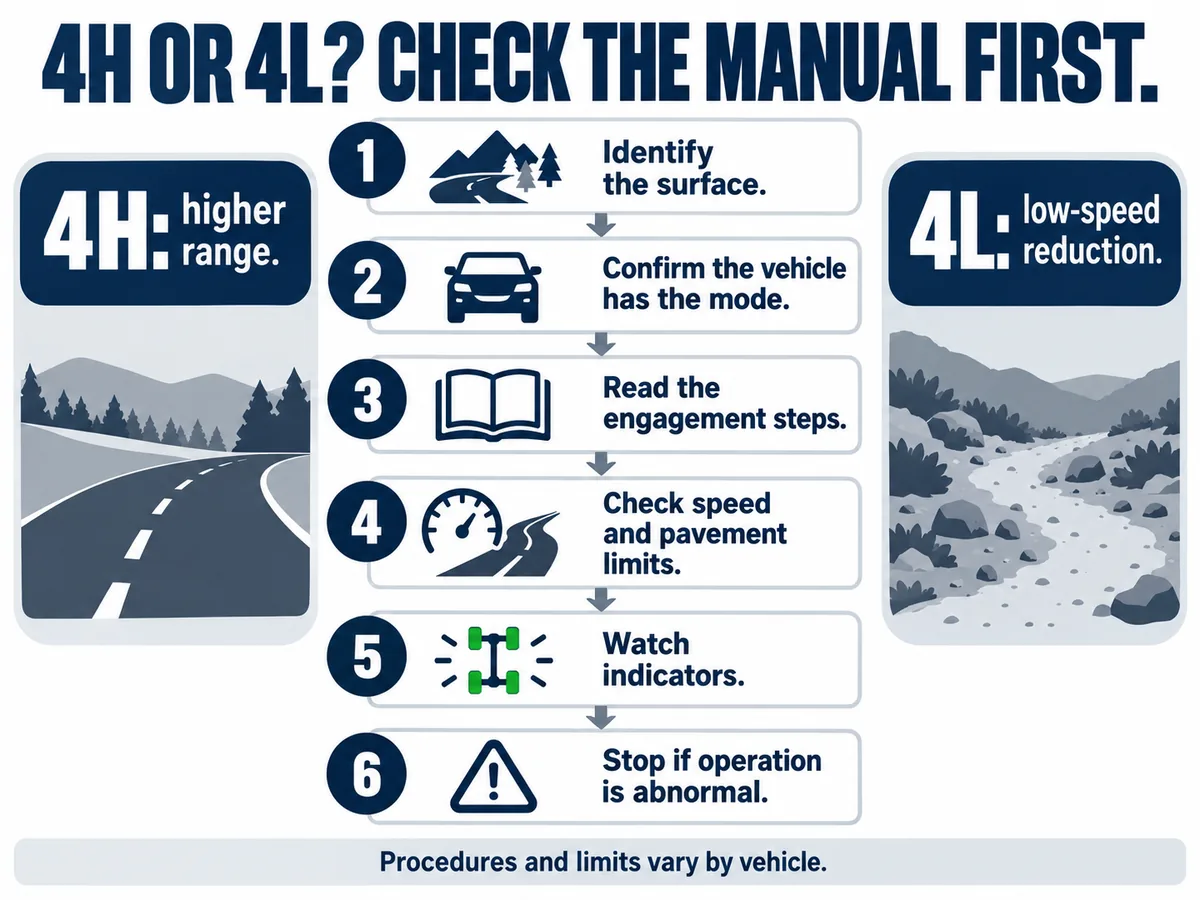
Quick answer: 4H generally provides four-wheel-drive operation in a higher gearing range for certain slippery or loose-surface conditions. 4L generally uses lower gearing for slow, demanding work where the manufacturer permits it. Exact engagement steps, speed limits, pavement restrictions, and available modes vary by vehicle. The owner’s manual—not a universal online rule—controls.
A safe 4H vs 4L decision always begins with the exact vehicle owner's manual because engagement procedures and limits vary.
To understand how selectable 4WD differs from automatic all-wheel drive, start with Carvul’s AWD vs 4WD buyer comparison.
Table of Contents
This guide explains the comparison for buyers and owners without pretending every transfer case works the same way. If the dashboard shows a warning, a mode will not engage, or the vehicle behaves abnormally, stop experimenting and seek qualified help.
4H vs 4L at a glance
| Question | 4H, generally | 4L, generally |
|---|---|---|
| Range | Higher | Lower reduction range |
| Typical purpose | Propulsion traction at ordinary low/moderate road or trail speeds where approved | Slow control and torque multiplication in demanding conditions |
| Surface | Loose, slippery, or otherwise approved by the manual | Demanding loose/steep conditions approved by the manual |
| Engagement | Vehicle-specific | Often requires stricter steps |
| Dry pavement | May be prohibited in part-time systems | Commonly inappropriate unless specifically allowed |
What 4H means
“4H” usually means four-wheel drive in the transfer case’s high range. It may be intended for snow, loose gravel, sand, mud, or other reduced-traction conditions, but permitted use varies. High range does not mean “high speed,” and no single maximum applies across manufacturers.
Some vehicles allow shifting between 2H and 4H under specified conditions. Others require a stop or a particular speed. Indicator behavior also varies. Read the manual before attempting a shift.
Use this 4H vs 4L comparison to understand the broad distinction, not as a substitute for manufacturer instructions.
What 4L means
“4L” usually means four-wheel drive with a low-range reduction. The reduction can improve slow-speed control and multiply torque at the wheels for steep, loose, or demanding terrain. It does not increase engine power and is not a substitute for traction, clearance, or judgment.
Engaging 4L may require stopping, selecting neutral, holding the brake, or following another exact sequence. Never copy a procedure from a different model. Toyota’s vehicle-specific owner information, for example, provides instructions tied to the exact model rather than a universal rule.
Seven checks before selecting a mode
1. Confirm the system actually has 4L
Some vehicles use terrain modes or an automatic system without a traditional low range. Check controls, build information, and the manual.
2. Identify the surface
Part-time 4WD can create driveline stress on high-traction pavement when front and rear axles cannot accommodate speed differences. Use only modes permitted for the present surface.
3. Read the engagement procedure
Find the manual section before reaching the trail or storm. Record required gear position, vehicle speed, brake use, indicator sequence, and any delay.
4. Check speed and duration limits
Use only the limits stated for the exact vehicle. Do not rely on a generic number from another truck, forum, or article.
5. Inspect tires and clearance
All four tires should meet manufacturer requirements. Low range cannot prevent underbody contact, sidewall damage, or loss of grip.
6. Watch indicators and warnings
Flashing indicators can mean a shift is still in progress or a condition has not been met, depending on the vehicle. Do not force the vehicle or repeatedly cycle controls without consulting the manual.
7. Disengage as instructed
Return to the appropriate road mode before high-traction pavement when the manual requires it. If the mode will not disengage, follow manufacturer troubleshooting guidance or seek qualified service.
When 4H may fit
4H may be appropriate for approved travel on snow-covered roads, loose gravel, sand, mud, or similar surfaces where additional propulsion traction is needed. The exact mode may alter throttle, transmission, stability control, or differential behavior.
It does not shorten stopping distances. Reduce speed and allow more space. Review NHTSA tire guidance because tire grip remains fundamental.
When 4L may fit
4L may be appropriate for slow climbs or descents, deep loose material, careful obstacle negotiation, recovery operations, or launching a load where the manufacturer permits it. Those activities can involve serious risk. Use qualified instruction and suitable recovery equipment rather than treating this page as an off-road technique manual.
What not to do
- Do not select a mode because its name sounds safer.
- Do not use a universal shift speed.
- Do not assume every 4WD system can run on dry pavement.
- Do not use 4L to exceed tow or payload ratings.
- Do not spin tires aggressively to force progress.
- Do not ignore a warning light, binding, clunking, or overheating message.
Buying a used 4WD vehicle
Verify every mode according to the manual in a safe, lawful setting. Inspect matched tires, leaks, transfer-case and differential service, underbody damage, modifications, and warning history. Arrange an independent inspection. Check the VIN through the NHTSA recall lookup.
For a purchase-level comparison, verify whether the added 4WD hardware solves a recurring need and price its effect on payload, fuel use, tires, and service separately.
Before making a 4H vs 4L selection, confirm the surface, speed, transmission position, indicators, and permitted operating range.
FAQs
Can I switch from 4H to 4L while moving?
Do not assume so. Follow the exact owner’s manual. Many systems require a specific speed, gear selection, or complete stop.
Is 4L stronger than 4H?
Low range generally multiplies torque and supports slow control; it does not add engine power or guarantee traction.
Can I use 4H in rain?
That depends on the system. A part-time 4H mode may be inappropriate on high-traction pavement. An automatic/full-time mode may be designed differently.
Why is the 4WD light flashing?
The meaning is vehicle-specific. It may indicate a shift in progress, unmet conditions, or a fault. Consult the manual and do not force operation.
The correct 4H vs 4L choice is vehicle-specific, and abnormal noise, binding, or warning messages are reasons to stop and recheck the manual.
Final verdict
4H and 4L are tools, not performance rankings. Use 4H only in conditions and at speeds approved for the exact vehicle. Use 4L only for approved low-speed demands and with the correct engagement procedure. When uncertain, remain in the normal road mode and consult the owner’s manual.