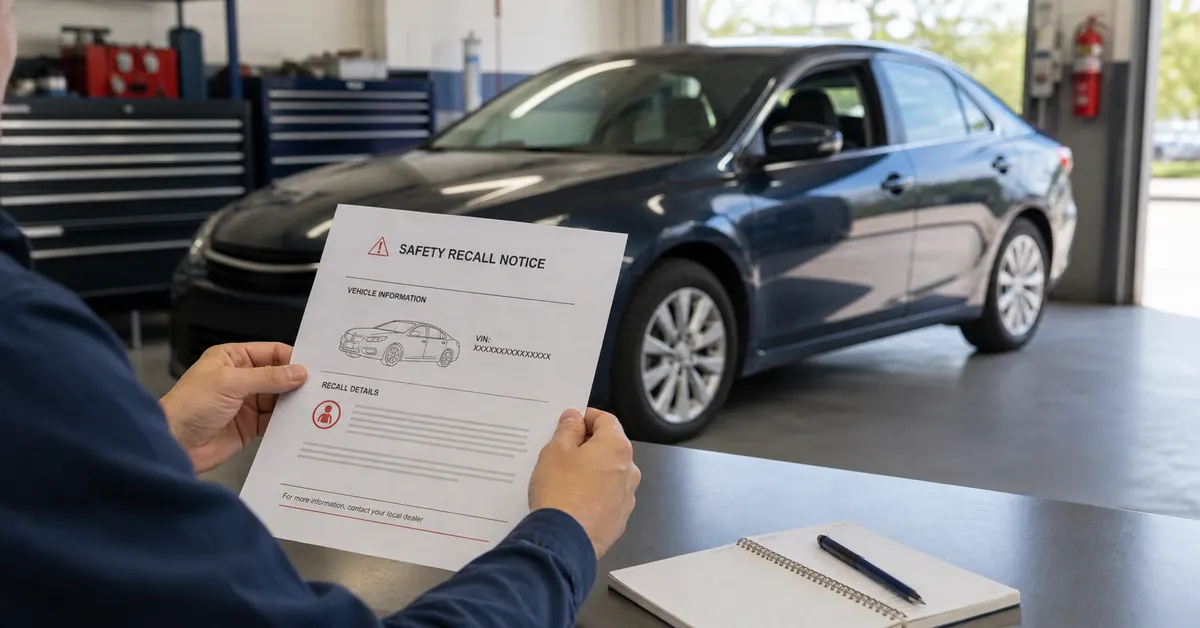
Quick answer: A Toyota recall check by VIN should use the exact 17-character number in both the official Toyota recall lookup and the NHTSA recall tool. Read every open campaign, confirm the repair status with an authorized Toyota dealer, and keep written completion records. A model-year headline alone cannot tell you whether a specific vehicle is affected.
For a U.S. used-car shopper, recall research is part of due diligence, not a replacement for a title check, vehicle history report, or independent inspection. The VIN connects a recall notice to the exact car, while the dealer can confirm whether a remedy, parts, and appointment are available.

Why a Toyota Recall Check by VIN Matters
Recall announcements often identify a make, model, model year, component, or production period. That information creates awareness, but it does not prove that every similar Toyota is included. Equipment, factory dates, parts suppliers, and VIN ranges can narrow a campaign. Two vehicles with the same model badge and year may therefore return different results.
A VIN lookup is also more useful than asking whether a model has “ever been recalled.” Many models have multiple campaigns across different years. What matters to the buyer is whether the exact vehicle has an open safety recall or service campaign, what the campaign requires, and whether the work has already been documented.
Find the VIN at the lower driver-side windshield, the driver-door jamb label, the title, registration, insurance documents, or seller paperwork. Compare these locations. If numbers do not match, stop the transaction until the discrepancy is explained. Never send money based on a VIN delivered only by text without checking it against the car and documents.
Toyota Recall Check by VIN: 7 Essential Steps
1. Copy and verify all 17 VIN characters
Photograph the windshield VIN and door-jamb label, then compare them with the title or registration. A single incorrect character can return the wrong result or no result. Modern VINs use 17 characters, and the letters I, O, and Q are not used because they can be confused with numbers.
2. Search the official Toyota recall tool
Open the official Toyota Safety Recall and Service Campaign lookup. Toyota allows U.S. shoppers to search with the VIN, or with a license plate and issuing state. Its tool covers open Toyota safety recalls and Toyota service campaigns, so read the campaign type rather than assuming every result means the same thing.
3. Cross-check the NHTSA recall lookup
Run the same VIN through the official NHTSA recall lookup. Using both sources reduces the chance that a typo, temporary website issue, or misunderstanding sends you in the wrong direction. Save a screenshot or printout with the date of the search, especially if a purchase is close.
4. Read the campaign details carefully
Record the campaign number, affected component, safety risk, warning signs, and remedy instructions shown by the official source. Do not translate a technical description into a stronger claim than it makes. If the notice says owners should avoid a specific action, park outside, or contact a dealer promptly, follow that official instruction.
5. Call an authorized Toyota dealer
Give the service department the VIN and campaign number. Ask whether the vehicle is included, whether the remedy is available, whether parts must be ordered, and how the appointment should be scheduled. Toyota states that the specified inspection or repair for its Safety Recall Campaigns is performed at no charge to the vehicle owner. Confirm the details for the exact campaign and VIN.
6. Match the result to the seller’s records
If the seller says the recall is complete, ask for an invoice or dealer record showing the VIN, campaign, repair date, and mileage. A generic receipt or verbal promise is not enough. Also check the vehicle history and service file, but remember that a history report may be incomplete. Use Carvul’s vehicle history report guide to understand what those records can and cannot prove.
7. Recheck after repair and before delivery
After the dealer completes the work, keep the repair order and run another Toyota recall lookup after the system has had time to update. If you are buying from a dealer, ask for completion before delivery when practical. If a private sale will close first, understand the official safety instructions and repair timing before deciding whether the risk is acceptable.
| Check | Best source | What to save | Why it matters |
|---|---|---|---|
| Vehicle identity | Car, title, registration | VIN photo | Prevents checking the wrong vehicle |
| Toyota campaigns | Toyota recall lookup | Dated result | Shows manufacturer recall and campaign information |
| Federal safety recalls | NHTSA recall lookup | Campaign details | Provides an official cross-check |
| Repair status | Authorized Toyota dealer | Repair order | Confirms work on the exact VIN |
How to Read Toyota Recall Lookup Results
The wording on the result page matters. Toyota distinguishes among Safety Recall Campaigns, Special Service Campaigns, and Limited Service Campaigns. A safety recall addresses a safety-related defect or noncompliance. Toyota describes a Special Service Campaign as a customer-notification program for certain product or technical issues. A Limited Service Campaign offers an inspection or repair for a specified period.
Do not treat an empty result as a permanent guarantee. Recall status can change, databases can be temporarily unavailable, and a future campaign may include the vehicle. Recheck periodically and after major recall news involving the model. If the official page cannot display results, contact Toyota or an authorized dealer instead of relying on a third-party decoder.
A completed campaign is different from an open campaign. Ask for proof that identifies the vehicle and the work. If the repair record is missing, an authorized dealer can review the VIN and available service information. A seller’s statement that “all recalls were done” should be verified before it affects your offer.
Used Toyota Buyer Checklist After the Recall Search
A Toyota VIN recall check answers one safety question; it does not establish the overall condition or value of the vehicle. Continue with an independent inspection, title review, history report, test drive, and ownership-cost estimate.
- Compare the VIN on the car with the title, registration, and seller documents.
- Review open recalls and campaigns in Toyota and NHTSA tools.
- Ask for recall completion records tied to the exact VIN.
- Check title brands, reported accidents, odometer history, and prior use.
- Arrange an independent pre-purchase inspection.
- Test brakes, steering, warning lights, seat belts, cameras, and driver-assistance features.
- Confirm maintenance records and budget for overdue service.
- Get insurance and financing numbers before negotiating the final price.
Use the complete used car inspection checklist before meeting the seller. If the VIN, paperwork, vehicle condition, or seller’s explanation does not agree, review the warning signs of a bad used car before proceeding.
| Result | Buyer response | Evidence needed |
|---|---|---|
| No open recall shown | Continue normal inspection and history checks | Dated official lookup result |
| Open recall; remedy available | Arrange dealer repair and confirm completion | Dealer appointment and repair order |
| Open recall; timing unclear | Ask dealer for written guidance before purchase or use | Campaign number and dealer guidance |
| Seller claims repair is complete | Verify by VIN instead of accepting the claim | VIN-specific dealer invoice |
Questions to Ask the Toyota Dealer
Call with the VIN and campaign number ready. Clear questions make it easier to separate an open recall from a completed repair or a non-safety service campaign.
- Is this exact VIN included in the campaign?
- Does your system show the repair as open or completed?
- What inspection or remedy does the campaign require?
- Are the required parts available now?
- Are there official driving, parking, or use instructions?
- How long should the appointment take?
- What document will prove completion?
- Does the VIN have any other open Toyota service campaigns?
If the car is at an independent used-car lot, you can still contact an authorized Toyota dealer. Do not let a seller’s deadline replace the time needed to verify a safety issue. A transparent seller should allow a VIN check and independent inspection.
Used Toyota Recall Decision Scenarios
The lookup result should change what you do next, but it should not be interpreted in isolation. These common scenarios show how a buyer can respond without ignoring safety or rejecting a potentially sound vehicle for the wrong reason.
The recall repair is documented as complete
Match the VIN on the dealer repair order to the vehicle and run a fresh official lookup. Then continue with the normal inspection, title, history, price, and test-drive process. A completed recall does not certify the rest of the vehicle, but clear documentation removes one uncertainty.
An open recall appears and the remedy is available
Ask the seller to arrange the authorized dealer repair before delivery when practical. If you plan to complete it after purchase, confirm the appointment, official instructions, and transportation plan first. Do not let a promised future repair substitute for understanding the current risk.
An open recall appears but repair timing is unclear
Contact an authorized dealer and ask for the latest VIN-specific guidance. The right decision depends on the official risk description, any driving or parking instructions, and the expected repair path. If the seller pressures you to decide before those questions are answered, pause the deal.
The seller refuses to share the VIN
Treat this as a serious transparency problem. A buyer needs the VIN for recalls, title checks, insurance quotes, and history research. Do not send a deposit or personal information merely to receive a VIN that should be available for basic due diligence.
Toyota and NHTSA results seem different
Check that the VIN was entered correctly and note the date and wording of each result. Temporary display issues and differences in campaign classification can cause confusion. Contact Toyota or an authorized dealer with screenshots and the VIN rather than choosing whichever answer is more convenient.
Recall and Service Records to Keep
After repair, keep the dealer repair order, VIN, date, mileage, campaign number, remedy description, and any follow-up instructions. Store a digital copy with the vehicle’s maintenance file. These records help a future mechanic or buyer understand what was completed.
Recall work does not replace routine maintenance. Connect the repair record with oil changes, tires, brakes, fluids, batteries, and mileage-based service. Carvul’s used car maintenance guide explains how to organize the broader ownership plan. For a vehicle near six figures on the odometer, use the 100k-mile maintenance checklist to identify likely catch-up work.
What to Do After Buying a Used Toyota
Run the recall search again after ownership records are transferred and save the dated result. Update your contact information through the appropriate Toyota owner resources so future campaign notices can reach you. Keep the VIN and dealer contact in the same digital folder as insurance, registration, maintenance, and inspection documents.
At the first service visit, ask the dealer or trusted mechanic to review open campaigns and the general condition of safety systems. Do not assume that a previous owner completed every notice simply because the car has dealer service stamps. Recall completion and routine maintenance are separate records.
If a new recall notice arrives, read the manufacturer or NHTSA instructions before relying on social posts or headlines. Confirm whether the VIN is included, then follow the official scheduling and use guidance. Save each completed repair order so the next owner can verify the history without repeating the same uncertainty.
Common Toyota Recall Check Mistakes
- Searching only by model year: campaigns can apply to narrower production or VIN groups.
- Using a third-party decoder as the final answer: official Toyota and NHTSA sources should decide the next step.
- Assuming no result means no future recall: recall status can change.
- Confusing a service campaign with a safety recall: read Toyota’s campaign classification and instructions.
- Accepting a seller’s verbal confirmation: request VIN-specific documentation.
- Skipping the physical inspection: a closed recall says nothing about tires, leaks, rust, crash repairs, or maintenance.
Toyota Recall Check by VIN FAQ
Where should I run a Toyota recall check?
Use the official Toyota recall lookup and the NHTSA recall tool with the exact 17-character VIN. If results are unclear or unavailable, contact an authorized Toyota dealer.
Can I check a Toyota recall with a license plate?
Toyota’s U.S. recall page provides a license-plate-and-state option as well as a VIN option. The VIN remains the strongest identifier to compare across the car, documents, and repair record.
Are Toyota safety recall repairs free?
Toyota states that the specified inspection or repair under a Toyota Safety Recall Campaign is performed at no charge to the vehicle owner. Confirm that the result is a Safety Recall Campaign and verify the remedy for the exact VIN with an authorized dealer.
Is an open recall an automatic reason not to buy?
No single rule fits every campaign. Consider the official safety instructions, remedy availability, seller transparency, repair timing, and whether the work can be completed before regular use. Do not minimize an open safety issue simply because the vehicle drives normally.
Does a clean recall result replace a vehicle history report?
No. A recall lookup, history report, title check, and mechanical inspection answer different questions. Use all of them before buying a used Toyota.
How often should Toyota owners check for recalls?
Check when buying the vehicle, after major recall news involving the model, and periodically during ownership. Keep contact and ownership information current so manufacturer notices have a better chance of reaching you.
Bottom Line
The safest process is simple: verify the 17-character VIN, check both official databases, read the exact campaign instructions, call an authorized Toyota dealer, and save the repair record. A Toyota recall lookup by VIN is most valuable when it is combined with a vehicle history review and independent inspection. The exact car, not the headline, should guide the decision.
Official sources reviewed: Toyota Safety Recalls and Service Campaigns and NHTSA Recall Lookup. Recall status changes; verify the VIN directly before acting.